

How chainsaws in the state can violate trans and disability quota laws
Both regulations establish a target for revenue in the public sector, which was to be met in 2023. However, LLA warned that they will not renew state contracts from the past year.


Share

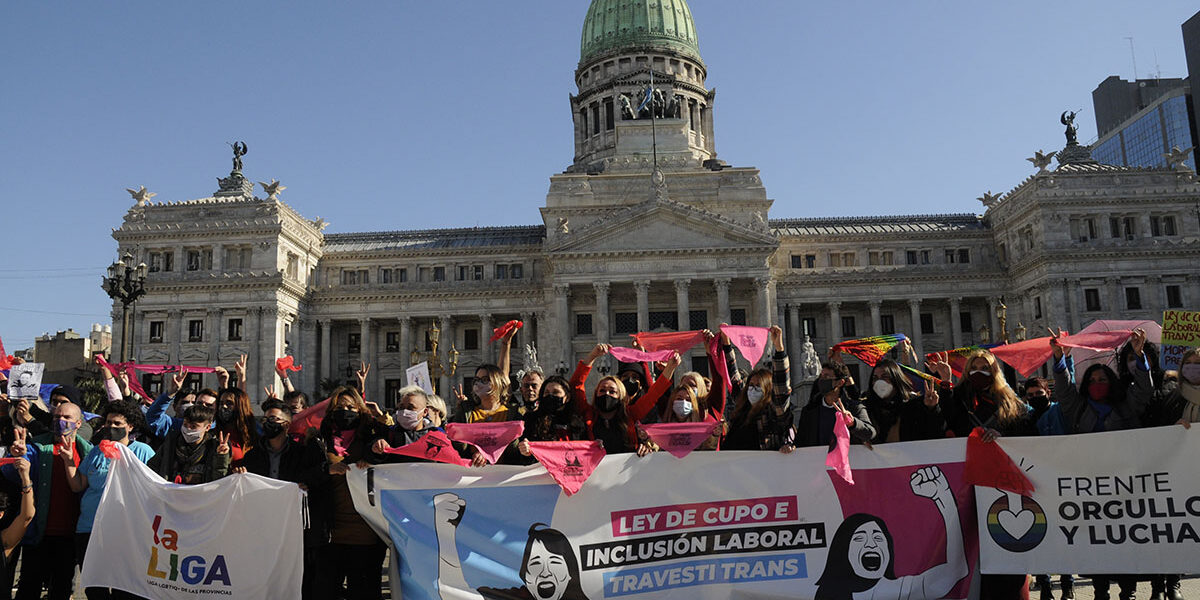
BUENOS AIRES, Argentina. Presidential spokesperson Manuel Adorni announced this week that public employment contracts signed during 2023 will be reviewed. It was later revealed that the intention is not to renew them. So far, no concrete action has been taken. However, some cases are related to existing regulations. At least 381 people were hired under Law 27,636, the trans and travesti employment quota , and an undetermined number of people with disabilities entered government positions under Law 22,431, the comprehensive protection system for people with disabilities . Both laws represent historic victories achieved through activism, passed by Congress, and remain in effect. These populations remain on alert, fearing the loss of their hard-won rights.
J. is trans and started working at the former Ministry of Women, Gender and Diversity in September. She feels caught in the middle. “Basically, what we're experiencing here is uncertainty. No one has come forward to handle the transition; the tasks we're wrapping up are those left over from the previous administration. No one is giving us any new assignments,” she says.
She is one of the 955 people who could lose their jobs in January. She knows the difficulties faced by the trans community when looking for new employment: many of her certifications are under her former name, interviews are uncomfortable, her pronouns are not respected, or she is looked at with prejudice.
Most of the private sector rejects transgender employees. “This new government has to recognize that we are a population that experiences structural and historical violence, which means that a large part of us haven't finished high school. We continue to suffer discrimination, directly or indirectly,” she asserts. And she emphasizes: the quota is barely 1%.
Income and the law
“The Quota Law is an affirmative action measure for access to employment for transvestite, transsexual and transgender people because their gender identity represents an objective barrier,” emphasizes Agustina Ponce, transvestite activist and former Undersecretary of Diversity Policies of the Ministry of Women, to Tiempo Argentino .
It highlights that there is still a strong prejudice and discrimination against the transvestite-trans community that prevents them from developing their lives and accessing all rights: "Not even the 1% employment quota is fully met, according to the latest monitoring.".
All hiring processes carried out under Law 27.636 rigorously and transparently adhered to the established procedures. “The law created a single registry of applicants, to which each state agency submitted profiles. Those who were hired did so based on their demonstrated abilities,” she asserts. All transgender individuals who joined the government were interviewed for their positions, following a pre-selection process by the Registry and the submission of ten profiles for each position to the requesting agency.
“We are the outgoing administration. No one from the current administration has contacted us yet, but we understand that what they are proposing is absolutely illegal. We are in daily contact with the ATE and UPCN unions,” she adds.
The 381 people who joined the Ministry of Women this year experience daily anguish. “And that anguish is intensified by the circumstances of their entry, which was through an affirmative action measure. This objectively means that they have had no opportunities for formal employment in their lives. For many, this contract represents their first job.”.
Another sector that received income this year by law was the disability sector. Unlike the transgender employment quota law, which has been in effect for two years, Law 22.431, which grants 4% of state employment quotas to people with disabilities, has been in effect since 1981. However, its actual implementation reaches only 2%.
Gabriela Ferreiro, co-director of the social consultancy Libertate , emphasizes: “It is a positive action measure, necessary in unequal societies that seek to compensate for this gap and historical exclusion that means that today people with disabilities of working age reach an unemployment rate of 80 percent.”
The first victims
Ferreiro points out: “If we cross-reference the gender data compiled by the National Disability Agency , it emerges that women with a Single Disability Certificate, of economically active age, have an unemployment rate of 90%.”
The co-director of Libertate highlights the need to make the quota law visible since "in contexts of recession, contraction of employment and with measures that threaten work and labor laws, the rights of those people who already have barriers to access are always violated in the first instance.".
In this regard, he recalled as a precedent that the last civic-military dictatorship eliminated a law that provided for a job quota for people with disabilities in the private sector.
The article was originally published in the allied media outlet, Tiempo Argentino .
We are present
We are committed to journalism that delves into the territories and conducts thorough investigations, combined with new technologies and narrative formats. We want the protagonists, their stories, and their struggles to be present.
SUPPORT US

FOLLOW US
Related notes



We are present
This and other stories are not usually on the media agenda. Together we can bring them to light.