

40 days of national strike led by indigenous peoples in Guatemala
The people have come down from the mountains to reclaim what belongs to them and has been stolen from them.


Share

Providing context about what's happening in the country we know today as Guatemala is always very complex. I don't think you'll believe what I'm about to tell you; it's a mix between a comedy and a dystopian or parallel reality in the 21st century, amidst a rise in fascism and an increasing erosion of democratic spaces worldwide.
From the perspective of legal experts and specialists, Guatemala has been a judicial dictatorship since 2017, having broken the constitutional order and arbitrarily and illegally maintained a Supreme Court in place beyond its term, thereby violating the Constitution, domestic laws, and ratified international treaties. In addition to this dictatorial situation, Guatemala continues to operate under a colonial estate system.
In countries that are supposed to be democracies, after elections a transition period begins to allow the new government to take office. And this is where things start to get interesting, if we can call it that. The pact of impunity has all the powers aligned to operate as they please.

In Guatemala, Parliament is controlled by organized crime, which enacts laws to protect corrupt and unpunished actors. The presidency, headed by Alejandro Giammattei, is orchestrating this plunder. The Supreme Court has not been elected for over five years, thus creating a judicial dictatorship that undermines the checks and balances of so-called democracies.
On the other side of the coin are the economic elites who, since colonial times, have accumulated their wealth at the expense of dispossession, slavery, and servitude. Extractive companies, mining operations , hydroelectric projects , and monoculture plantations are the new economic means of perpetuating this dispossession, ensuring that the elite continue to profit and that, in this way, Guatemala remains a "banana republic," with the tacit approval of the United States government.
This dictatorship has more than 50 people in exile, including prosecutors and high-ranking officials in the justice system, journalists, activists, and land defenders—people who are a thorn in the side of those in power. There are also several people imprisoned for fabricating spurious and false cases to justify impunity and illegality; among those imprisoned is lawyer Virginia Laparra, who was named a prisoner of conscience by Amnesty International this year.
Guatemala held elections last June, in which the first round elected representatives, mayors, and the presidential ticket. But the pact of impunity, as it has been called, had plans in place to ensure that at least one of its more than 25 candidates and parties could become president, allowing the political class and elites to continue their plundering. They hadn't counted on the rebellious youth voting for a social democratic option to advance to the runoff in the second round.
After almost 70 years of extreme and reactionary right-wing rule, the option of choosing a ticket between the social democratic party Movimiento Semilla, led by Bernardo Arévalo and Karin Herrera, and the center-right party Unidad Nacional de la Esperanza UNE, led by Sandra Torres and Romeo Estuardo Guerra, reached the second round.
A spark of hope ignited, and the population rallied behind the Semilla Movement, which won decisively by more than 30 percent. We cried, we laughed, and this opened a possibility for the exiled women .
Without much attempt at concealment, the business elites and leaders of the dictatorship had to acknowledge the results, at least publicly. The electoral process was questioned from the outset, and the entire country couldn't believe what we were witnessing, even those of us living abroad as part of the migrant diaspora or in exile. The excitement lasted five minutes. Remember, we are a banana republic, and the instrument of impunity, responsible for the criminalization, imprisonment, and exile of many people, is the Attorney General's Office. From the Public Ministry, led by Consuelo Porras and Rafael Curruchiche, they have undertaken what experts now call a "technical electoral coup." They began fabricating and disseminating the narrative that Semilla had forged signatures in the party's constitution, and the criminalization and persecution of party members began; some were forced into exile.
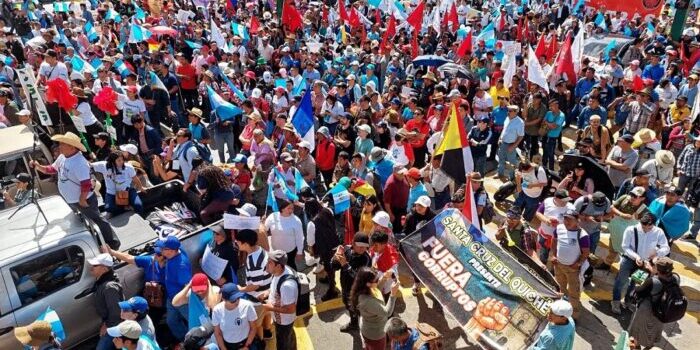
The final straw was the Public Prosecutor's Office's literal seizure of the ballot boxes containing the votes cast by citizens on August 20th. Never before in the country's democratic history had such a situation occurred, prompting the general population and Indigenous organizations, led by the 48 Cantons of Totonicapán , the Indigenous Municipality of Sololá, the Xinka Parliament, and the Departmental Council of Indigenous Authorities of Totonicapán, to call for street protests to defend Guatemala's fragile and almost nonexistent democracy.
Guatemala is in crisis and experiencing a coup . The dictatorship refuses to relinquish power and its privileges, refusing to recognize the results of the popular vote, which is fed up with impoverishment . And it is doing everything possible to prevent those who won the elections peacefully and democratically from taking office. The courts have just suspended the Semilla Movement.
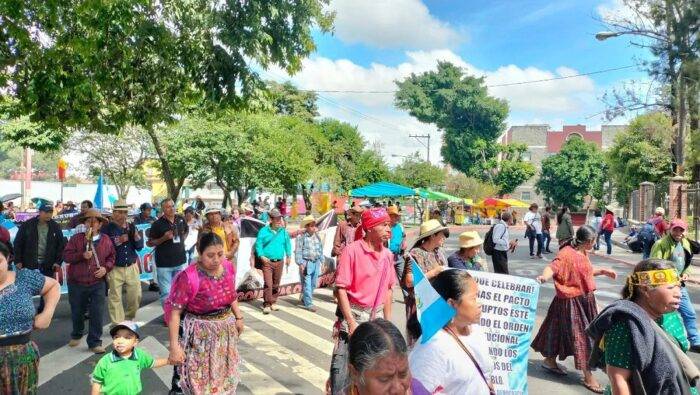
After more than 40 days of mobilization, the country's main highways are almost completely paralyzed. This makes me think that the colonial estate or banana republic is finally beginning to show cracks in its structures. The people have come down from the mountains to reclaim what belongs to them and what has been stolen from them.
The streets of Guatemala have overflowed with indigenous dignity, and the country's oldest and most legitimate indigenous organizations have asserted the authority and leadership they have always held . This indigenous leadership survived genocide and colonial dictatorship and continues to survive the current dispossession.
Indigenous resistance is not for a political party, our indigenous authorities have said since the first day of the strike; these peaceful demonstrations are for the respect of democracy and the popular decision.
A part of Iximulew is awakening and beginning to recognize itself for what it is: an original, indigenous country; a part of the country is ceasing to feel ashamed of who it is. For the first time in more than 500 years, the colonial mindset regarding the indigenous population is beginning to be dismantled.
Another part of the country has never stopped fighting, they have always been in the streets with open wounds, surviving the genocide, giving birth to life and dignity, the original world that has always been awake, waiting for the dawn, in mobilization and resistance.
*This article was originally published in Pikara. To learn more about our partnership with this publication, click here .
Share
We are present
We are committed to journalism that delves into the territories and conducts thorough investigations, combined with new technologies and narrative formats. We want the protagonists, their stories, and their struggles to be present.
SUPPORT US

FOLLOW US
Related notes


We are present
This and other stories are not usually on the media agenda. Together we can bring them to light.