

“The Afro rights movement was born with pioneering women who went to knock on the doors of the State.”
Activist and visual artist María Gabriela Pérez highlights the importance of Afro-Colombian women in the independence struggle and


Share

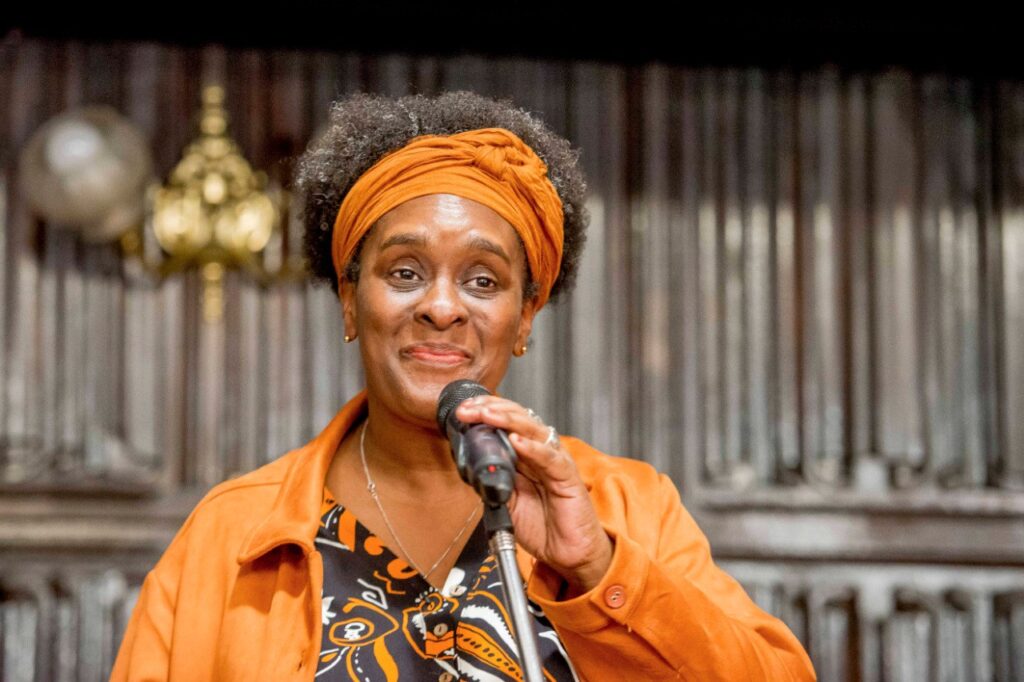
“This first National Assembly undoubtedly marks a turning point in the Afro-descendant women's and LGBTQ+ movement, and it mobilized a structure that the Afro-descendant community is frankly not used to,” says María Gabriela “Maga” Pérez, an official with the National Institute Against Discrimination, Xenophobia and Racism (INADI) in charge of organizing the first National Assembly of Afro-descendant Women, Lesbians, Bisexuals, Transvestites, Transgender, and Non-Binary People of Argentina. Recognizing history is fundamental to beginning the process of healing.
“In every corner of the country there are stories that link this land to 16th-century slavery, a social institution that was part of the very foundation of Argentina,” Pérez adds. She is an activist and visual artist, the creator of an iconic painting of Remedios del Valle in the Ministry of Education. She currently heads the Historical Recognition Commission of the Afro-Argentine Community at INADI ).
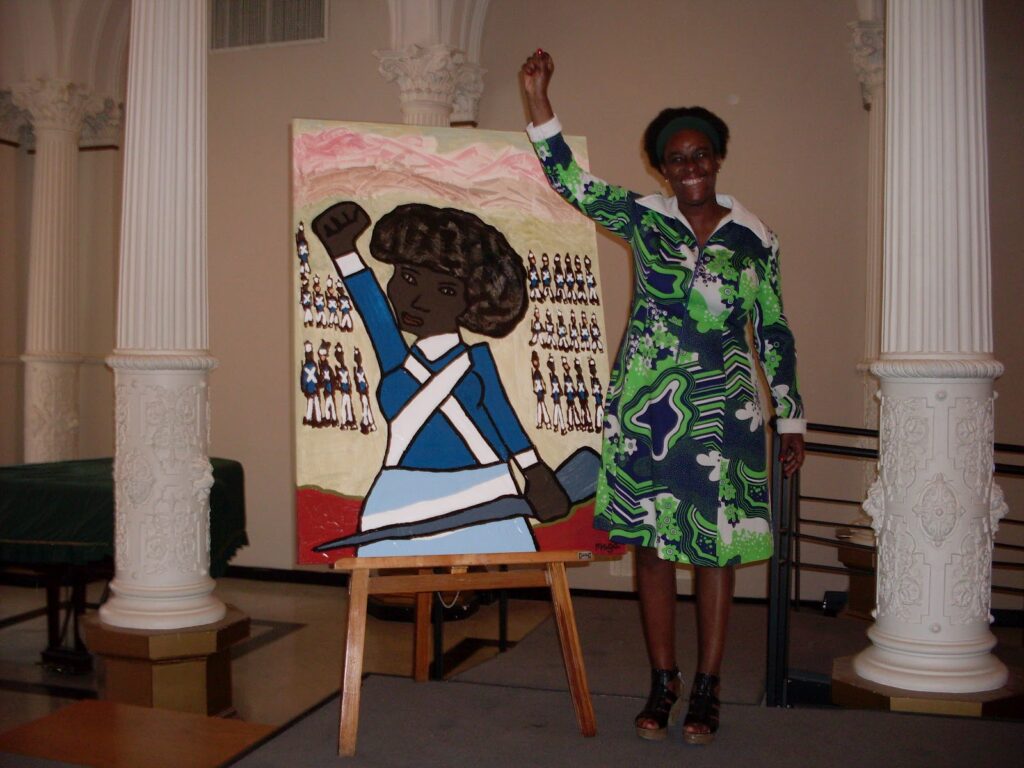
The objective of the meeting is threefold : to make visible, to recognize and to reclaim this deeply denied identity.
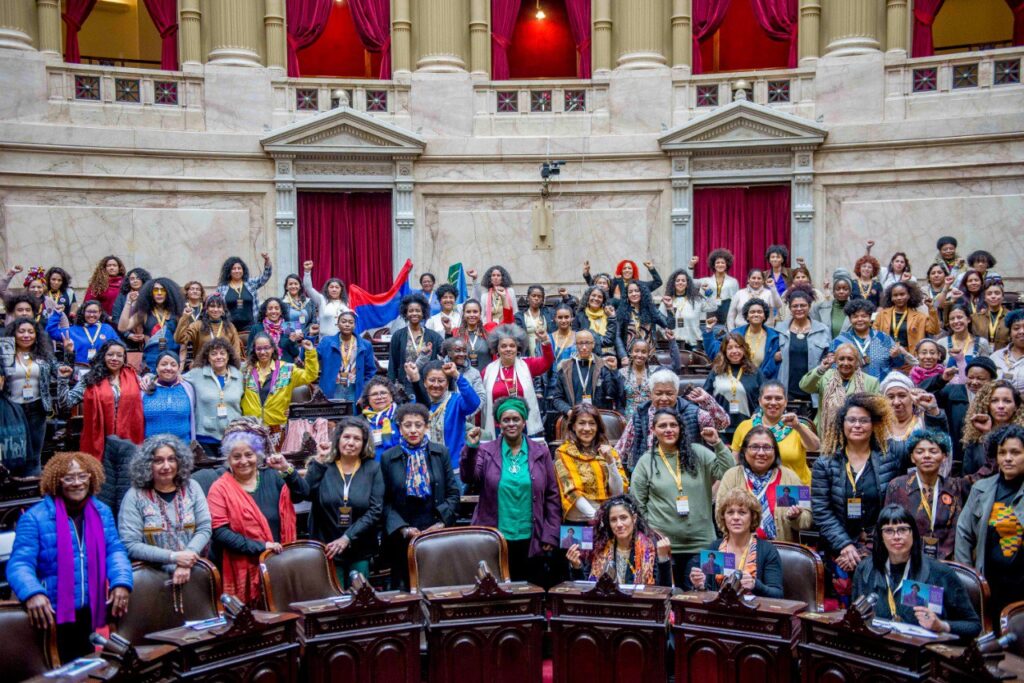
With this initiative, the State seeks to partially redress its debt to the community and strengthen the leadership of Afro-descendant women and diverse groups: a strategic action to combat racism and inequality. The event was jointly organized by the National Institute Against Discrimination, Xenophobia, and Racism (INADI) and CAF (Development Bank of Latin America and the Caribbean). Over three days, from August 4th to 6th, it brought together more than 200 Afro-descendant women, lesbians, bisexuals, transvestites, trans people, and non-binary individuals.
Afro-Argentinians: victims and patriots
The 1778 Census revealed that 46% of the Argentine population was of African descent. But official history was written by the elite. The Generation of 1880, with figures like Juan Bautista Alberdi, Julio Argentino Roca, and Domingo Faustino Sarmiento, planned a white, European Argentina. “ As a result of this generation’s work, when we look in the mirror, we say, ‘I am of European descent,’ even if we have nothing to do with Europe, and even if we know it. We were denied the pride of being Afro-descendants, just as we were denied Indigenous pride, I dare say. Both roots denied,” summarizes María Gabriela. “But racism isn’t a problem of one social group. It’s a structural issue that comes from the very heart of our country’s structural order. Through the expression ‘Melting Pot,’ they tried to erase identities so that a pretty, white, European mass would emerge.”
Between 1777 and 1812, more than 700 ships carrying 72,000 enslaved Africans entered the ports of Buenos Aires and Montevideo. Some came from southern Ecuador, Angola, Congo, and Mozambique, while others came from Southeast Africa. A second migration occurred with the arrival of Europeans in the 19th and early 20th centuries, and again after the end of World War II in 1945.
Finally, in the 1990s, the so-called "new African migrations" arrived in Argentina. These are commonly referred to as "the Senegalese," even though their countries of origin are Mali, Senegal, Mauritania, Liberia, and Sierra Leone. They are mostly young men.
Today, organizations speak of about two million Afro-descendant people in Argentina, and the last census in 2010 counted 149,493 people who identify as Afro-descendants.
– How is this story expressed in our times?
– We are deeply affected by structural racism and inequality. For Afro-descendant women and diverse communities, all issues related to sexism, gender identity, and patriarchy are significant factors in our lives and in everything we do. These past few days (at the Assembly) we've been working on our political participation and representation as a sector. The Afro rights movement was born with pioneering women who went knocking on the doors of the State, proposing policies for visibility and recognition, and they were met with closed doors. And when the State finally opened its doors, it didn't recognize these women, while it did recognize Black men. To give just one example.
– How is this representation strengthened?
– The movement for the recognition of rights was born with women at the forefront: Lucía Dominga Molina , María Elena Lamadrid , Miriam Gómez Lima or Pocha Lamadrid , who in 1996 worked by the hour as a domestic worker when she responded to former president Carlos Menem who had said in the US that black people did not exist in Argentina. She managed to promote the first census of the Afro-Argentine community at the beginning of the 21st century.
Now, if anyone finds any representation of Afro-descendant women in the Ministry of Women, let me know. (Laughter) I don't mean it in a bad way, because I understand that sometimes you just don't know. But if we say, "Now that they see us," why aren't we part of the structure of the Ministry of Gender and Diversity? That's a question we ask the State. Just as we criticize, we also take action, defining where we want to go. Because we understand that the driving force is the Women's Movement, and Black women must be present in this movement.
Does strengthening the leadership of Afro-Argentine women contribute to building a less racist and less sexist society in a comprehensive way?
– Exactly. Because the problem of racism is a social problem, not just a problem of the Black community, or of people who see us as phenotypically Black. Thanks to the struggle we've been waging for many years, today we talk about racially motivated hate crimes, because it's become clear that there's police brutality based on skin color, based on identity. There's a lack of police protection that isn't the same for all groups. Who are called Black? People of Black genetic descent are called Black, but not only that group, considered "non-white." Impoverished people are also called Black. Lucas González's ruling, which speaks of "racial hatred," is the result of our community's struggle over these 40 years of democracy.
– Rethinking who we are.
– In these territories, this is a moment where society is much more open to listening and more willing to begin looking at itself in the mirror it needs to see. In the mirror of who we are: a country with diversity. There are three roots: that of the Indigenous peoples, peoples who existed before the nation-state; the African community, which is connected to that pre-existence, because many Afro-Argentinians are descendants of those who were victims of the transatlantic slave trade of the 15th century. And many centuries later, the community emerged, but it has always been the most valued. The issue is us. Africa needs an apology for everything that was stolen from it, for that extractivism.
A story of many colors
The armies were bolstered by edicts signed by the supreme authority, which compelled landowners to hand over their enslaved people. But in the narrative of slavery, gender issues were always even more obscured. “Mixed race didn’t occur because Europeans wanted to marry dark-skinned, mulatto, or Indigenous women. Other things were happening,” says Maga.
She questions the liturgy of school events: the burnt cork, the hot empanadas, the banalized candombe, and the figures of leadership, San Martín or Belgrano, embodied by the whitest children with the lightest eyes possible.
– What roles did Africans and people of African descent play in the birth of the nation, in the struggle against Spain (and other empires)?
– Sometimes the armies of independence are discussed as if they were a monolithic entity without a name or identity. But in reality, there were countless generals and sergeants of our independence, such as María Remedios del Valle, the Mother of the Nation, but also Cipriana Campana, Lorenzo Barcala , and Josefa Tenorio (among the women of the Army of the Andes ), just to name a few who came from the historic mixed-race battalions, which later became battalions of mixed-race and Black people, where racialized and Afro-descendant individuals were forcibly recruited. We can discuss the specifics, because they are heroes of the nation, but they were forced to go to war under promises of freedom that never materialized. Some received recognition, but the treatment was unequal for Africans and their descendants.
– Let's talk about Remedios.
She was a woman of this era in another time. Disobedient as ever, she enlisted in the army, surely motivated by the desire to fight against a common enemy, the same royalist army that had brought her parents from Africa. The cause of the tragedy was a powerful incentive to go to war, and so she did, fulfilling the roles women were expected to play at that time. But in some battles, she went to the front lines, helped out of difficult situations, and took up arms, even though it wasn't what women were supposed to do. She asked permission to follow Belgrano, and he didn't grant it, until her own comrades in arms changed his mind. The cry, "She is the mother of the nation!" is the acclaim of other generals who witnessed what María Remedios was capable of.
– Were Afro-Argentine families already familiar with Remedios and other stories of liberation?
– In the Afro-Colombian community, we knew their history, but we didn't have all the evidence from historical documents. Like when they hold events on May 25th, and people think that Afro-descendants only sold empanadas and danced candombe. They would take us to the events, but we are part of the community and we knew that wasn't all that happened. We knew from childhood that the characterization of the grenadier army, that they were all white European men, doesn't match the reality of how that first patriotic army was formed, which had 2,300 people, including mixed-race and Black people, enslaved and freed people (that is, with a condition of semi-freedom), and the rest who came from patrician families.
– How do you relate to that story and national history in general?
My family comes from the first Afro-Argentinians. We are six generations. I am the great-great-granddaughter of an army sergeant who served in the war against Paraguay, who had been part of the army of mixed-race and Black people. This case I'm mentioning, which is individual, is actually very much a collective one, representing many people who have this historical connection to our country. Those of us who descend from the first group have a great interest in having that history recognized. We are moved by the recognition of María Remedios del Valle, and it is a victory in our struggle.
Their recognition would come late: it was only 10 years ago that Law 26.852 was passed, commemorating the “National Day of Afro-Argentinians and Afro Culture” on November 8, precisely because of the death of the Mother of the Nation. But Maga recalls the words of General José de San Martín: “One day it will be known that this nation was liberated by the poor and the children of the poor, our Indigenous people and the Black people who will never again be slaves to anyone.”
We are present
We are committed to journalism that delves into the territories and conducts thorough investigations, combined with new technologies and narrative formats. We want the protagonists, their stories, and their struggles to be present.
SUPPORT US

FOLLOW US
Related notes
We are present
This and other stories are not usually on the media agenda. Together we can bring them to light.