

Wawa Huasi: the indigenous kindergarten in La Quiaca that resists the constitutional reform
In La Quiaca, the only bilingual community kindergarten in the country operates: they teach in both Spanish and Quechua. The Jujuy government refuses to officially recognize it.


Share

LA QUIACA, Jujuy. Special correspondent
The province of Jujuy continues to be gripped by protests across its territory. There are blockades on the main national highways that cross it—34, 9, 52, and 40—and on some provincial roads. This coordinated action, now in its second week, is in rejection of a constitutional reform approved on June 21 by the government of Gerardo Morales . The provincial police have fiercely repressed these demonstrations.
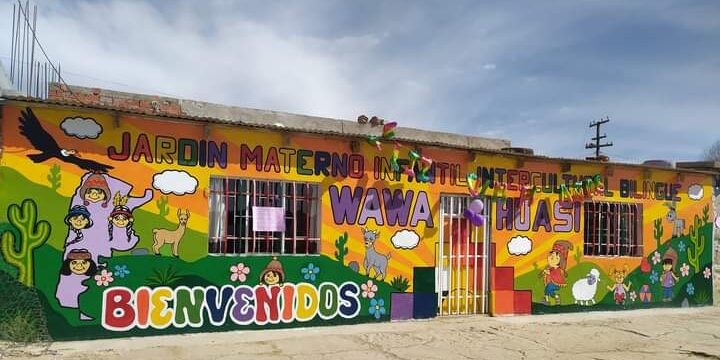
In one of those rural areas, far north in La Quiaca , lives Vilma Llampa. She is a Quechua woman, the daughter of a miner and a farmer, a single mother, and a teacher. She is also the current director of the Wawa Huasi Intercultural Bilingual Nursery School, where 164 Indigenous children between the ages of two and five learn, play, and live in Spanish but also in their native language, Quechua. This bilingual experience is, so far, unique in the country. It is neither a private nor a state-run nursery school: it is a community-based organization.
“We know what’s coming with the reform,” says Vilma Llampa. She is sitting on a platform along the road, on the long stretch of shelters set up to withstand the winter cold in this dry valley, more than 3,400 meters above sea level.

The workers of Wawa Huasi (Children's Home), belonging to the Natividad Quispe Community, are also part of the Multisectoral group that is maintaining the blockade of National Route 9 at the southern entrance to the city of La Quiaca. In addition to rejecting the reform of the provincial constitution, they have a specific demand: that the Jujuy government recognize this preschool as part of the official education system. In 2015, when Morales was a candidate for governor, he promised that it would be incorporated into Jujuy's official education system. Once in office, he revoked their CUE, the number assigned to each educational establishment incorporated into the official education system.
“We experienced a lot of discrimination”
Wawa Huasi began operating on June 7, 2010. Vilma and other colleagues who had completed their higher education came up with the idea after observing the situation of the workers at the CCC cooperative. “There were more women than men in the cooperative, so the women had to bring their children, and the young children suffered a lot because they had nowhere to eat properly.” In addition to the extreme cold, the place was also difficult. “We started with a small daycare, with an enrollment of just 15 children, and then it grew.”
As teachers, they developed an institutional educational project (IEP). “We didn’t just want to provide these children with a safe space, but also to offer them learning and knowledge.” With this intention, and with the seeds of an education conceived from the indigenous worldview, they met with officials from Region 1 of the Jujuy Education Supervision area.
“They said we couldn’t handle children.” Despite this reluctance, Wawa Huasi developed its Institutional Educational Project (PEI), which included the goal of interculturalism and the mother tongue: Quechua. “We took it one step at a time. We faced a lot of discrimination from the education system. They wouldn’t accept a preschool that was teaching the Quechua language .” Just as the formal education system covers content related to Flag Day, at Wawa Huasi they cover topics such as Inti Raymi, Qapaq Raymi, and Pachamama.

"They wouldn't let us raise our Wiphala."
“There were supervisors who wouldn’t let us raise our wiphala, the Andean flag, so we had to tell them to put it in writing. We told them we were going to report them to Inadi for discrimination. The supervisors didn’t dare to do anything about it.”
Vilma Llampa recalls that at the beginning they also had to fight against prejudices ingrained in their own city, where mothers and fathers “preferred English to Quechua, they didn't recognize our ancestors.” That was also a process: “It was quite difficult, but little by little we made progress.” From an initial eight teachers, they now have 28 staff members, including teachers, special education teachers, and support personnel, and from an enrollment of 15, they have grown to 164 children, distributed among classrooms for five, four, three, and two-year-olds, in two shifts.
Broken promises
Despite meeting all the requirements set by the Jujuy Ministry of Education, the governor refused to officially recognize the kindergarten. This time, he claimed it was because the kindergarten operates in a space that formerly belonged to the Belgrano Railway. Instead, the governor offered to "build a new kindergarten, but it would be state-run." The community agreed and offered land for the construction. But so far, nothing has happened.
The request for incorporation into the formal education system has another, significant dimension, linked to the teachers' salary demands that sparked the current social unrest in Jujuy. Because it is not part of the official system, the teachers' salaries at Wawa Huasi are still lower than the base salary of a regular teacher, which is currently 35,000 pesos.
Food to sustain the garden
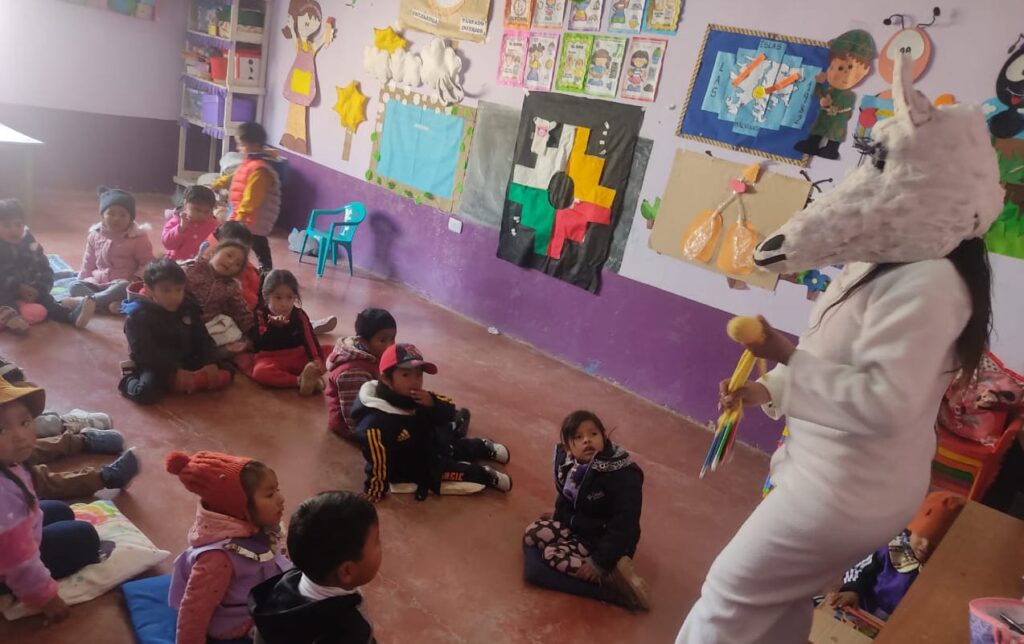
Even without formal integration into the education system, Wawa Huasi is now recognized by the community of La Quiaca. In addition to community members, there is demand from state employees and members of the security forces. According to its director, this is because “we have worked extensively on the pedagogical aspects and on building relationships. Initially, society didn't accept the Quechua language, much less that we were teaching the children ancestral values and customs. And raising the wiphala flag was also seen as something strange. Now, many people from La Quiaca want to join the preschool and don't want to attend a state school.”
The preschool has reached its enrollment capacity. At Wawa Huasi, the children receive breakfast, a mid-morning snack, and lunch. In the afternoon session, there are also three meals. These meals are provided by the state through the Social Development department. “It's not always enough, but we have never lost sight of our focus on working as a community.” We try to make every teacher or staff member who joins the preschool understand that we don't work alone. We all work as a team. Even though I'm the director, I don't get paid as director. I get paid the same as them as teachers. I don't have to do everything; we all have to contribute to maintaining this space.
That's why they work weekends selling food to support the kindergarten. "Our goal has always been to provide the children with the best education and to instill in them an appreciation for our customs and knowledge," Llampa insists. But she laments that when these children reach primary school, they no longer have that intercultural education.

Rich territory, poor people
“And that’s why we’re here,” Vilma Llampa sighs, gazing at the road blockade as she finishes her story about the Intercultural Garden she and Hugo Chavarría, now a municipal official, envisioned.
Then she takes a moment to talk about the other major issue under discussion in Jujuy today, the reason they’re on the road: the mineral wealth of this vast territory where llamas and vicuñas roam. “ We know what’s coming with the (Constitutional) reform regarding land because in our community we have lands that belonged to our parents, who still live there. We know these lands are rich, with plenty of water and minerals, so that’s another reason we’re here.”
Vilma’s father, Santos Felipe Llampa, lives in Mina Pirquitas, more than 185 kilometers from La Quiaca, a journey of over three hours. There he worked as a miner, then as a municipal commissioner, and finally for Ejesa, the electric power company.

The mine that gives its name to the small town of about a thousand inhabitants was closed for years. But mining activity has reopened, this time under the Chinchillas-Pirquitas project, which extracts silver from those hills. Its workers yesterday disseminated messages of support for the indigenous communities resisting the reform of the Jujuy Constitution and demanding the resignation of Gerardo Morales.
Vilma was born there, in Mina Pirquitas, but at 13 she arrived in La Quiaca to study. She completed her higher education in Abra Pampa and returned to the border city to continue her life. She is the youngest of six siblings, four brothers and two sisters. Her sister is a custodian at a school, one of her brothers is a police officer, and the other three work at the mine.
“Here in La Quiaca, it’s difficult to find work. If you’re a professional, in this case a teacher, you can’t get positions because it’s based on a points system, and when you finish your studies, you have a low score and it’s hard to find a job. You’ll find work as a restaurant assistant or cleaner, which pays minimum wage. What helps here are the job creation programs. Life is difficult here.”
We are present
We are committed to journalism that delves into the territories and conducts thorough investigations, combined with new technologies and narrative formats. We want the protagonists, their stories, and their struggles to be present.
SUPPORT US

FOLLOW US
Related notes
We are present
This and other stories are not usually on the media agenda. Together we can bring them to light.