

Jujuy: Indigenous communities resist constitutional reform
Indigenous women describe in this article how they are carrying out days of resistance against Governor Gerardo Morales' constitutional reform.


Share

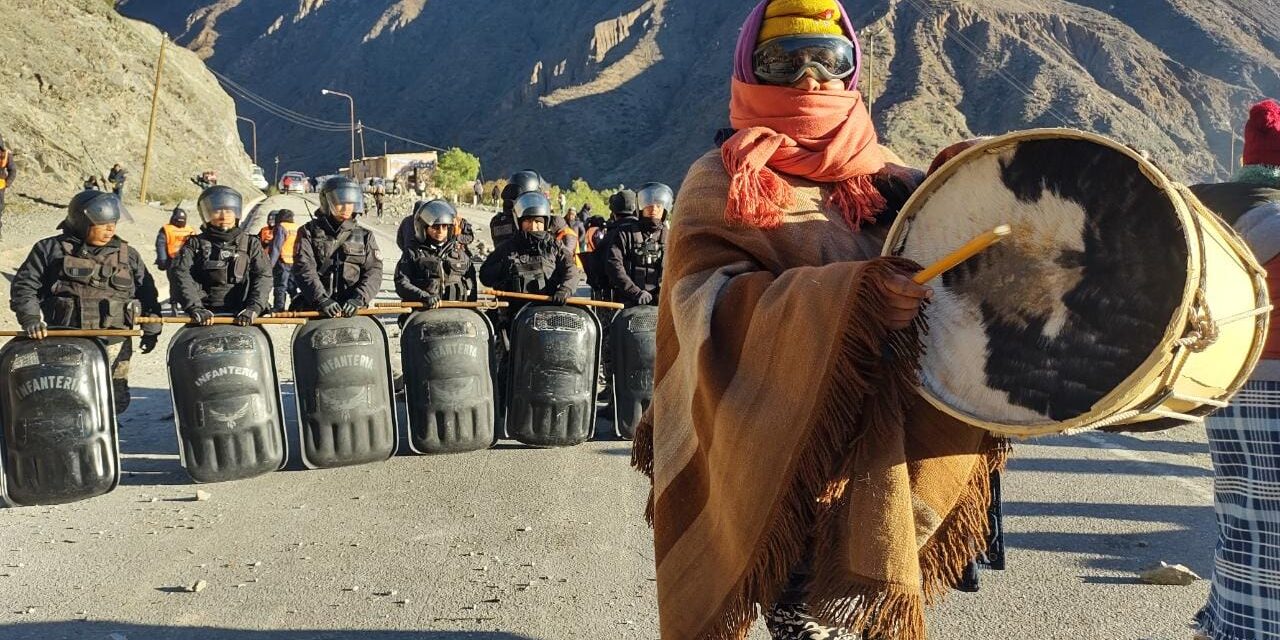
The Indigenous communities inhabiting the province of Jujuy are engaged in a struggle. Their objective: to overturn a constitutional reform they consider an attack on their rights. On Saturday, June 18, there was a violent crackdown at the Purmamarca roadblock; 27 people were arrested and several were injured.
The protests have been ongoing since the Constitutional Convention began its sessions on May 22. They escalated on the night of June 15, when the provincial government and part of the Justicialist Front approved the reform .
On June 14 and 15, Indigenous communities began a march to the provincial capital, San Salvador. They called it the Third Malón de la Paz (Peace March), because it is based on the same demands as the historic Malón de la Paz of 1946. Back then, they marched more than 2,400 kilometers to reach Buenos Aires to demand land titles.
This Third Malón added current slogans: the rejection of the exploration and exploitation of lithium in the Salinas Grandes basin and the rejection of the “unconstitutional” reform.

In defense of water
“They are eliminating many rights from the previous Constitution,” stated Verónica Chávez, president of the Tres Pozos Community, of the Kolla people. She is a spokesperson for the communities of Salinas Grandes and Laguna de Guayatayoc. They oppose lithium mining because they believe it could leave them without drinking water, which is scarce in this part of the Puna region.
These communities began their journey from the salt flats on June 14th. In Purmamarca, they met up with others coming from the Cochinoca department and from La Quiaca , in the Yavi department, in the far north of Jujuy province. Together they marched towards San Salvador.
On the other side of the map, in the Yungas region of the Ledesma department, members of the Cherenta Community, of the Ava Guaraní people, marched. “We are against the unconstitutional reform that Gerardo Morales and Minister Natalia Sarapura carried out behind closed doors against Indigenous peoples. There was no prior, free, and informed consultation, as it should be. That is why we, our brothers and sisters, are marching against this and in support of the teachers of Jujuy,” Gabriela Situé, leader of the community, told Presentes . She added that in Jujuy, 60% of the population is Indigenous. Therefore, their demands overlap; they are also part of the teachers' movement, which is demanding salary increases.
From the first Malón de la Paz
The column from Abra Pampa was seen off by Nicanor López, one of the elders who participated in that first Peace March in 1946. He wished them “a safe journey.” “We can’t do anything with our hands folded. We have to have a good heart, good thoughts, to be able to work.” “Because we are from here in the Puna, they want to dismantle us . They want to see us with nothing . So we have to fight ; this fight began in the first (Peace March) and we will continue to fight,” he affirmed.
In Maimará, a town in the Tilcara department, in the Quebrada de Humahuaca, another elderly woman, nearing 85, waited for the hikers coming from Cochinoca and La Quiaca. A retired teacher and herself Indigenous, Erminda Mamaní also warns of the regression implied by the new Jujuy Constitution: “It has points that we, as citizens, cannot accept under any circumstances,” she asserted.

Courts for an indefinite period
The plan for the third Malón de la Paz (Peace March) was to conclude on June 16th, participating in the general provincial mobilization called by teachers and workers from other sectors of Jujuy, who are demanding salary increases and opposing the reforms promoted by Governor Gerardo Morales. However, on the night of the 15th, while they were still approaching San Salvador, they learned that the amendment had already been approved. In quick assemblies, they adapted their plan of action to the new situation.
And on June 16, a crackdown on protesters in Abra Pampa, in the far north of the province, further inflamed tensions. Spokesperson Verónica Chávez reported that the National Assembly of the Peoples of the Puna had decided to indefinitely block the national highways leading to Chile and Bolivia. “The blockade will only be lifted with the restoration of the provincial constitution and the unequivocal resignation of the provincial governor,” she stated. In response, residents of the high mountains and lower-lying areas of the Yavi and Cochinoca departments, as well as other departments in the Puna region, gathered in La Quiaca and Purmamarca, along National Routes 9 and 51, which lead to the border crossings to Bolivia and Chile, respectively.
“They are taking away our rights”
The indigenous peoples who inhabit the territory now called Jujuy oppose the constitutional reform, firstly because there was no prior, free and informed consultation, as mandated by Argentine law.
Among the reformed points, the provincial government's bill modified Article 36 of the Constitution, "right to private property." The text incorporated into the new Constitution is directed at Indigenous peoples, the vast majority of whom lack property titles, despite their ancestral occupation of their territory. In many cases, they endure pressure from individuals who never occupied the land but possess property titles.
The reform provides for the incorporation of “mechanisms and swift procedures to protect private property and restore any alteration in the possession, use, and enjoyment of property to its owner.” Furthermore, “unauthorized occupation” will be considered a “serious violation of property rights,” and “the conditions for eviction will be established so that the owner(s) of the affected property rights can immediately exercise their rights, even if those responsible for the unauthorized occupation claim to represent or exercise the rights of the people.”

Ancestral lands in private hands
“Now, with this Constitution, we have no rights whatsoever; all the resources remain with the government,” asserted Verónica Chávez. “It harms us as Indigenous peoples because it takes away our rights,” added Gabriela Situé. She pointed out that “many communities don’t have legal title to our territories. They would take away the ancestral land our grandparents left us, and that’s where our ancestral remedies are also kept, because we are guardians of that, of the environment.”.
The Cherenta community, located in the rural area of Libertador General San Martín, does not own its territory. “We don’t have any deeds because most of the land belongs to the Ledesma company,” Gabriela explained. The sugar mill itself was built on land belonging to the Guarani Nation.
Erminda Mamaní, a member of the Cochinoca people and a teacher in the rural areas of Abra Pampa, Humahuaca, and Tumbaya, also emphasized that the new Constitution “would give the authorities the right to do whatever they want with lands that lack titles,” which is the case for most of the community's territory. For this reason, she said she supports this struggle “for the sake of justice.”.
“If the people of Puno don’t have the land, where will they live? And if the lithium mining companies come and leave us without water, where will they be expelled to? That’s what they’re thinking. Right now, people are realizing, they’re becoming aware of what could happen with this government reform,” he reflected.
A strategic meeting
Verónica Chávez's image has circulated around the world in recent days. She was seen accompanied by American film director James Cameron, from whom she secured a commitment to support the communities opposing lithium exploration and mining.
The meeting with Cameron was the culmination of a misstep by the governor of Jujuy, Gerardo Morales, who invited the filmmaker to visit the Cauchari Solar Park located in the Susques department. Cameron himself later said he felt he had been ambushed and highlighted the paradox that this incident led him to focus on lithium mining . Cameron declared his support for the communities opposing mining operations in their territory and pledged his backing.

Verónica Chávez recalled that the communities of Salinas Grandes and Laguna de Guayatayoc have long resisted lithium mining. “We filed complaints, we filed lawsuits with the Supreme Court (of Justice of the Nation), everything, but they continue to violate our rights,” and now with the provincial reform, “they are taking away all our rights; we can’t protest, we can’t do anything.”
In early March of this year, these communities suffered what they call "a betrayal." The commissioner of Lipán, Angélica Castillo, some members of that community, and President Alberto Fernández signed an agreement consenting to lithium mining in their territory, which the governor then used to claim that he had indeed carried out the required prior consultation.
So the communities rethought their strategy. “We said we’re not going to stop, we have to make this struggle visible; we said that in a meeting.” As a spokesperson, Verónica Chávez was working on this when she learned of James Cameron’s visit. “And I asked my mother, my father, and my mother, who are no longer with me, to arrange a meeting for me with this man, because I saw that he would help me raise awareness of the struggle,” she recounted. With that conviction, she secured the meeting with the filmmaker.
Two women, in the lead
Verónica Chávez and Gabriela are almost the same age, 49 and 48 respectively. Both are mothers, and both share a commitment to defending their communities and their knowledge. “I work in the area of Indigenous health,” Gabriela told Presentes, explaining that during the pandemic, “we searched for our native herbs to heal our people.”.
Verónica explained that in Tres Pozos, they dedicate themselves to crafts, livestock farming, agriculture, salt extraction, and tourism. “Our grandparents, who lived in this beautiful territory of Salinas Grandes and Laguna de Guayatayoc, preserved it for years and years and years, and now it's our turn.” “Here we have an economy that our grandparents lived on, and we are living it now, and we want to leave the territory healthy, as our grandparents left it, as we found it, for future generations, with clean water, and that is the struggle we have been waging for thirteen years.”.
Although there is no lithium in her territory, Gabriela highlighted the actions of “the brothers and sisters of the Puna” defending water and land as one of the reasons for marching. “What Gerardo Morales does is take what we have to give it to the big landowners. We know this well, because we are not fools; our grandparents taught us to defend our territory, our water, our lives, our forests, our nature.”
“It’s so sad” what’s happening to them today, Gabriela lamented about the situation in her province. “We have a right-wing government in Jujuy today,” she added, recalling that this is why they held an assembly of representatives from all the province’s Indigenous peoples—Kolla, Chichas, Okloya, Guaraní, Omaguaca, Tilián, and Quechua—on June 1st. There, they formed the Plurinational Constitutional Convention, with the aim of ensuring their worldview was respected in the reform of the provincial constitution, but they were not heard.
We are present
We are committed to journalism that delves into the territories and conducts thorough investigations, combined with new technologies and narrative formats. We want the protagonists, their stories, and their struggles to be present.
SUPPORT US

FOLLOW US
Related notes

We are present
This and other stories are not usually on the media agenda. Together we can bring them to light.