

Hate speech and disinformation about trans people after the Nashville shooting
Disinformation in the days following the shooting fueled transphobic rhetoric. This comes amid a political and social climate in which the lives and human rights of transgender people are being violated in the United States.


Share

A week ago, three children and three adults were killed at Covenant High School in Nashville, Tennessee. It is the most recent mass shooting in the United States. Regarding the shooter, surnamed Hale, police speculated about his gender identity, which sparked a wave of misinformation and hate speech against the entire transgender community in the country.
The victims are: Evelyn Dieckhaus, William Kinney and Hallie Scruggs, all 9 years old; the custodian Mike Hill, the teacher Cynthia Peak and the school principal, Katherine Koonce.
After 14 minutes of shooting and following a 911 call, police officers killed Hale, the person identified as responsible for the shooting.
Disinformation in the days following the shooting fueled transphobic rhetoric. This comes amid a political and social climate in which the lives and human rights of transgender people are being violated in the United States.
The media failed to verify the information. They didn't focus on the victims, nor on violence as a public health issue, much less on gun control. On the contrary, journalists, media outlets, and Republican members of Congress demonized transgender people, portraying them as "dangerous" and responsible for gun violence.
There is no evidence that transgender gender identity links the reason for the attack
The Nashville police released information about Hale's alleged trans identity on the afternoon of the shooting. "We believe she identifies as trans, but we are still in the initial stages of investigating whether that actually played a role in this incident," said John Drake, chief of the Nashville Metropolitan Police Department.
The police chief initially referred to Hale as a “female shooter.” Later, after speculating that she was transgender, the police continued to use female pronouns. It is unclear how the police arrived at their conclusion about Hale's gender identity, and to date, that information has not been officially verified or denied by the department.
On March 31, Reuters reported that police spokeswoman Kristin Mumford responded via email, “We do not know your personal gender identity.”

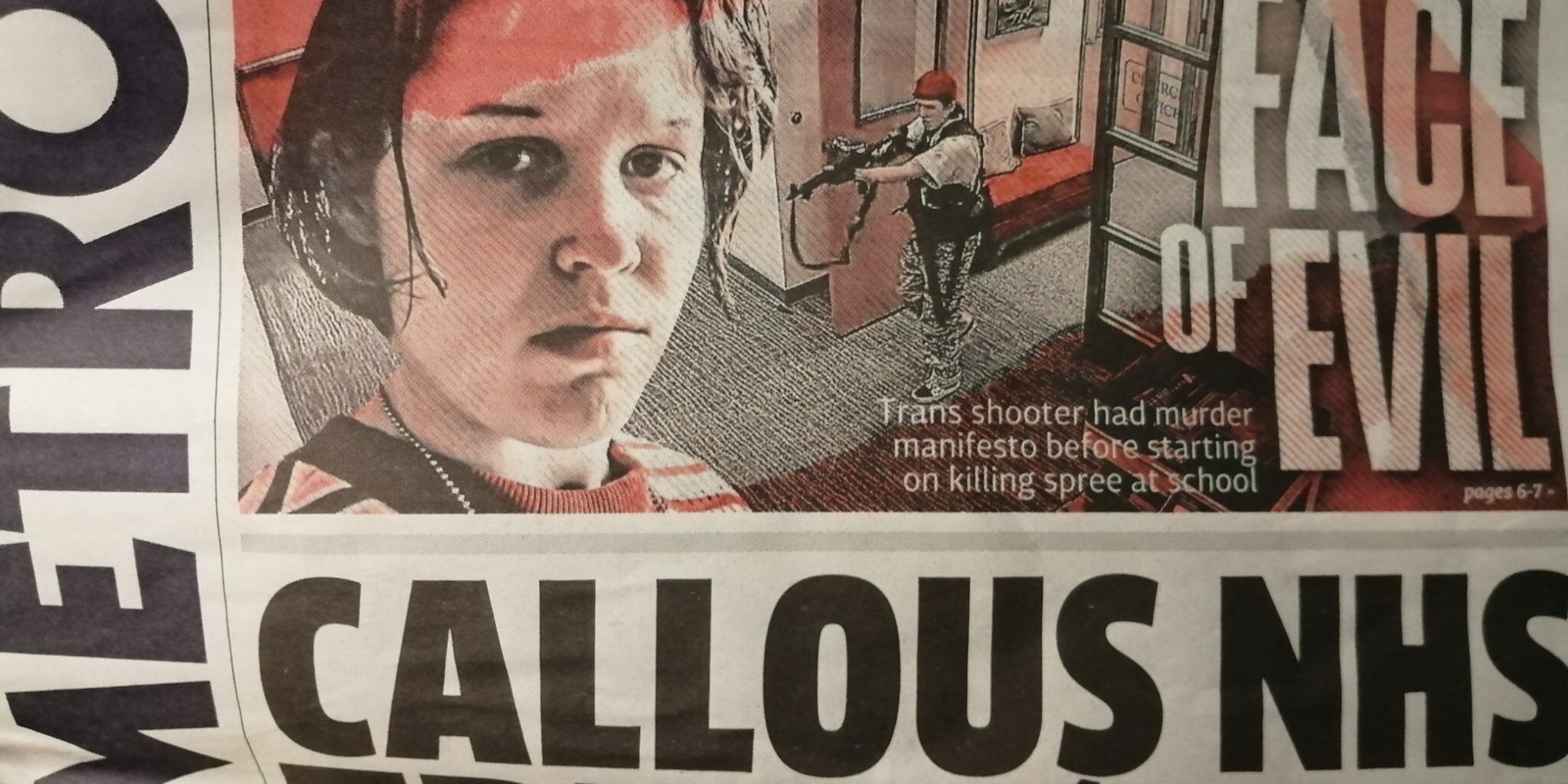
The fact that the police officer said she was transgender was enough for media outlets (from various editorial lines, primarily conservative) and Republican members of Congress to blame her transgender identity for the shooting. They also attempted to use statistically unsound data to hold transgender people responsible for gun violence in the country.
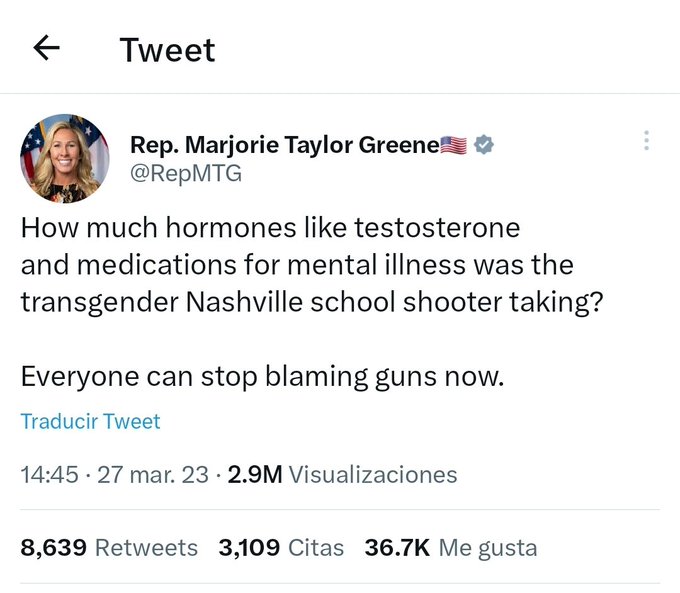
Republican Congresswoman Marjorie Taylor Greene, in a tweet, distanced herself from the guns. Instead, she blamed transgender identities, speculating that testosterone and the use of medication to treat mental health conditions may have played a role in the shooting. But there is also no information indicating that Hale was undergoing gender-affirming treatment.
Based on this, conservative congressmen and media figures attempted to claim that "there has been an increase or trend" of trans and non-binary people perpetrating mass shootings in the last five years.

To support their claim, they cited four cases that occurred since 2019. From that year to 2022, were recorded . This means that 0.016% of shootings were committed by a non-cisgender person. A statistically insignificant figure to qualify as a “trend.”
According to an analysis and fact-check conducted by AP : “The number of mass shootings committed by those who identify as trans or nonbinary, and their proportion compared to mass shootings committed by other groups, is difficult to quantify. It depends on the database used, how the act is defined, and how gender identity is recorded; for example, transgender men may be statistically counted as just men. But experts agree that the most reliable data still shows a clear pattern that cisgender men are the most likely to commit such an act of mass violence.”
In contrast, transgender people are four times more likely than cisgender people to be victims of violent crime, according to a study by the Williams Institute at UCLA.
The media amplifies transphobia, and trans people suffer the consequences.
Headlines in print and digital media have used the word “trans” to identify not only the person responsible for the Nashville shooting, but also to create a kind of “brand” of all trans people as guilty or potentially responsible for gun violence.
These media actions are particularly alarming because they occur at a political juncture in the United States where the human rights of trans people (adults and minors) are being violated exponentially .
So far in 2023, at least 422 bills are under review and 26 anti-trans laws have been passed in states governed by the Republican party.
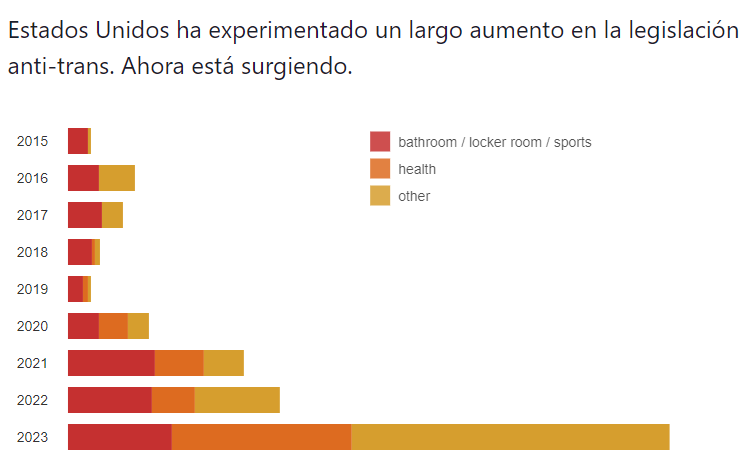
The role of the media in the wave of anti-trans laws is significant. The ways in which journalism portrays the lives of trans people without a human rights perspective are being used to support the anti-rights narratives behind these laws.
Researcher Julianna Neuhouser explains in the book Polarization and Transphobia that “in Texas, the state defended its policy of separating trans children from their families with a report that cites a controversial piece from The New York Times that uses stories of detransitioners (trans people who detransition) and interviews with Genspect, an organization that promotes conversion therapies.”
Anti-trans laws on the rise
Anti-trans laws in the United States seek to deny trans people access to basic and comprehensive medical care, deny them identity documents, prohibit them from playing sports and accessing bathrooms or changing rooms according to their gender identity, as well as censor educational material on comprehensive sexuality and diversity in public schools, including drag shows.
In Mexico, the amplification of transphobic narratives surrounding the Nashville shooting was swift. With headlines like “Trans person attacks school” and “Trans person with psychiatric problems,” the newspaper El Heraldo de México failed to provide rigorous journalistic reporting on the incident.
Raúl Cruz, editor and journalist, explains that “while in Mexico we have not seen the explicit weaponization of the media against gender and sexual dissidence, we do frequently see how they are instrumental in importing hate speech and disinformation campaigns disguised as 'journalistic' news.”
And he adds that it is imperative to understand that social networks, the media and the political and social context of Mexico are “feeding and at the same time forming a transphobic discourse that is subsequently operated by anti-rights groups to achieve specific political interests.”
This is no coincidence. This year in Mexico, at least three bills have been introduced that violate the rights of transgender children and criminalize anyone who supports the transitions of transgender children and adolescents. Essentially, they are copies, not adapted to our country, of similar laws in the United States.
We are present
We are committed to journalism that delves into the territories and conducts thorough investigations, combined with new technologies and narrative formats. We want the protagonists, their stories, and their struggles to be present.
SUPPORT US

FOLLOW US
Related notes

We are present
This and other stories are not usually on the media agenda. Together we can bring them to light.