

Updated information on sexual diversity worldwide: what ILGA's new database is like
Starting today, ILGA's free and open access database makes crucial information about sexual diversity available worldwide.


Share

The International Lesbian, Gay, Bisexual, Trans and Intersex Association ( ILGA World ) today launched a database providing up-to-date information on sexual diversity worldwide: legislation, progress and setbacks, opportunities for activists, and news focused on LGBT+ human rights. This means that information that was previously time-consuming to gather, or nearly impossible to find, will now be accessible and available through a series of easy-to-use clicks and filters.
“We created this database to facilitate access to information. The intention is to make it more accessible to activists, journalists, academics, and people working on this cause in different fields, in order to reduce the overall time it takes to systematize this information,” Lucas Ramón Mendos Presentes . It is the result of extensive research involving people from various countries.
"A powerful source of information for activism"
Among the objectives of the database is also to streamline action and, based on the accessibility of the data, allow people not only to access systematized and current information, but also to use that time to "strategize, achieve more analytical work, and see the trends," Mendos added.
In addition to being very useful for news production and analysis, and for research, the database is a valuable tool for activists. “Organizations in the field often have very limited resources to keep up with global developments,” commented Julia Ehrt, Executive Director of ILGA World. “In the database, they can find information they can use in their activism or campaigns. It’s a powerful source of information at their fingertips.”
What is the ILGA Database for and how to use it
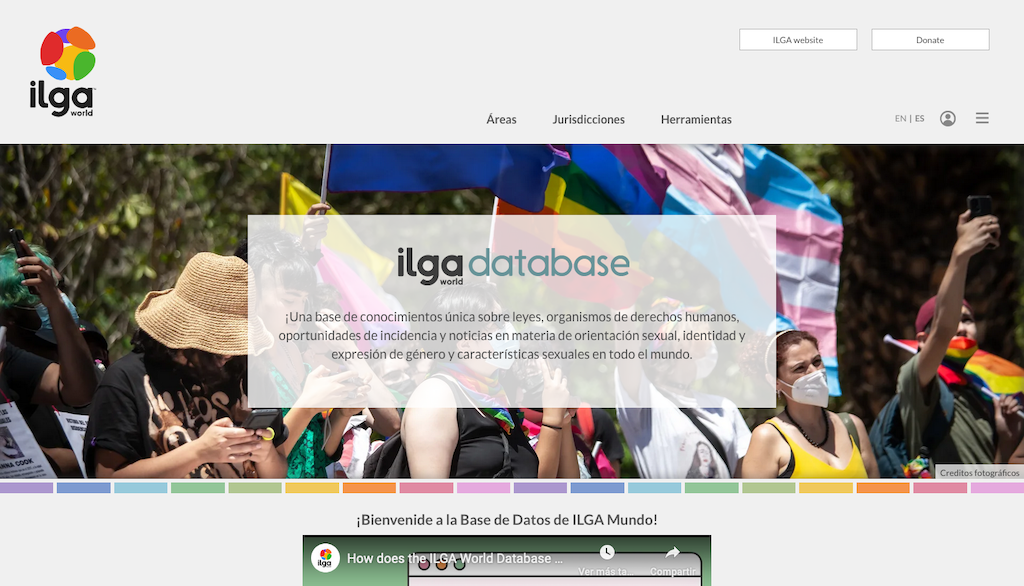
The ILGA World Database contains up-to-date information on laws affecting LGBTI people.
- The information can be filtered into 18 legal categories and more than 100 topics.
- It allows visualization on interactive world and regional maps.
- Each state and jurisdiction in the world has its own profile with laws, upcoming activism opportunities for human rights defenders, and a selection of the latest LGBTI news.
- It allows you to track the evolution of all UN human rights bodies, monitor the timelines for engaging with them, and integrate any input into research or policy work.
What the database reveals today

“Without data, states can deny the existence of LGBTI+ people or downplay how violence affects us. We often say that data speaks for itself, but first we have to find it to be able to say anything. Myths can go very far without real data to counter them,” said Daniele Paletta, Communications Manager at ILGA World, at the presentation of the database to journalists from around the world, in which Agencia Presentes participated.
Today, the database shows progress worldwide in recent decades, but also significant setbacks. On the one hand, twenty countries allow legal recognition of gender based on self-determination, and same-sex marriage is legal in 33. Furthermore, 58 countries have laws protecting people from hate crimes based on sexual orientation. However, only 37 of these laws address gender identity, 9 gender expression, and 5 sex characteristics.
While in six countries (Brunei, Mauritania, Iran, Nigeria, Saudi Arabia, and Yemen) homosexuality is punishable by death, in the last thirty years, 49 states have decriminalized consensual same-sex sexual acts. Furthermore, in 11 countries, so-called "conversion therapies" , and in seven, non-life-threatening medical interventions on intersex children .
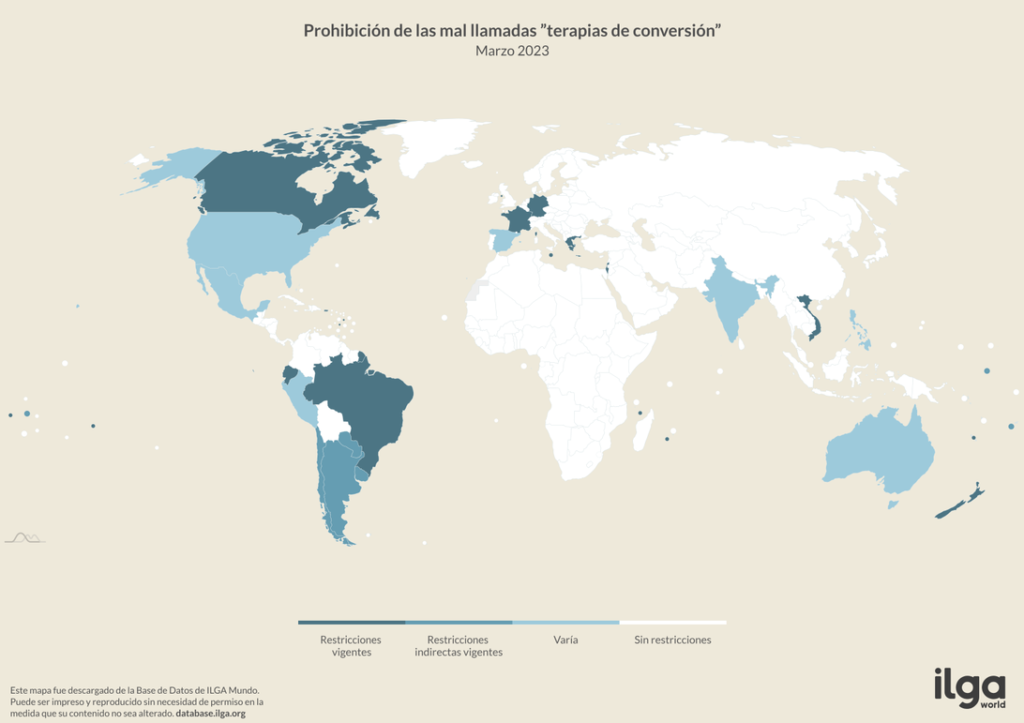
These are examples of what can be found in the database, which compiles information from 193 United Nations and 47 non-independent territories. The data available includes laws, news articles, and references to human rights organizations, as well as activism opportunities related to LGBTI people worldwide.
Equality is still a long way off for LGBTI people

On the other hand, other data show that " true equality is still far from our reach for many LGBTI people around the world ," ILGA stated. In addition to the six countries where same-sex sexual assault is punishable by death, five others lack legal certainty regarding its application. Meanwhile, at least 51 states have restrictions on freedom of expression related to issues of sexual and gender diversity, including in the educational sphere. And 64 criminalize consensual same-sex sexual relations.
“This data speaks volumes and provides the world with the missing evidence of how lesbian, gay, bisexual, trans, and intersex people continue to be marginalized in many areas of life,” said Luz Elena Aranda and Tuisina Ymania Brown, co-secretaries general of ILGA World. They emphasized that this data can be used to “advocate for programs and services” to make “the world a better place for our LGBTI communities.”
How the ILGA World Database Works
We are present
We are committed to journalism that delves into the territories and conducts thorough investigations, combined with new technologies and narrative formats. We want the protagonists, their stories, and their struggles to be present.
SUPPORT US

FOLLOW US
Related notes

We are present
This and other stories are not usually on the media agenda. Together we can bring them to light.