

How and why do LGBT people disappear in Mexico?
Disappearances have been on the rise, but the State does not keep a separate record.


Share

MEXICO CITY, Mexico. The Mexican state makes the sexual orientation and gender identity of missing LGBT+ people invisible, obstructing their search, their access to justice and the truth.
In Mexico, we are missing more than 60 LGBT+ people . That is the figure that the Center for Support of Trans Identities ( CAIT ) has recorded in twelve years because people of diverse sexual orientations remain underrepresented in official statistics that allow us to understand the scale of a human rights crisis with more than one hundred thousand people currently registered as missing.
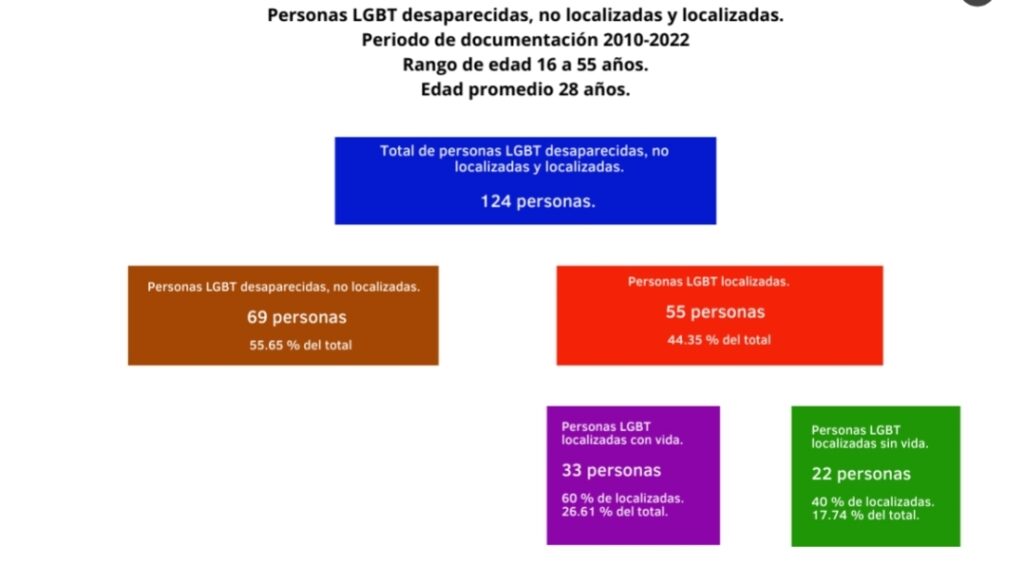
While the National Registry of Missing and Unlocated Persons ( RNPDNO ) of the National Search Commission records, as of November 9, 51 LGBT+ people missing over a period of 58 years (1964-2022), the CAIT has documented the disappearance of 124 LGBT+ people in the last twelve years, of whom 69 remain missing. Among them is Mario Antonio de la Cruz Miranda.
First records
Mario, 16, disappeared in the early morning of February 18, 2017. He was last seen leaving Laser Hot, a bar in Cancún, Quintana Roo, at 5:30 a.m. There has been no progress in locating him.
Viridiana, Mario's mother, denounced discrimination and negligence on the part of the justice system. Because he was a minor, an Amber Alert was not issued, and his sexual orientation was disregarded in the investigation. Furthermore, upon learning that her son is gay, the authorities told her, "He probably ran off with his boyfriend; he'll come back when he calms down."
Mario's disappearance was the first one registered by human rights defender Rocío Suárez, director of CAIT, one of the few organizations in Mexico that registers disappearances of LGBT+ people.
From then on, Rocío built a database where she classifies the information by name, LGBT identity, age, date and place of disappearance, migration status, location alive, location dead, investigation file and press notes.
What do we know about missing LGBT+ people in Mexico? What obstacles do they face in accessing justice? Why is it important to conduct searches with a differentiated approach and a gender perspective?
To answer these questions, Presentes spoke with Rocío Suárez, director of the Center for Support of Trans Identities (CAIT); with Linda Ruíz and Mario Juárez of Idheas , a civil organization specializing in strategic litigation of cases of serious human rights violations that documents and investigates cases of disappearance of trans people in Mexico.
What do we know about missing LGBT+ people in Mexico?
According to CAIT figures, in Mexico 124 LGBT+ people were reported missing between 2010 and September 2022. Of these, 69 are still missing, 33 were located alive and 22 were found dead.
According to the disappearances report prepared by CAIT, which Presentes accessed, two out of every three missing persons are trans women. 17.74% are gay men, 12.10% lesbians, and 4.03% trans men. The average age of these individuals is 28.
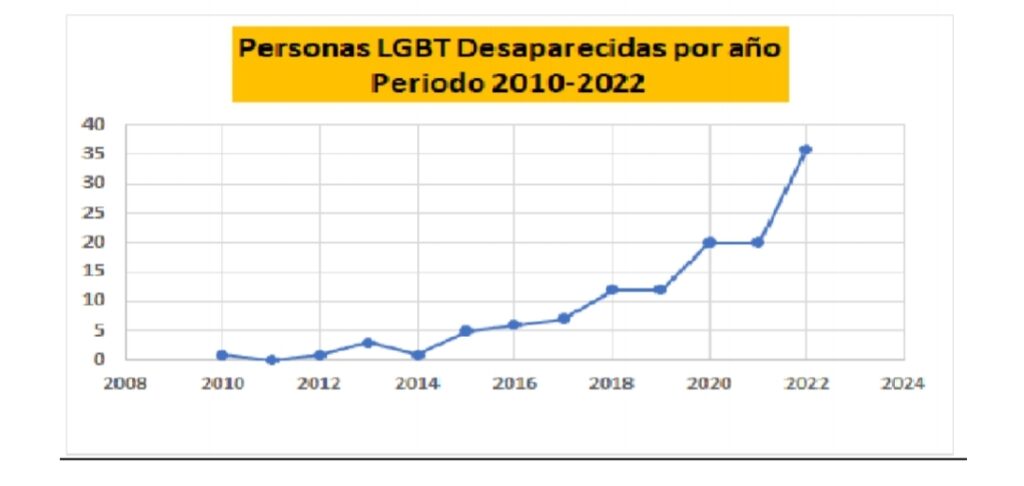
The CAIT highlights that in the last four years there has been an increase in reports of disappearances and non-location of LGBT+ people.
This, they explain, is due to two factors: 1) an increase in reports of murders and disappearances of LGBT+ people by family and friends, and 2) greater visibility of these crimes by organized groups of relatives of missing persons and media reports.
For its part, the Idheas association has identified that the disappearance of trans people occurs, above all, where there are previous contexts of family and social violence.
“What we have documented is that, in general, there is prior violence that facilitates or causes trans people to be in a situation of special vulnerability, not so much because of their gender identity, but because of family and community violence. It is dangerous to generalize, but we have detected contexts of family exclusion, internal migration, sex work, control of spaces, group violence, or crime that place them in a vulnerable position of being exploited for drug trafficking and other activities,” explained Linda Ruiz.
“Underreporting and invisibility contribute to non-location”
Although the National Registry has a marker for LGBT people in its "differentiated approach" section, the information it provides is deficient.
The Registry maintains a binary division of 'male/female' and a further category labeled 'undetermined'. The sexual orientation and gender identity of the victims are not specified. Therefore, we do not know how many registered individuals are transgender women and men, lesbians, gay men, or bisexuals. Nor do we know their names. There are no photographs to help identify them.
Likewise, the filters within the platform are insufficient . They prevent us from understanding the circumstances of the missing LGBT+ individuals . There is no information available to help us understand this violence in order to prevent further disappearances.
“Generalizing data leads to invisibility, and this affects search efforts because the contexts are unknown. Therefore, there are no working structures in search commissions or prosecutors' offices to locate them. Failing to consider sexual orientation, gender identity, the victims' legal and social names, or the role of chosen and blood relatives in the search for the missing person creates gaps. Underreporting and invisibility contribute to the failure to locate them,” argues Rocío Suárez.
Ecosig, night, police chase
Over the years, Rocío Suárez has identified what she calls "common patterns".
In the case of missing lesbian women, Suárez observes a trend in Jalisco. women who have recently come out are being taken by their families to places where LGBTQ+ rights (practices that repress gender identity and sexual orientation). She explains that the report is filed as a disappearance, and it is usually the partner who reports it.
In the case of trans women and gay men, their disappearances happen, above all, in meeting places such as parties, nightclubs, and bars.
However, he cautions that these patterns should not be understood as a general rule.
“I think these patterns we’ve identified raise even more questions. There’s still a historical gap that isn’t being discussed, such as the raids and the ongoing police persecution of trans sex workers,” she says.
“The disappearance could also be related to a hate crime.”
In that sense, Linda Ruiz de Idheas warns that "the disappearance could also be related to a hate issue."
"That's why it's so important to make visible and conduct research with a differentiated and gender focus."
At Presentes we have reported how sometimes the crime of disappearance is the step prior to transfeminicidal and lesbofeminicidal violence.
As happened recently with Odilia Castillo, a 17-year-old lesbian who disappeared on August 26. On September 1, she was found dead in a cistern. Yessi Montero , a 34-year-old trans woman, was reported missing, and on March 24, 2022, her body was found lifeless and showing signs of torture on the side of a road in Veracruz. Loren Guzmán , a trans woman who disappeared on December 3, 2021, and whose body was found with signs of violence on February 2, 2022, in Guanajuato.
The State does not guarantee searches or access to justice with a gender perspective
In Mexico, both the Standardized Protocol for the Search for Missing and Unlocated Persons and the General Law on Disappearance and the National Search System for Persons state that if the victim of disappearance is an LGBT+ person, the principles of equality and non-discrimination must be applied, in addition to a gender perspective and a differential and specialized approach.
“There is a legal obligation for the authorities that, as with every violent death of a woman, femicide must always be considered as a line of investigation. Every disappearance of women, girls, and people belonging to the LGBTQ+ community must always include, as a line of inquiry, the possibility that it is linked to other forms of gender-based violence. Sexual violence, domestic violence, human trafficking, femicides, transfemicides, or any other crime—such as enforced disappearance or disappearance by private individuals, kidnapping, etc.—are outlined in the Standardized Search Protocol .”
However, both CAIT and the members of Idheas maintain that these standards are not applied. Not even in the first contact with the authorities when a missing person report is filed or when filling out the search forms.
“The trend in human rights internationally is to try to distinguish how the same phenomenon affects different groups in order to understand their particular situation. In that sense, if at some point judges determine that the investigation into the disappearance of a trans person did not comply with the established search protocol or the law, it sets a precedent that could be cited later. That is the potential of differentiated searches, and conducting them in collaboration with civil society organizations, families, and collectives is key,” explains Mario Juárez of Idheas.
What to do in case of disappearance?
In 2019, the journalistic innovation and research laboratory, Quinto Elemento Lab, along with other organizations, created the Socorro Bot .
Socorro Bot is a WhatsApp guide to support those searching for a missing person. It is not affiliated with authorities but provides advice and information on required documents and your rights when reporting a disappearance . It also includes a directory of authorities and family groups searching for their missing loved ones.
Remember that all people, regardless of our sexual orientation or gender identity, have the right to be searched for.
We hope you don't have to use it. This link will take you to Socorro Bot.
We are present
We are committed to journalism that delves into the territories and conducts thorough investigations, combined with new technologies and narrative formats. We want the protagonists, their stories, and their struggles to be present.
SUPPORT US

FOLLOW US
Related notes

We are present
This and other stories are not usually on the media agenda. Together we can bring them to light.