

Protests against Mexican public television for broadcasting transphobic rhetoric
A public television channel gave airtime to members of an extremist group that spreads hate speech. LGBT people held a demonstration.


Share

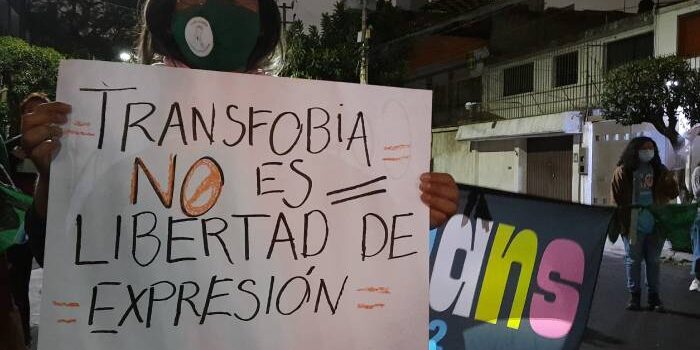
MEXICO CITY, Mexico. Trans people protest and denounce Capital 21, a public television channel, after it gave airtime to members of the LGB Alliance, an extremist group, who broadcast transphobic speeches El Aquelarre
Activists are demanding the resignation of the program's hosts and a public television free of hate speech. Human rights organizations are analyzing the incident, and the television station has appealed to freedom of expression.
To understand what happened, what the LGB Alliance is, and how hate speech affects trans people, Presentes spoke with researcher and activist Julianna Neuhouser. She studied the links between the far right, anti-rights groups, and feminists who call themselves 'gender critics'.
What happened at Capital 21?
The program El Aquelarre, broadcast on Capital 21, a public television channel funded by the government, is hosted by Renata Turrent. Every Wednesday there is a segment called Hombres (Men ), co-hosted by Mercurio Cadena and Braulio Luna. The September 21st edition featured guests Mauricio Dimeo and Itzel Suárez, both cisgender individuals.
According to Turrent, the purpose of the program was a panel discussion on masculinities, but first he clarified the reasons for his guests.
Turrent explains that Capital 21 gave Dimeo and Suárez the opportunity after the National Autonomous University of Mexico (UNAM) canceled their participation in a forum. However, the host does not clarify why.
What is known is that UNAM's decision comes after learning about the positions and ideas of Dimeo and the extremist organization, Alianza LGB.
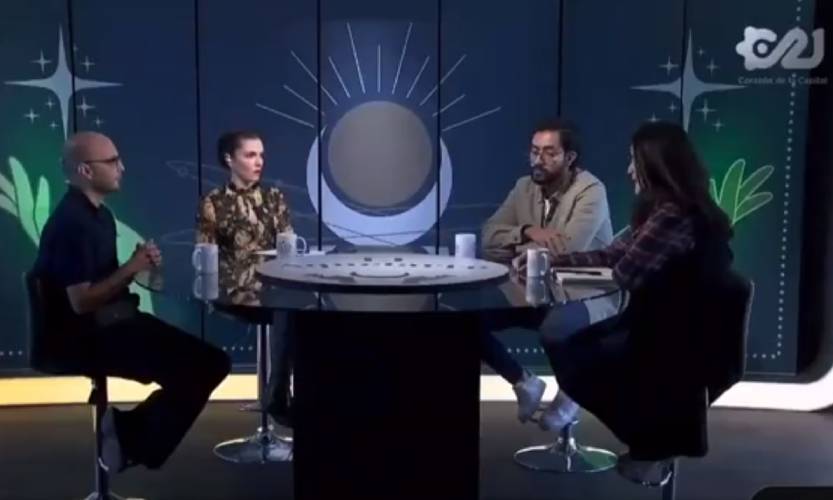
The program barely touched on masculinities. Instead, activists and trans people denounced the dissemination and amplification of hate speech.
“Mercurio Cadena repeatedly steered the conversation toward attacking what he called 'queer theory,' which is simply the identities and rights of trans people. (…) He let out a mocking laugh when there was a brief mention of the use of gender-neutral pronouns. Renata Turrent presented the existence of trans people as a debate that belongs to cisgender feminisms, and she too let out a mocking laugh at the mention of the feminist author and academic Judith Butler. For his part, Mauricio Dimeo repeatedly attacked the right to identity of trans people, the labor rights of sex workers, and closed the program by suggesting that trans women and other transfeminine individuals are sexual predators.”
During the thirty minutes that this segment lasted, there was no counterbalancing voice against the narratives used, and no one denounced the hate speech that was uttered.
What is the LGB Alliance?
Julianna Neuhouser answers through her study what the LGB Alliance is and what its level of influence is in Mexico.
“The LGB Alliance is a hate group. They are individuals who left large organizations in England in 2019 that are closely linked to the Conservative Party. It's important to note that their origins are English, and since then they have attempted to establish groups in countries such as Spain, the United States, Canada, and Mexico.
To understand what this group is, we need to know that, from its origins, its members have been linked to evangelical, pro-life groups, and those are their values. It's not very clear how they are financed, and there aren't that many LGB people in the LGB Alliance.
Their name might suggest they work for lesbians, gays, and bisexuals, but that's not the case. What they actually do is campaign against the ban on ECOSIG ; against the organization of LGBT students in schools; they oppose sex education; the gender identity law; and they even claim that opposing same-sex marriage is not homophobic.
They do nothing for the cisgender LGB community. There's no grassroots work, no support for victims of discrimination. They also don't offer any community service beyond, basically, having a Twitter account.
Their practice is to adopt any conservative stance, claiming to speak for LGB people, in order to create alibis with conservative groups. That's essentially their function: to spread hate.”.
How does the LGB Alliance operate in Mexico?
According to Neuhouser, "the LGB Alliance of Mexico is not relevant, they have no base. They are a very small group that only gained relevance after that program. Television made them relevant."
“Renata Turrent said she didn’t know who they were (Mauricio Dimeo and Itzel Suárez), but that only raises another question: if you didn’t know who they were, why invite them on television? That only creates more doubts. In my opinion, Renata invited them because she sympathizes with them, but she doesn’t want to say so publicly because the channel has a history of transphobia.”
Following complaints from transgender people, Renata Turrent stated that she did not investigate her guest, Mauricio Dimeo, before inviting him to her program and that she was not responsible for the comments he made.
This is not the first time
On March 10, 2022, Mikaelah Drullard, an Afro-mestizo trans woman, denounced racism and transmisogyny on the part of Capital 21 when they invited Afrontera, the collective to which she belongs, to a panel discussion on feminisms.
When Mikaelah arrived at the program, they prepared a microphone and a chair for her, but just as it was about to start, they kicked her out.
“I don’t know what happened, I don’t know if the TERFs felt uncomfortable with my presence, my body. I’m always a suspicious life/body, my trans body is always suspicious to feminism; you only have the legitimacy to speak as long as you’re cis. THE VIOLENCE IS BRUTAL (…) When they had to choose the legitimate voices, they chose the voices of cis whites, and eliminated other narratives, of existences from Blackness and transitivity,” wrote on her Twitter account at the time.

“We need reports that explain how anti-rights groups operate.”
What needs to be addressed by the public so that hate speech is not seen only as a matter concerning historically marginalized groups, and so that only these populations are responsible for reporting it?
“It’s important to report on hate groups. Understanding what happened, analyzing it, studying it—that’s not giving hate groups a platform, but I think many journalists don’t quite grasp that difference. Many journalists think it’s about creating debates, about presenting both sides. That’s not good journalism. What we need are reports that explain how anti-rights groups operate, what their alliances are, why they emerged, and how and by whom they are funded.”
“I believe that understanding and studying this isn't giving a platform to hate, and the media can play a very important role in providing answers to understand what happened. What happened in the five years since the Hazte Oír transphobic bus ? Why is J.K. Rowling, someone everyone loved 15 years ago, so controversial today?”
How are hate speech and violence against trans people related?
Researcher Julianna responds:
“Clearly, anti-rights groups like the LGB Alliance don't directly perpetrate violence, but they do exert structural violence. Especially when they have a presence in the media or in politics, and that's something we have to prevent. What these groups do is establish an ideological justification for discrimination, and this discriminatory environment means it's difficult for us (trans people) to access our rights. This pushes us into risky situations, and that's when things get serious.”
“Hate speech is not freedom of expression”
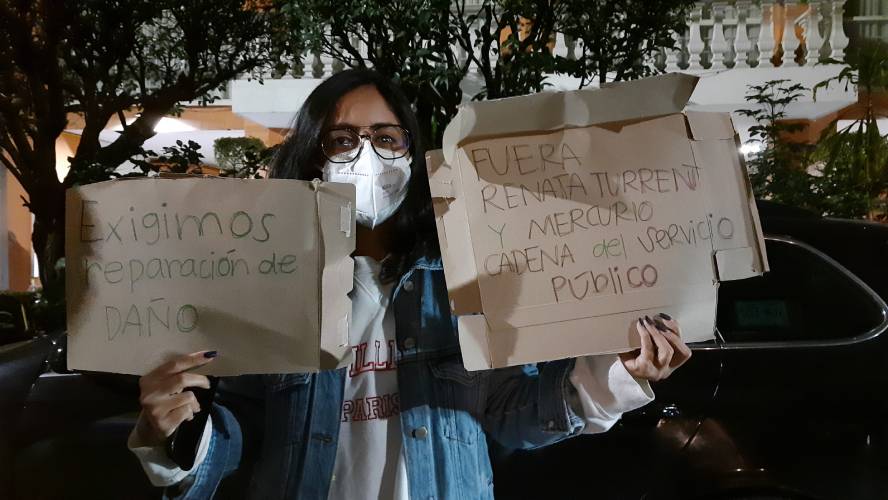
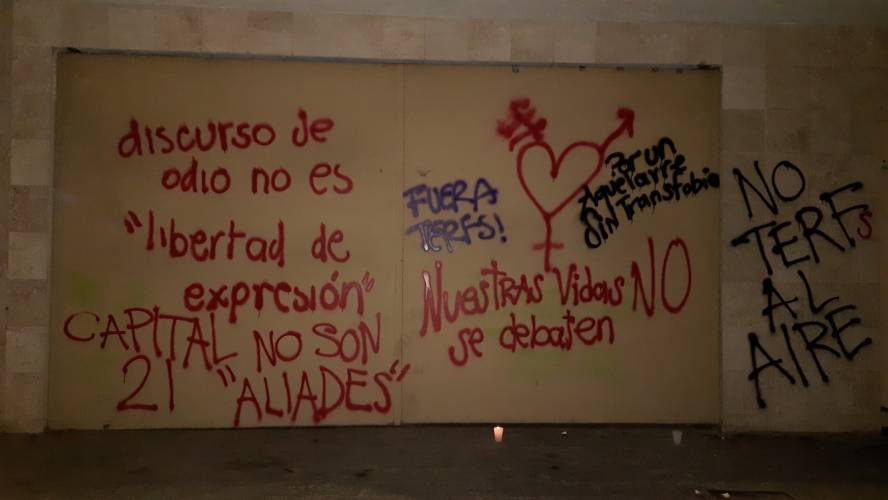
On the night of September 28, trans people demonstrated outside the facilities of the Capital 21 channel in Mexico City.
There they read two statements highlighting the institutional and social consequences of opening television space to hate speech and how the amplification of these narratives violates the Code of Ethics of the Public Media Service of Mexico City and the Law of Administrative Responsibilities of Mexico City.
Their requirements are:
- Follow-up on complaints issued through the Audience Advocacy mechanism of the Public Media Service of Mexico City.
- Public apology from Capital 21 and those who participated in the program El Aquelarre on September 21.
- That appropriate sanctions be established for those responsible for non-compliance with regulations and laws to prevent discrimination and transphobia.
- Guarantees of prevention and non-repetition.
- That Capital 21 staff receive awareness training from the National Council to Prevent and Eliminate Discrimination (CONAPRED).
- That Capital 21 guarantee opportunities for trans and non-binary people to share information.
Furthermore, the Network of Sexual and Gender Resistance and Dissidence demands the resignation of Renata Turrent and Mercurio Cadena .
Regarding this, they explain, “ This is not a request we make lightly. It is not a whim or an attack, but simply what we believe is essential to achieve reparations and justice (…) Renata Turrent and Mercurio Cadena must leave their hosting duties on El Aquelarre , not as punishment or revenge, but because they have demonstrated their inability to manage the space, power, and visibility that the government gave them on broadcast television.”
Eme Flores, a member of the Network of Sexual and Gender Resistance and Dissidence, told Presentes that they met with the Council to Prevent and Eliminate Discrimination in Mexico City in order to link reparation measures for trans people and awareness-raising for staff at Capital 21 channel.
“If they open this space to a trans journalist or trans communicator tomorrow, it will go very badly for them. This channel is not a safe space for trans and non-binary people. We will not allow them to bring in a trans person to whitewash their image in the coming days or weeks. We want them to listen, to reflect, to make amends, and for the efforts that Copred can make not to be wasted. If we feel they are closing ranks to dialogue again, we will protest again,” Flores asserted.
We are present
We are committed to journalism that delves into the territories and conducts thorough investigations, combined with new technologies and narrative formats. We want the protagonists, their stories, and their struggles to be present.
SUPPORT US

FOLLOW US
Related notes


We are present
This and other stories are not usually on the media agenda. Together we can bring them to light.