

What do LGBT+ people face when renting?
Higher deposits, double requirements for guarantees, and "suggestions" on behavior are some of the discriminatory situations when renting.


Share

BUENOS AIRES, Argentina. In Jujuy, Córdoba, or Buenos Aires. In hotel rooms or apartments. With or without a contract. In the most diverse situations, one thing is common: for people in the LGBTI+ community, access to housing in general, and to renting in particular, is fraught with difficulties . There are widespread difficulties that affect all renters. And there are specific difficulties, with all the statistics stacked against them and the mark of discrimination.
With the Rental Law (once again) under discussion and a growing federal economic and inflationary crisis, the outlook is especially bleak for trans women. But the problem—exacerbated by the impact of the pandemic—also affects other minorities and gender non-conforming groups: single mothers with children, migrants, and same-sex couples.
According to a 2020 survey conducted by the National Tenants Federation (FIN) , 60% of respondents were unable to pay their rent in May of that year, at the height of the coronavirus pandemic lockdown, with isolation measures in place and widespread uncertainty. The same survey showed that, for the LGBTI+ population, that percentage reached 100%.
Yesterday and today
“When I talk about access to housing, it takes me back to a timeline where violence persists and is reproduced despite advances in rights,” says Sofía Zurueta. She is 37 years old, works as a therapeutic companion, and identifies as a cisgender lesbian.
The timeline she recounts includes milestones in the feminist movement as well as the discrimination she encountered while searching for a roof over her head. She orders the events as follows: before and after the Equal Marriage Law, passed in July 2010.
“I’m from Jujuy, from San Salvador. Before the legalization of same-sex marriage, around 2006, I was looking for a place to rent with my partner at the time, and we went to a place where we’d been told there was a room available. As soon as they realized we were a couple, we lost the chance,” he recounts.
“Suddenly there were no more rooms, without any explanation. We simply had to leave without being able to check in. It was a discriminatory and violent act because we were a lesbian couple. As long as they hadn't seen that we were a couple, everything was fine and check-in was immediate. It was very unscrupulous,” she recalls.
The advances that fall short
Years later, with same-sex marriage now legal, it happened to her again. In Córdoba, with a different partner. “It was different: finding a place to rent wasn't a problem, we were able to do it. But we experienced violence and harassment from one of the landlords. He would supposedly come to check on things related to the property and would barge in with very suggestive behavior. He'd practically throw himself on us,” Sofía recounts.
The women experienced intrusions and intrusions into their daily lives, which were, at the very least, violent. "It was very blatant. We experienced it as a harassing intrusion, a presence that bothered us a lot," she says. "All of this stemmed from a position of power, because the economic situation wasn't easy, and neither was accessing housing. There was this dynamic of trying to figure out how to put a stop to it and set boundaries without reaching a confrontation that would leave you homeless. The hostility in the neighborhood was constant, with neighbors' children shouting insults; they even threw stones at us."
In 2022, and with the pandemic upon us, the situation for Sofía didn't change much. In the country's wealthiest city, the only accessible roof over her head was a hotel room in Constitución. But an additional hardship arose once again.
“In a general situation where housing is very difficult, where accessing a rental is very challenging, the most affordable option ends up being rooms in run-down hotels. And they're incredibly expensive, with a lot of price gouging,” she complains. “They helped us get that room, and as long as they didn't know we were a couple, everything was fine. But once the person in charge found out, they sent us a message demanding certain behavior. Something that no heterosexual couple is ever required to do anywhere. For us, any display of affection in the hotel's common areas was forbidden. Something that's commonplace on the street, in any public place—a glance, a caress—was forbidden to us in the hotel.”
Without guarantees
“It’s the criminalization of a way of life,” explains Luci Cavallero, a lesbian, feminist, and member of Ni Una Menos (Not One Less) . From that platform, she maintains the alliance with the tenants' group. With that phrase, she summarizes the specific obstacles the LGBTI+ community faces in accessing rental housing, especially trans women.
“There is a whole problem of income and difficulty in accessing rental housing that has been increasing since the pandemic and has not been addressed. Within this general context, we also find specific difficulties for certain populations: women with children who do not live with their partner, lesbians, gays, non-binary people, and a worsening situation in the case of trans women,” she lists.
He elaborates: “It is a statistically non-property-owning population. With lifestyles that fall outside the typical property transfer model of heterosexual families. This, combined with a higher rate of informal employment and lower incomes, results in difficulty accessing rental housing.”
The violation of rights is amplified for women, within a general framework that does not benefit tenants. On the contrary: deregulation reigns. “There is no national government agency dedicated to regulating relations between tenants and landlords. Within this framework, episodes of discrimination occur that reflect power imbalances between landlords and real estate agencies. They are the ones who can choose who they want as their tenants,” Cavallero points out.
A permanent expulsion
Faced with a formal rental market that excludes them, trans women and sex workers in Buenos Aires often live in hotels and boarding houses. Or they seek alternative strategies in the face of a shrinking range of options. “There is a whole system of collectively accessing rental housing. But it is also becoming less and less possible: there are fewer large houses available to rent and the prices are extremely high,” Cavallero points out.
All of this is happening against a backdrop of increasingly vacant homes, at least in the City of Buenos Aires. According to a report prepared late last year by the Empty Housing Study Group— comprised of the City's Housing Institute and organizations such as the Civil Association for Equality and Justice (ACIJ) and the Center for Legal and Social Studies (CELS)—almost one in ten homes in Buenos Aires remains unoccupied. While the housing deficit affects 11.6 percent of households, some 300,000 people live in slums and informal settlements, another 7,500 (closer to 10,000, according to more recent estimates) are homeless, and 35 percent of families pay rent.
“The pandemic created a labor problem for those who did informal work, such as sex workers. For a long time, they couldn't work on the streets, and that caused them to accumulate rent debt. That's why evictions of trans women increased so much during the pandemic, even with the decree that prohibited them,” she says, referring to Decree 320, signed in March 2020 and later extended until 2021, which, within a framework of “public emergency” due to the coronavirus pandemic, established the suspension of evictions.
In March 2020, during an interview on Public Television, President Alberto Fernández had to address the issue. It came in response to a question from Diana Zurco, the first transgender anchor of the state news program. After receiving pleas for help from transgender women who were being evicted , the journalist raised the issue with the president. Fernández announced the decree, condemned the evictions, and described those responsible as “despicable.”
With guarantees (that do not break with discrimination)
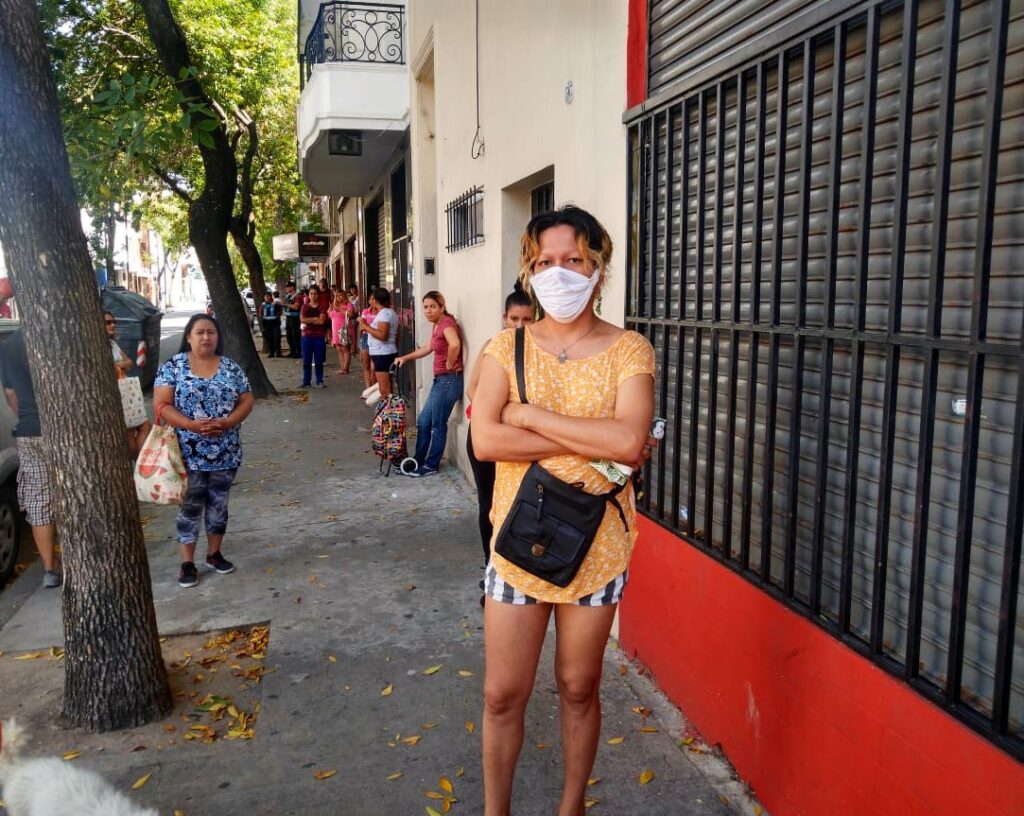
For Yanina Chávez, 32, it wasn't a matter of lack of resources, informal employment, or lack of a guarantor. In December 2020, she became the first trans woman to join Trenes Argentinos (Argentine Railways). It was a milestone in her life, allowing her to leave behind the prostitution she had resorted to for more than a decade as a source of income. With her pay stub, the money for the deposit, and a guarantor, she wanted to rent a studio apartment in the northern part of Buenos Aires Province. Because she is trans, she was turned down.
“It happened to me with a real estate agency in Carapachay. I had seen a studio apartment that I really liked. When the agent was showing me other apartments, he started noticing my voice. First, he asked if I was from the provinces, and I said yes. Then, if I was trans. I said yes. The way he treated me started to change. We went back to the agency, and I said I wanted to keep the studio apartment. He asked for a deposit of 25,000 pesos. I paid it. In total, I had to pay 110,000 pesos, 54,000 of which were just for the agency's fees. I had asked if the Rental Law applied, and they told me, 'No, that doesn't exist.' It was in August of last year,” Yanina recounts. Law 27,551 had been in effect since June 30 of that year.
Yanina noticed the obstacles mounting. They questioned the validity of the guarantee—issued by a professional—and even asked for the phone number of the real estate agency she had previously negotiated with, to check references. “Nobody asks for that,” she says indignantly. Finally, they told her to come and collect her deposit, that she wouldn't be able to sign the contract. “I told them, ‘Instead of giving me so much trouble, you could have just said, “We won't rent to you because you're trans.”’ They said, ‘No, not at all, I have a gay friend.’”
Even with a payslip from a state-owned company like Trenes Argentinos, Yanina felt the stigma surrounding her lifestyle. Her identity was associated with prostitution. “I felt that. That they thought I wanted to use the studio apartment for that. Despite my payslip and the fact that I didn't need it. They still have that idea.”
Landlords who hate diversity
Gigi Krein is part of the Housing Councils , a group that aims to help those most affected by the housing crisis, evictions, and speculation. “Now that the Rental Law is being re-debated, it would be important—and it can be done—to add an article establishing that, under the principles of non-discrimination, no one can be denied a rental. Our focus is always on children, but we also include the migrant population and LGBTQ+ individuals,” she explains.
“This lack of access to housing and the extremely abusive rents for the LGBTI+ community is something that the Rental Law could eventually remedy. Or at least provide a better foundation to continue fighting for fundamental rights. But nobody is talking about this,” she laments.
For Thiago Leis, the legal aspect wouldn't be enough. Last September, he shared a story on Twitter that went viral : “They won't rent to us because of Emma's transition. 21st century.” It was after a failed rental attempt in Colegiales. The person who had helped him with the search, and who acted as an intermediary with the owners, simply explained that the landlord “is homophobic.” After sharing his story, at least five people who had gone through similar situations contacted him.
“It’s what Emma was already experiencing, but now it involves contacting a private landlord to rent. It was just one more problem. But not related to the law, but rather to people’s reactions. People’s attitudes when something like this happens often override the law. You can’t force someone to feel something or not. Hate, in this case,” the young man, about to graduate with a degree in political science, explains.
“I think the most effective thing we can do is to educate people by making these cases visible. The most positive effect is when people can empathize with other people's stories. When that happens, something can change. When someone thinks, 'I wouldn't want that to happen, to be rejected, or my partner, because of who one of us is,' that can change people who hate diversity,” she hopes.

The law was made (and unmade).
Whether or not it impacts the specific situation of the LGBTI+ community, the future of the Rental Law – and what certain sectors want to do with it – will affect the situation of thousands and thousands of tenants nationwide.
“We joined forces with the Tenants' Union because there was a campaign, driven by real estate groups in conjunction with the major media outlets and opposition leaders, to blame the Rental Law, which is not being fulfilled due to all the difficulties in accessing housing,” explains Luci Cavallero, from Ni Una Menos.
“A consensus emerged that allowed us to move forward with repealing the most progressive rights in the law: the annual rent adjustment and the possibility of remaining in the same home for three years. This was achieved after significant political work was done to inform and convince legislators from the Frente de Todos coalition, who then presented a more progressive bill. It became clear that the opposition wanted to further weaken the progressive clauses,” Cavallero summarizes. He emphasizes, “It is important to continue defending the Rental Law and to demand regulations at this time of such a severe income crisis.”
We are present
We are committed to journalism that delves into the territories and conducts thorough investigations, combined with new technologies and narrative formats. We want the protagonists, their stories, and their struggles to be present.
SUPPORT US

FOLLOW US
Related notes



We are present
This and other stories are not usually on the media agenda. Together we can bring them to light.