

Luisa Paz, a story of trans activism, love and motherhood
An undisputed leader in the trans struggle in Santiago del Estero, she is a mother and grandmother and serves as a delegate for INADI.


Share

SANTIAGO DEL ESTERO, Argentina. She was one of the first trans women in Argentina to receive her identity document reflecting her gender identity change. The first to marry in a church ceremony in Santiago del Estero. Recently, she was granted custody of two daughters and two granddaughters, becoming a mother and grandmother. She suffered, fought, and transformed her life, the lives of her family, and the lives of her community.
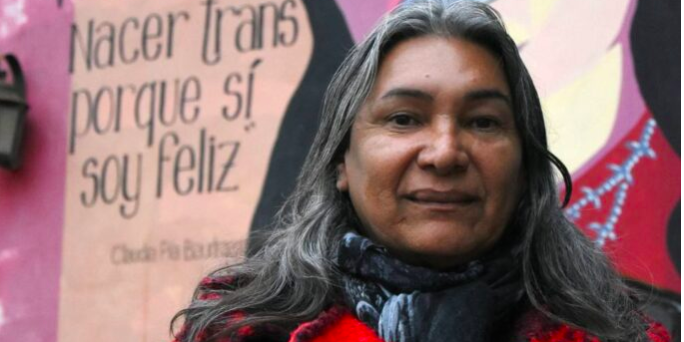
Luisa Paz's house is located in the Primera Junta neighborhood of Santiago del Estero, the capital city of the province of the same name. The area is a working-class neighborhood inhabited by lower-middle-class families. When you enter her address into Google Maps, it appears as "La Casa de la Diversidad" (The House of Diversity). It's the only two-story house on the street: the facade is painted in bright colors and features a mural of a woman and the phrase: "I would be born trans again because yes, I'm happy."
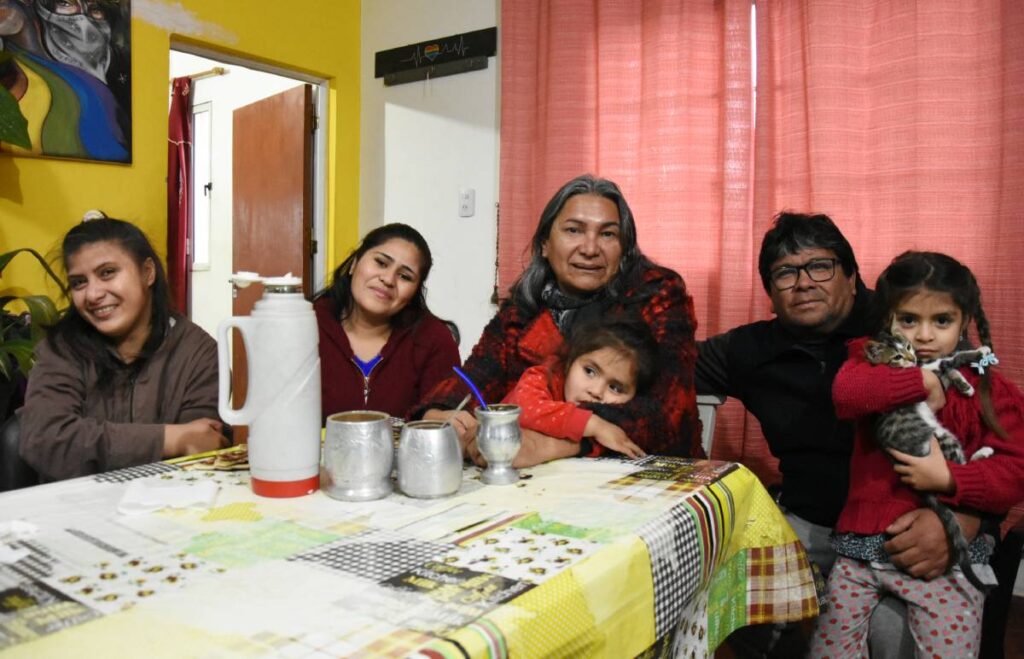
The ground floor has a large hall that houses the offices of the Association of Transvestites and Transgender People of Argentina ( ATTA ) and DIVAS , as well as a dining room. Activities and workshops are held there. A hallway leads to a spiral staircase that ascends to the first floor where Luisa and her family live. The reception area is a large patio filled with plants and dreamcatchers. Inside, after more than two hours of interviewing, a family photo will be taken: Luisa, her partner José, her daughters Gilda and Felisa, and her granddaughters Karen and Silvina. This is the home she built with activism and love.
“Activism gave me the opportunity to dream and to create”
In many ways, Santiago del Estero remains a conservative province—for example, the majority of its national legislators voted against Law 27610 on the voluntary termination of pregnancy . However, thanks to the struggles of the LGBTQ+ community, feminist groups, and government initiatives, in recent years this northern Argentine province has established an Inclusive Clinic at the Hospital Independencia , the Voluntary Interruption of Pregnancy (IVE) protocol is implemented in various public hospitals, and comprehensive sex education (ESI) and the National Plan for Early Childhood Interruption (ENIA) are implemented in most public schools and health centers. Recently, the Undersecretariat of Tourism released a promotional video aimed at LGBTQ+ tourists, featuring members of the local community visiting different tourist attractions in the province.
In 2012, Luisa became the first trans woman in Santiago, and one of the first eight in Argentina, to receive her official document reflecting her gender identity change from Cristina Fernández de Kirchner. In 2014, she was the first trans woman to marry in a church ceremony. Three years later, in 2017, her book, " The Gay Child in Primary School ," was published. In 2021, she was granted custody of her two daughters and two granddaughters, becoming a mother and grandmother. All of these actions garnered significant social and media attention, establishing her as a leading figure in the province's LGBTQ+ community.
But before becoming this icon, like many trans women in Argentina, Luisa suffered humiliation and violence at home, at school, and on the street. How did she overcome the statistic that indicates trans women have an average life expectancy of 35 years? But above all, what allowed her to survive that fate and also fulfill many individual and collective dreams?
She herself answers: “Activism gave me the opportunity to dream and to create . After dropping out of school, working cleaning a kiosk at the bus terminal, engaging in prostitution on the streets of Buenos Aires, opening a fruit and vegetable stand in Santiago, and helping out at a local bar, Luisa began her political activism in the early 2000s. And politics improved her quality of life.
She founded the provincial branch of the Association of Transvestites and Transgender People of Argentina, and the local association DIVAS. “Throughout my life,” she reflected, “I never had protection from the State: neither in school, nor from the police, and these spaces of activism became places where I felt protected. I felt that, if something happened to me, someone would do something for me.”
As she drives her car through the streets of Santiago del Estero, she recalls: “I became involved with Peronism when Néstor Kirchner convened the diverse organizations. I am grateful to life for having had the opportunity to be a contemporary of these struggles. In 100 years, they will be talking about us. We are part of Argentina's history. What more could we ask for?”
School violence
Luisa was born in 1963. Until she was 11, she lived with her parents in the same neighborhood where she lives today. “We lived in my paternal grandfather’s house, and my father’s side of the family didn’t like me because I was different. They made fun of me, they rejected me,” she recalled. “When my parents separated, I thought it was my fault.”
She didn't find refuge at school either: “Until third grade, I was on the honor roll, but on a field trip to Las Termas and Tucumán, a seventh-grade boy treated me like a girl, and the teacher scolded me for letting him call me feminine. As punishment, she made me stay inside the bus, so I missed most of the sightseeing. The teacher kept telling me, ‘You have to talk like a boy, walk like a boy.’ The following year, she stopped doing her homework, her grades dropped, and she had to repeat the grade: she would never be on the honor roll again.”
Things didn't improve in high school. At ENET N° 1, his classmates mocked him, put gum in his hair, and one classmate punched him in the back. “One day I told the teacher's aide that a classmate was bothering me. 'What does he say to you?' she asked, and I didn't know how to tell her that he called me 'faggot.' When he insisted, and I finally told him, he replied: 'Oh well, what do you expect them to call you? Look at the way you walk, the way you talk.' He heard what the teacher's aide had said to me, and that gave him the right to treat me even worse: 'Now, after school, I'm going to beat the crap out of you for being such a jerk.'”
As they left, the other students formed a circle, and the two of them were left in the middle. Her classmate hit her while no one intervened, while no one said a word. “He punched me, kicked me, spat on me until he got tired, and I stayed there crying for hours,” she recalled. “I was dirty, in pain, but I wanted to let it all out alone so I wouldn’t have to explain anything to my mom.”
That was the last time Luisa went to school.
To be free
In her youth, her happy moments happened when she went out with her friends, when she took care of the children of a lady who lived alone and could dress as a woman, and when she danced in the carnival troupes.
Since her mother sold Avon products, one day she took some items and put lipstick and eye makeup on herself. Her mother found her and took her to the back of the yard with a chain, telling her never to do it again or she would tie her to a tree.
“I couldn’t understand it. I had no answer as to why I liked being with women, why I liked dressing and wearing makeup like a woman. And I didn’t understand why the person I loved most in life didn’t accept me. Now I know that she, at that time, didn’t have the information we have today.”
In 1983, at the age of 20, she ran away to Buenos Aires to live her gender identity freely. However, over the course of 13 years, she was arrested and tortured more than 100 times for working on the streets. Democracy and a new era had returned for everyone, except for the trans community.
The following year, she wrote a letter to her mother telling her where she was, about her experiences, and asking if she could send her a photo so she could see who she was now. Her mother said yes, and before she could send the photo of her new appearance, her mother came to the village where she was living. They hugged, cried, and rekindled their relationship.
“Mothering in a diverse family”
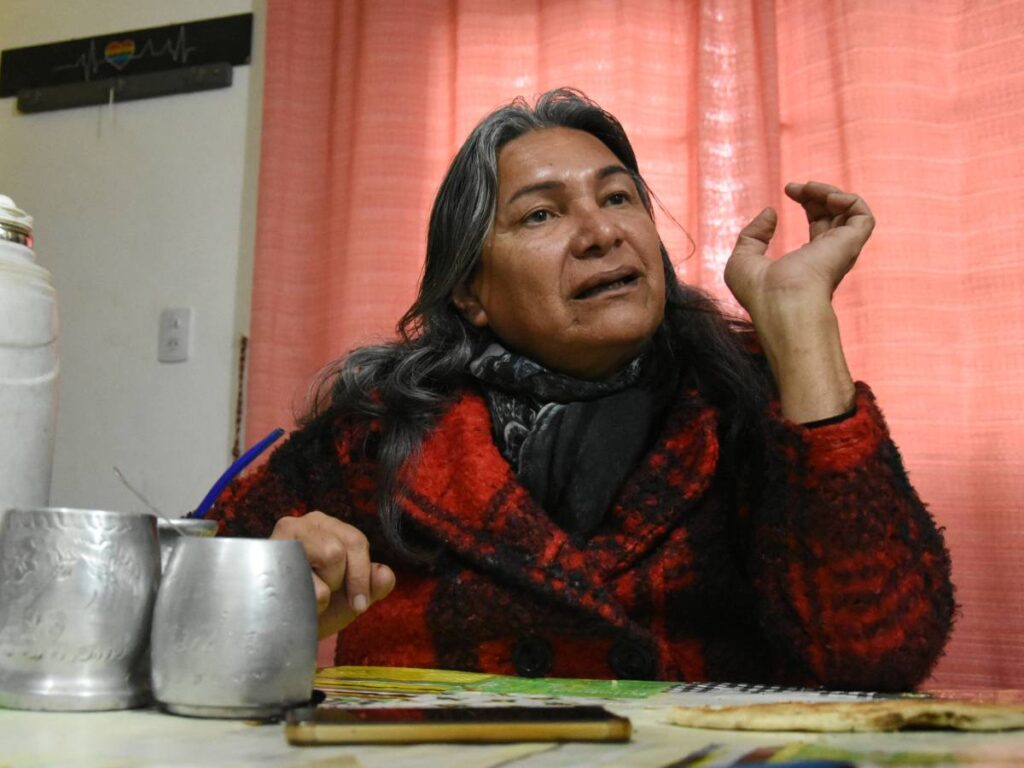
In the land of sun and warmth, the winter siesta is gray and cold. José, with whom Luisa has shared her life for 39 years, puts the kettle on and arranges the thermos and mate gourd on the table. Luisa cuts a piece of grilled tortilla. Sitting next to her is one of her daughters: Felisa, a young woman with a developmental delay.
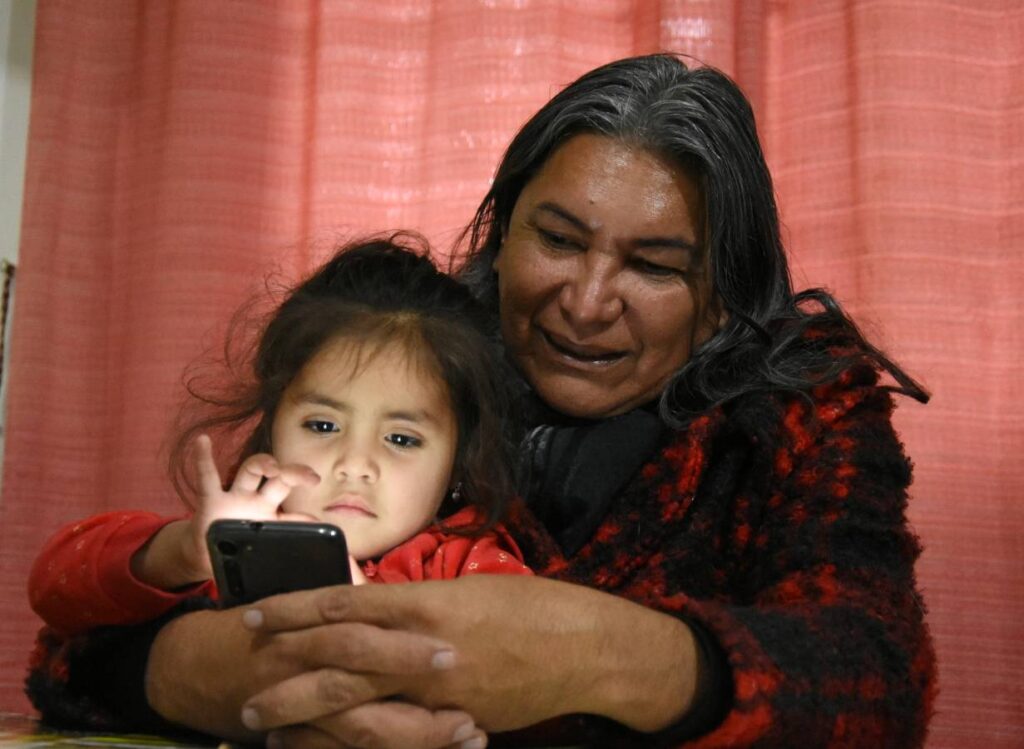
Gilda, her other daughter, and Karen and Silvina, her granddaughters, will soon join us at the table. One is playing on her cell phone, and the other with the cats—Machito and Franco—and the dogs—Pocho and Lolita.
As in other provinces, Santiago del Estero has a significant number of femicides, abuses, and domestic violence. Originally from the interior of the province, her daughters suffered these problems before being housed in the Shelter for Adolescent Girls in the provincial capital. Invited to give a workshop on diversity at that institution, Luisa met Gilda.
“José and I always had the idea of starting a family,” she says. “In 2019, I met with the director of the Adoption Registry, and she told me, ‘Go ahead and submit the paperwork; adoption is possible now.’ So we did the workshops, submitted the paperwork, and were approved. Since we’re older, we asked for someone between 6 and 12 years old because we wanted them to be somewhat independent.”
In that process, Luisa met Gilda and her daughters. “Their story was incredibly powerful and deeply moving. It was like remembering the times when I was vulnerable and I questioned myself. I told myself I can't be a coordinator, a delegate, and do nothing about this. All that talk, all that talk, but this is a reality that's hitting me like a ton of bricks, that's really getting to me.”
Since Gilda was 16 and would have to return to her hometown at 18, Luisa started the paperwork. “I didn’t want them to go back to their ranch in the middle of the woods and be exposed to danger. I wanted to break that cycle. With my friends, we formed a working group and visited the 11 girls at the home. That’s how we built a relationship, and they started authorizing me to take her from Thursday to Monday.”
A loving cohabitation
At the beginning of the pandemic, Luisa was informed that the home was going to close, so she was authorized to take Gilda, her daughters, and Felisa to her house. Although she initially wanted to adopt only one person, after living together for a while, Luisa decided to accept custody of all four.
“It wasn’t easy learning to live together in the middle of the pandemic, locked up 24 hours a day. We learned over time, day by day, how to deal with a person with a disability. But we’ve adapted very well now,” she noted.
Currently , Luisa works as the national delegate for INADI in Santiago del Estero. At night, she is completing her secondary education and pursuing a specialization in Cultural Studies. Gilda is finishing her primary education at night, Felisa attends a special education school, Karen is in first grade, and next year Silvina will start kindergarten.
“Thanks to her, my sister, my daughters, and I got out of where we were,” Gilda said. “She gave us a new life. We’re going to school, we’re doing well, and we have what we’ve always wanted. I love my mother, and I love Luisa because she gave me the life that no one else could.”
We are present
We are committed to journalism that delves into the territories and conducts thorough investigations, combined with new technologies and narrative formats. We want the protagonists, their stories, and their struggles to be present.
SUPPORT US

FOLLOW US
Related notes


We are present
This and other stories are not usually on the media agenda. Together we can bring them to light.