

Lesbophobia: They were kissing in the streets of Coyoacán and were attacked with a brick
This is the seventh known attack against lesbians in Mexico so far in 2022.


Share

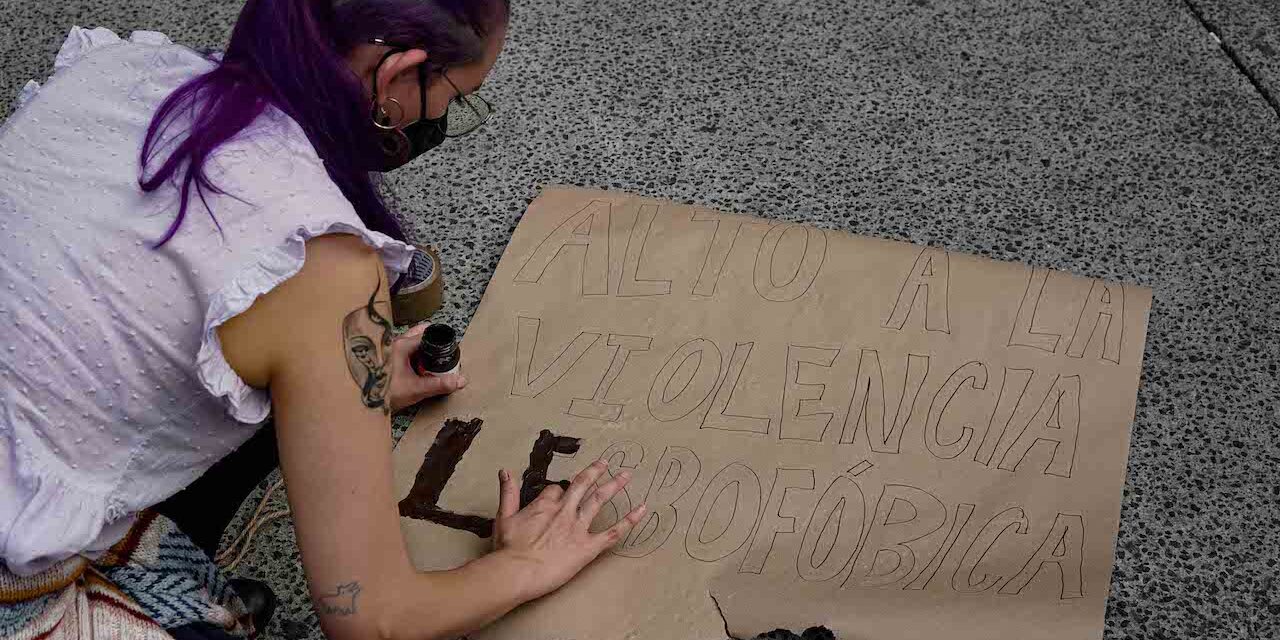
A man attacked and struck two lesbian women in the head with a brick as they kissed on a street in the Coyoacán borough, south of Mexico City. Activists, collectives, and associations that defend the human rights of lesbian, bisexual, and queer women protested yesterday to demand guarantees for their right to a life free from violence. This is the seventh known attack against queer people in Mexico so far in 2022.
There is no prevention
It happened in the early hours of July 2nd. But this homophobic attack only came to light after a security camera video was shared on social media. It had been shared in a neighborhood chat group. The video shows the violent assault, which began at 1:24 a.m. and lasted less than a minute.
“In Mexico, there are no social programs or public policies that make lesbians and bisexuals believe that violence against us exists and that we don't deserve it under any circumstances. On the contrary, the narrative we hear is 'it happened to me because I'm a lesbian.' This is a perfect storm for preventing violence!” explained Fabiola Baleón, director of Jóvenes por una Salud Integral (Youth for Comprehensive Health), an organization dedicated to promoting the sexual health of lesbian and bisexual women, in an interview with Presentes. She added, “Almost all institutions disclaim responsibility for why the direct victims didn't report the crimes. So there's no reparation for the harm done, no prevention, no measures to guarantee non-repetition within a human rights framework. This generates anger among lesbians, but also fear. Because that could have been me.”
Lesbian women's groups were the primary ones who publicized and expressed their outrage at the lesbophobic attack. So far, no institution providing services to LGBTI+ people or women in Mexico City has commented on the matter.
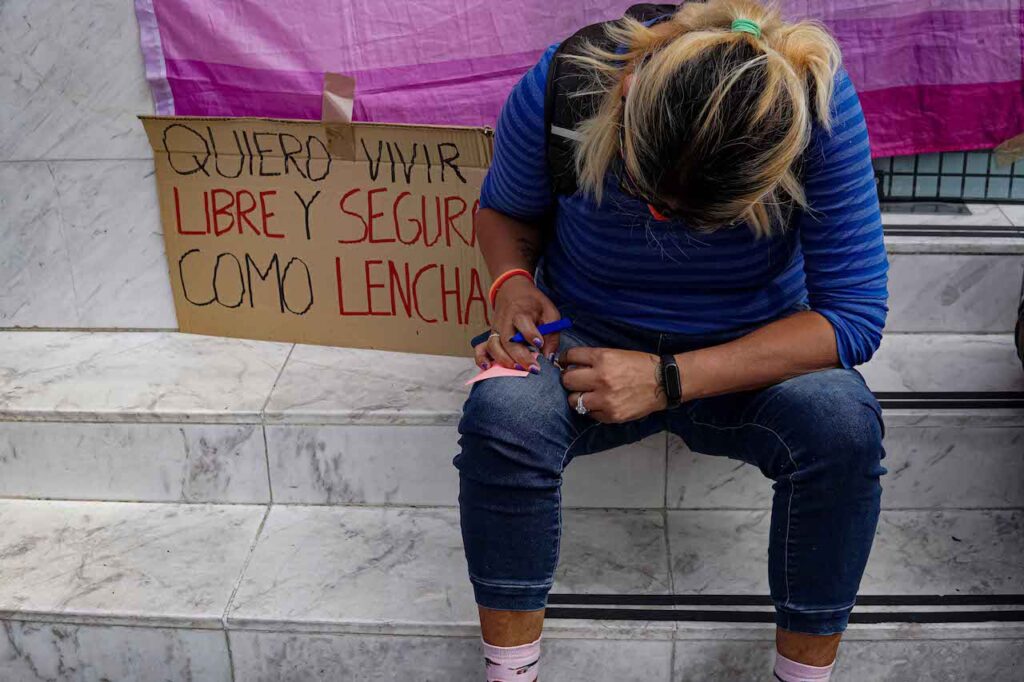
Following this, women's groups demonstrated outside the Secretariat of Women (SeMujeres) of Mexico City, an agency whose objective is to eradicate violence against all women.
The lesbian-hating attack
The surveillance video shows two women facing each other, hugging and kissing. Seconds later, a man hits both of them on the head with a brick. One of the women struggles with the assailant, who then hits her, takes a few steps back, turns around, stops, points at them, and leaves the scene.
The extent of the physical injuries the women sustained in the attack is still unknown, as is whether they reported the incident. The attacker's identity remains unknown.
“For those of us who unfortunately saw the video, it was a brutal shock. The guy seems completely unconcerned, with an air of ' because I want to and because I can .' It's brutal. If we look at it in a more nuanced way, it was an attempted femicide motivated by lesbophobia. With that blow, with a brick to the head, he could have killed them. It's serious that no institution has spoken out,” warns Fabiola Baleón.
Seven acts of lesbophobia in 2022
Of these seven documented attacks so far in 2022, the first occurred on January 11. Two young women were Mexico City's Chinatown
Five days later in Chihuahua, the double lesbofeminicide of Nohemi and Yulitza .
In February, police in Tabasco harassed a couple and forbade them from kissing.
On June 22, Arlen and his girlfriend were harassed and censored at Reforma 222 , a shopping plaza in Mexico City.
Fabiola Baleón described to Presentes two more attacks: one in which almost teenage couples were spat on in the street for kissing and another where a person was denied service at a gym just for being a lesbian.
From August 2020 to July 2022, the hotline for lesbians and bisexuals of the association Jóvenes por una Salud Integral (Youth for Comprehensive Health) collected at least 140 cases of violence against lesbians, ranging from psychological, economic and work violence, to attempts to repress their sexual orientation with false conversion therapies .
“We demand a guarantee of a life free from violence.”
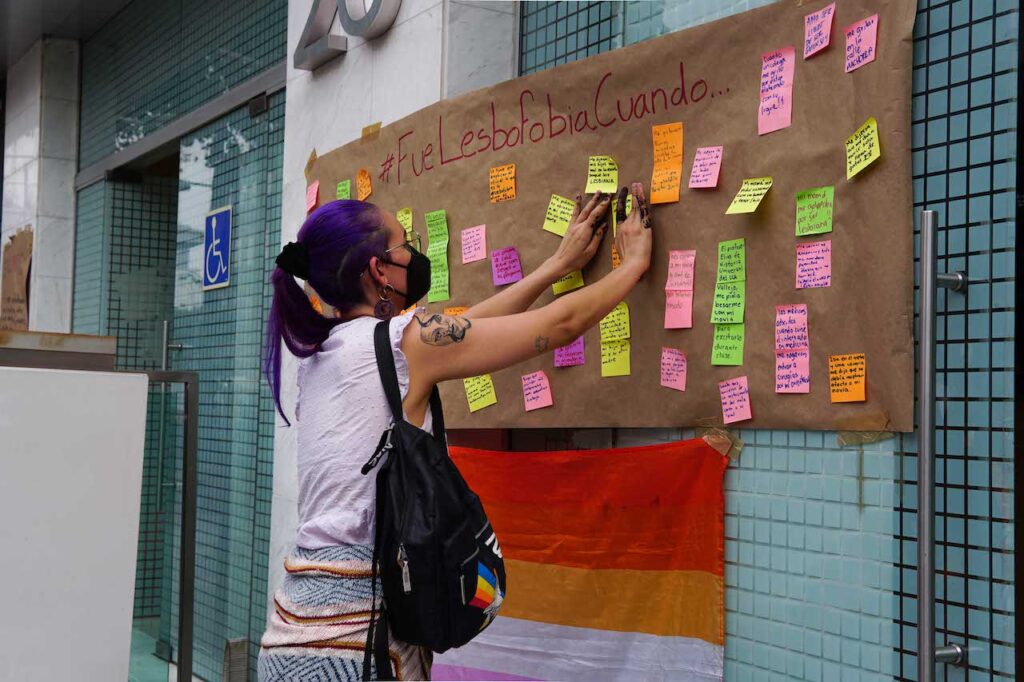
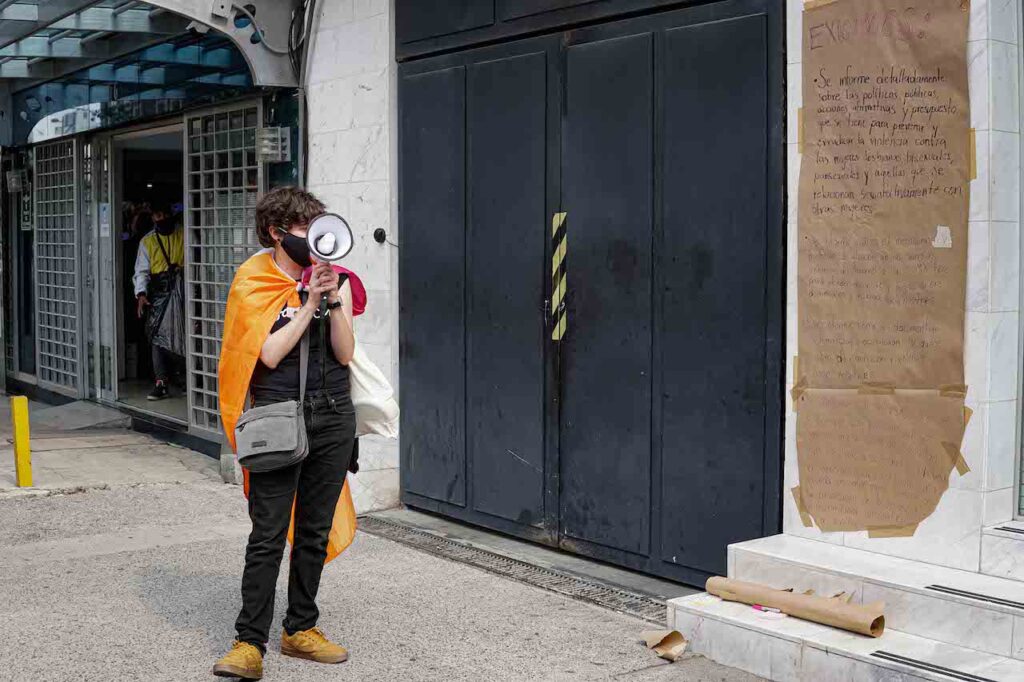
After the video was released, the collectives and associations Balance , Marcha Lencha , Queereme Mucho , Jóvenes por una Salud Integral , México Igualitario and the Red de Madres Lesbianas de México demonstrated on July 11 outside the facilities of the Secretariat of Women (SeMujeres).
“(Lesbian-hating violence) has been happening for ages, it’s just that now we have social media as allies, but it makes me feel so angry, lonely, hopeless (…) it hurts because you realize it’s a social issue. Right now we’re hearing slogans like: “It was lesbophobia when my mom hit me for being a lesbian,” a member of the Queereme Mucho who attended the demonstration outside SeMujeres told us.
“It was lesbophobia when my classmates were kicked out of school for holding hands,” she added. “But at the same time, these actions make me feel that we are not alone. And I think we are here because of that hope. Not putting our faith in what the authorities do, but putting our faith in our organization, in being together, and not leaving each of us in our own trenches with this pain.”
The protesters denounced instances of lesbophobia with the statement: “It was lesbophobia when…”. And they read a statement outlining their demands to the Ministry of Women:
- That detailed information be provided on public policies, affirmative actions and budget to prevent and eradicate violence against lesbians, bisexuals, dykes and other women who have erotic relationships with other women.
- That the mechanism and protocol for addressing complaints and grievances of discrimination and violence be made public; and that information be disseminated on how reports of discrimination and violence are documented, broken down, and systematized.
- That inter-institutional working groups be convened.
“There are no public policies that address the needs of the lenchities.”
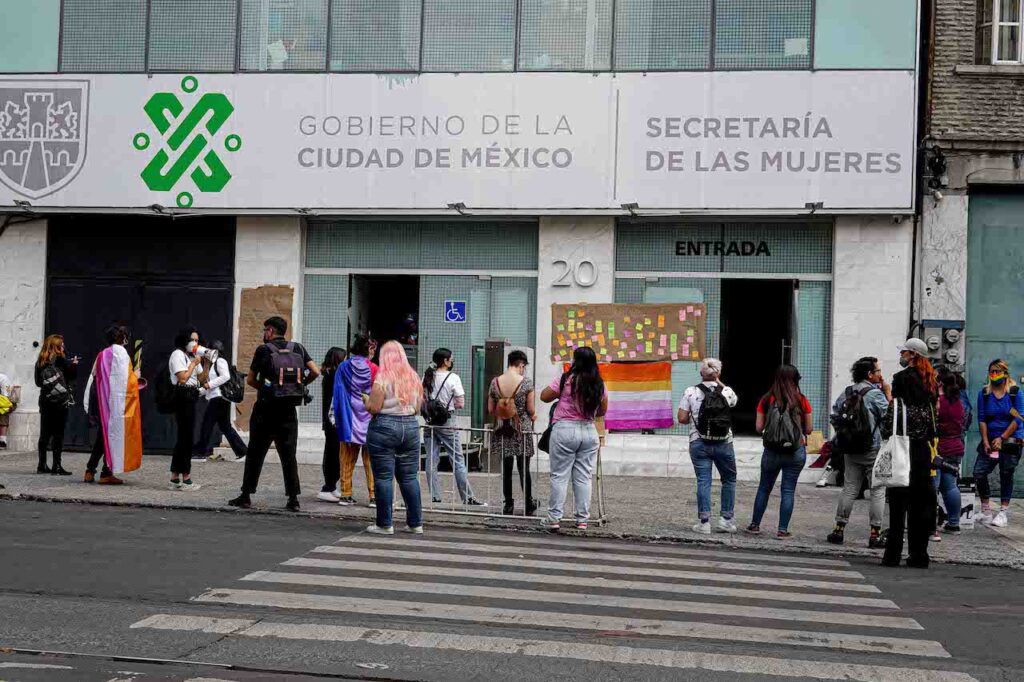
Of the eight programs and four services offered by the Mexico City Women's Secretariat, none explicitly mention lesbian, bisexual, trans, and intersex women. According to Fabiola Baleón, "there are no public policies that address lesbian identities and their needs."
“From the Women’s Secretariat—and they could deny this—we are unaware of any affirmative action programs for lesbian, bisexual, and other diverse women; their narrative continues to be directed at heterosexual women, lacking a vision that represents all women. Many friends, acquaintances, and I know that the Women’s Secretariat’s programs are not designed to address my needs regarding the violence I may experience. This contributes to the low number of reports filed. It is also a form of violence that these experiences are rendered invisible in public policy,” she emphasized.
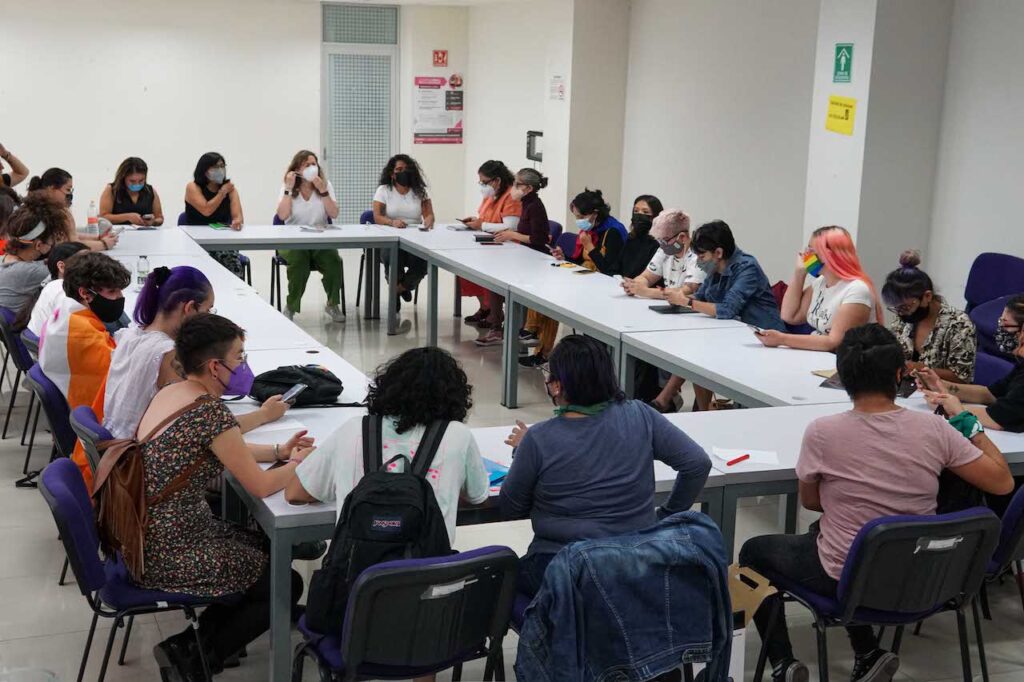
Paula Soto, head of the Executive Directorate for Substantive Equality, received the protesters at the Women's Secretariat (SeMujeres). There, they presented her with their list of demands. Other female public officials who work at that institution were also present.
During the meeting, Paula Soto commented, “The Women’s Secretariat is not the only agency obligated to respond to women. The issue of diversity is becoming more complicated because many offices have these departments (…) We need women to report abuse so we can move forward with the cases (…) We cannot change the structure of society; we, the few of us who are here, have tried to make a lot of progress, and they are legitimately within their rights to demand change. We want to address the shortcomings we have, and we are also obligated to learn.”
Women's issues, without programs focused on lesbians
At the meeting, they acknowledged that they do not have prevention programs or specific support for violence against lesbian and bisexual women.
They also commented as an achievement, in terms of the activists' demand for data, the implementation of the field "belongs to the LGBTTTIA+ population" in the single registration card (an information system on victims of violence) that they activate in each Women's Care Center, known as Lunas (spaces where women who experience any type of violence find advice and psychological and legal support).
However, they do not have systematic data on how many women they serve in these places identify as LBTI (lesbian, bisexual, trans and intersex).
Paula Soto offered the activists the opportunity to provide training at the 27 Lunas. “If you would like to help us reduce this invisibility you've described, I offer you the commitment to come and train the entire team, bringing all your knowledge. Thank you for making us aware that we haven't been giving you enough visibility,” she said.
At the meeting, the public officials reminded everyone that “there is a prosecutor’s office that is sensitive to and prepared to assist all of us,” referring to the Specialized Agency for Attention to LGBTI+ Persons of the Mexico City Prosecutor’s Office. They also mentioned the Council to Prevent and Eliminate Discrimination in Mexico City (Copred) and the General Directorate of Sexual Diversity and Human Rights of the Secretariat of Inclusion and Social Welfare (Sibiso) as spaces where LBT women can report any act of discrimination and violence.
What commitments did the Women's Secretariat make?
Following the meeting with activists, the public officials from the Women's Secretariat (SeMujeres) pledged to speak out against lesbophobia and to publicize the number of people who identify as LBT+ within the single registration system for those receiving services at the Women's Care Centers (Lunas). They also proposed providing rapid training to collectives and activists on how the sexual diversity services operate within the Mexico City government.
Where to report and receive support
First contact and support hotline for lesbian and bisexual women from Jóvenes por una Salud Integral (Youth for Comprehensive Health). Calls are free and confidential.
55 75180565.
We are present
We are committed to journalism that delves into the territories and conducts thorough investigations, combined with new technologies and narrative formats. We want the protagonists, their stories, and their struggles to be present.
SUPPORT US

FOLLOW US
Related notes


We are present
This and other stories are not usually on the media agenda. Together we can bring them to light.