

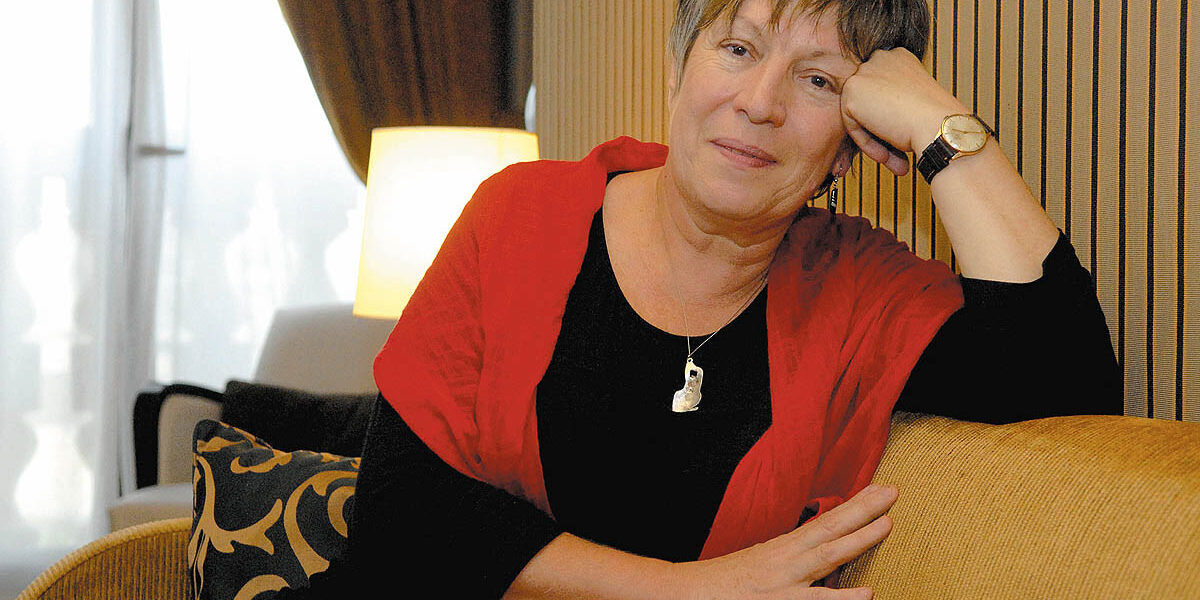
María Teresa Andruetto: "Inclusive language is the possibility of naming what was not being named."
Writer María Teresa Andruetto analyzed the Buenos Aires city government's decision to prohibit the use of inclusive language in schools. Intellectuals and artists also condemned the measure.


Share

The pedagogical and linguistic arguments issued by the head of the Ministry of Education of the City of Buenos Aires have been deconstructed and refuted by many linguists and language scholars in recent days.
“Language is a space that exists in constant tension between the old, the new, what appears, what one wants to name in another way. New ways of naming what has been gained, what has been lost, what is archaic, what is groundbreaking. Let's say language is all of that,” the writer Teresa Andruetto Presentes .
In 2019, Andruetto opened the International Congress of the Spanish Language with a presentation that addressed, among other topics, the use of inclusive language. That lecture was criticized by some academic circles but became one of the most interesting perspectives on the possibilities of language heard in recent times. That speech, along with an interview, has been published as a book and will be presented on June 18.
“Language use is unique. That’s why the prohibition is also absurd. Because we use language in a unique way. Language belongs to everyone and has the complexity of something that belongs to everyone, with its enormous diversity, variations, and so on. But the way we use it is always unique.”
A political issue
Denying identities, excluding, making invisible are some of the possible answers when thinking about why there is so much resistance to the use of a new language that in turn has so many speakers in the world.
“The use of inclusive language is a way to name something that wasn't being named, or something that was being named differently. Or something that wasn't visible, and in that sense it's important,” Andruetto explains.
“This reminded me of a time when radio announcers, for example, couldn't speak with the accents of their provinces. If you were an announcer on a provincial radio station, you had to speak with a neutral accent because it was somehow forbidden to have a regional accent. Fortunately, that's not the case today. And one might ask why one accent is better than another, or why one thing can be prohibited in favor of another. It's absurd because it's trying to impose a uniformity that is unrealistic, but which at the same time has a connection to the uniqueness of the language,” the writer states.
“I think it’s a very unintelligent approach. There’s probably a desire to win over voters on the right wing of society. To win them over with a certain conservatism. Because it’s not the E or the X that bothers people, what bothers them, what irritates them, is the ideological stance that underpins it.”
To know what is being named
“To promote reading and writing, we must teach the language properly; then each person will decide how they want to express themselves, but the Spanish language must be respected in school,” said the Minister of Education in defense of the ludicrous measure. However, there is no connection between that argument and the ability to understand texts.
“Acuña also speaks of the rules or regulations of the Royal Academy. I don't know which rule she's referring to. In reality, whoever uses inclusive language is deviating from that rule. That deviation is ideological, conscious, and also indicative of certain social struggles and achievements. Now, if those rules are unknown, the deviation cannot be made, so it's the opposite of what the minister says.”
In fact, manuals on the use of inclusive language were created, material available for trainers and students. “Inclusive language is already here. Perhaps it's more established in the middle class, but it's present there as a form within the forms of language. What it does is make visible those issues related to patriarchy and a conservative and purist conception.”
Naming the struggles and the advances
“It’s not the ‘todes’ itself that’s bothersome, it’s what fuels it,” María Teresa Andruetto reflects over the phone. “What sustains that ‘E’ or that ‘X’ is a struggle that takes place in the streets, on paper, in the pronouncements of women and gender-diverse people. That’s why I see this as a political measure. Many ways of naming coexist in language, and prohibition itself is petty and unwise.”
The political context is fundamental to understanding this prohibition. So too is the way the Buenos Aires city government has historically deflected attention from its own political shortcomings.
“I say it’s a very unwise decision because it also comes at a time when there is so much anger among teachers regarding the city government’s education policies. There has been a stripping of rights and poor working conditions and a lack of space for teachers,” he explains.
“The City of Buenos Aires, with its large middle class, highly educated and so on, has always been rather progressive in terms of individual rights. The only reason I can see for such a clumsy pronouncement would be the desire to gain more right-wing voters.”
The hatred propagated in the media and in the speeches of various politicians also provides a framework for this measure. “The ban is framed within hate speech, the rejection of women's activism, the rejection of the acquired rights of women and non-binary people, the rejection of street protests, and the rejection of hard-won rights.”
Teresa Andruetto's book, Ecos de la lengua, can be downloaded here.
The condemnation of writers and intellectuals
The academics who wrote the Inclusive Language Manuals for Early Childhood, Primary and Secondary Education, at the request of the Ministry of Education of the city of Buenos Aires, criticized the decision of the government of Horacio Rodríguez Larreta to prohibit the use of 'e', 'x' or '@' in Buenos Aires schools.
Diana Maffía, Patricia Gómez, Celeste Moretti, Romina Zonzini and María Paula García disseminated the document “Language is built collectively, it is not unilaterally prohibited”.
They explained that three years ago, the Ministry of Education invited them to “develop a set of materials on inclusive language for use by the entire educational community: students, teachers, and families.”
“These manuals required the work of specialists in education, communication, and specifically in inclusive language, not only in relation to sexual diversity. They were written independently of yesterday's resolution, of which we had no prior knowledge.”
They emphasized that the resolution's rationale “represents a step backward in terms of the scope of the manuals. And the prohibitionist statements indicate a political stance and decision that runs counter to the spirit of the work we have done. This is not a fad, but rather one of the ways to demand equality.”
A letter against the ban
A group of writers and artists signed a lengthy letter criticizing the city government's ban. You can read it in full here:
“That the political and educational authorities of Buenos Aires City are prohibiting teachers from using inclusive language in classrooms fills us with perplexity. In a community with deficiencies and shortcomings of all kinds, for an educational policy to prohibit free expression is, at the very least, deeply concerning.
Inclusive language is a product of the struggles and achievements of women and the LGBTQ+ community. Banning it in classrooms is an invitation for schools to ignore or denigrate the rights they have won and those they represent.
Comprehensive Sexuality Education (CSE), the Gender Identity Law, and the quota for transvestite, transsexual, and transgender people are not matters to be debated by public officials on social media, and in no way can what the State guarantees through national laws be contradicted.
Bringing up these fundamental issues on social media or in the press seems to be driven by a proselytizing interest, aimed at demagogically satisfying anti-rights groups and the most reactionary sectors of society.
That language includes us and names us all, in classrooms, in all official departments, is the way we win in and as a community.
The richness of our language allows us to express ourselves in many ways. Inclusive language is one of them. No one is obligated to use it if they don't feel represented. For municipal authorities to prohibit it is absolutely unacceptable.
Signatures :
Claudia Piñeiro, Marcelo Piñeyro, Sergio Olguín, Selva Almada, Mercedes Morán, Mariana Enríquez, Nora Domínguez, Roque Larraquy, Gabriela Cabezón Cámara, Julia Magistratti, Fabiana Rousseaux, Victoria Larrosa, Eugenia Almeida, Albertina Carri, Gabriel Giorgi, Luis Sagasti, Cecilia Roth, Dolores Reyes, Gloria Peirano, Jorge Consiglio, Franco Torchia, Luciana Peker, Agustina Bazterrica, Mercedes Araujo, Soledad Vallejos, Noelia Rivero, Ezequiel Pérez, Guillermo Martínez, Adriana Kogan, Sebastián Martínez Daniell, Alejandra Zina, Marina Bellati, Gabriela Larralde, Cristian De Nápoli, Walter Lezcano, Gabriela Luzzy, Ricardo Romero, Adriana Fernández, Valentina Vidal, Enrique Viale, Mercedes Calzado, Natalia Crespo, Marcelo Figueras, Claudia Aboaf, Julieta Obedman, Débora Mundani, Laura Cukierman, Enzo Maqueira, María Inés Krimer, Cecilia Szperling, Juan Carrá, Julián López, Silvina Gruppo, Gabriela Saidon, Clara Anich, Graciela Repun, María Laura Hoyo, Julián Giordano, Sebastián Izquierdo, Marcelo Bello, Marcela Fumale, Walter Abaca, Laura Dolagaray, Cristina Aisemberg, Atilio Perín, María Raquel Resta.
We are present
We are committed to journalism that delves into the territories and conducts thorough investigations, combined with new technologies and narrative formats. We want the protagonists, their stories, and their struggles to be present.
SUPPORT US

FOLLOW US
Related notes
We are present
This and other stories are not usually on the media agenda. Together we can bring them to light.