

The trial for the Napalpí indigenous massacre began: a 114-year-old survivor testified
The investigation seeks to clarify the murder of 423 people - the vast majority of them indigenous - at the hands of a group of police officers and civilians in July 1924.

Share

The trial for the Napalpí massacre began today to "seek the truth of what happened," Judge Zunilda Niremperger stated at the start of the hearing. The event being investigated is the murder of 423 people—the vast majority of them Indigenous—at the hands of a group of police officers and civilians in July 1924. During the proceedings, the prosecution and the plaintiffs presented their opening statements, and recorded testimonies were played from historian Juan Chico and two survivors, including 114-year-old Rosa Grilo, the only one still alive.
“The trial for truth has this connotation: to seek the truth of what happened. What we will try to achieve through the various testimonies and the different pieces of evidence that the plaintiffs and the Attorney General's Office have worked on is to arrive at an approximation of the events as they would have happened back in 1924,” explained Judge Zunilda Niremperger, in charge of Federal Court No. 1 of Resistencia, in the province of Chaco, at the opening.
He also clarified that "the trial for truth does not seek criminal accountability." "We are not looking for those directly responsible; you will not find any defendants here," he explained.
The truth is sought “to vindicate the memory of the people, to soothe wounds, to provide reparations as a form of positive action,” the judge stated, and continued: “But it also has the purpose of activating memory and generating collective awareness that serious human rights violations must never be repeated. Especially in these cases where the violations were allegedly perpetrated by the State or generated by the State, against a highly vulnerable group.”
In the courtroom where the hearing took place, the flags of Argentina, the province of Chaco, and the Wiphala were displayed. Present were prosecutor Federico Carniel and Diego Vigay, representing the prosecution. Representing the plaintiffs from the Secretariat of Human Rights and Gender of the province of Chaco were Secretary María Silvana Pérez and Undersecretary Nayla Bosch, with legal counsel provided by Dr. Duilio Ramírez. Finally, representing the plaintiffs from the Chaco Indigenous Institute was President Miguel “Iya” Gómez, with legal counsel provided by Emiliano Núñez.
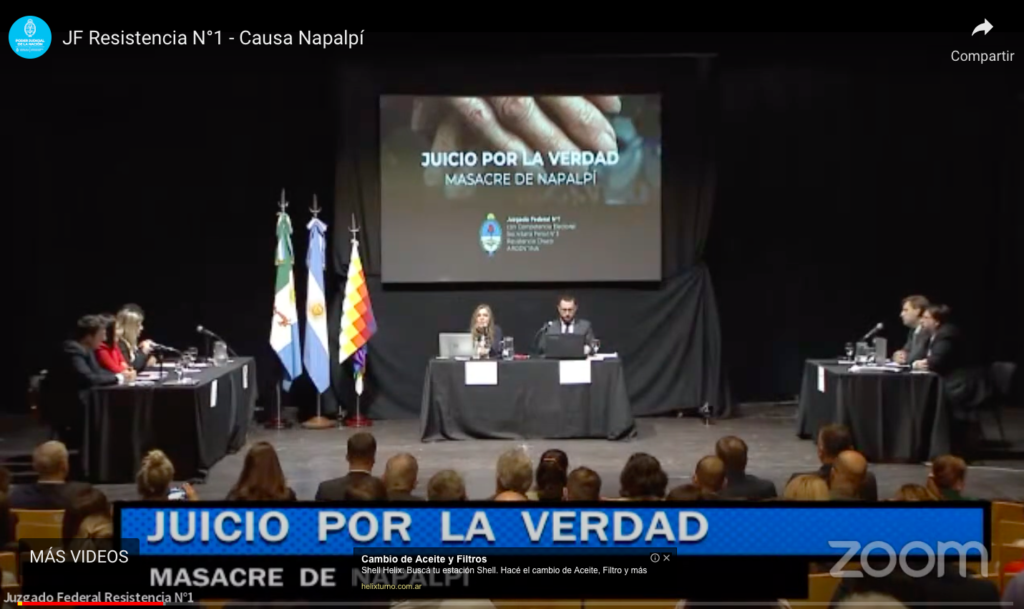
The hearings are public and will be broadcast via the YouTube channel of the National Judiciary .
The massacre
The Napalpí massacre occurred on July 19, 1924. On that day, a group of 130 police officers, along with civilians, murdered approximately 423 people, 90 percent of whom belonged to the Qom and Moqoit indigenous nations. This is according to documents and testimonies gathered in the preliminary investigation conducted by the Human Rights Prosecutor's Office of Resistencia, which is handling the case.
The attack was carried out on the orders of Fernando Centeno, then governor of the Chaco National Territory, who was acting under the government of President Marcelo Torcuato de Alvear of the Radical Civic Union. His aim was to silence the demands of Indigenous people and Creoles who were calling for fair compensation for the cotton harvest, or for the opportunity to work from the Chaco territory to the sugar mills of Salta and Jujuy, where better pay was offered.
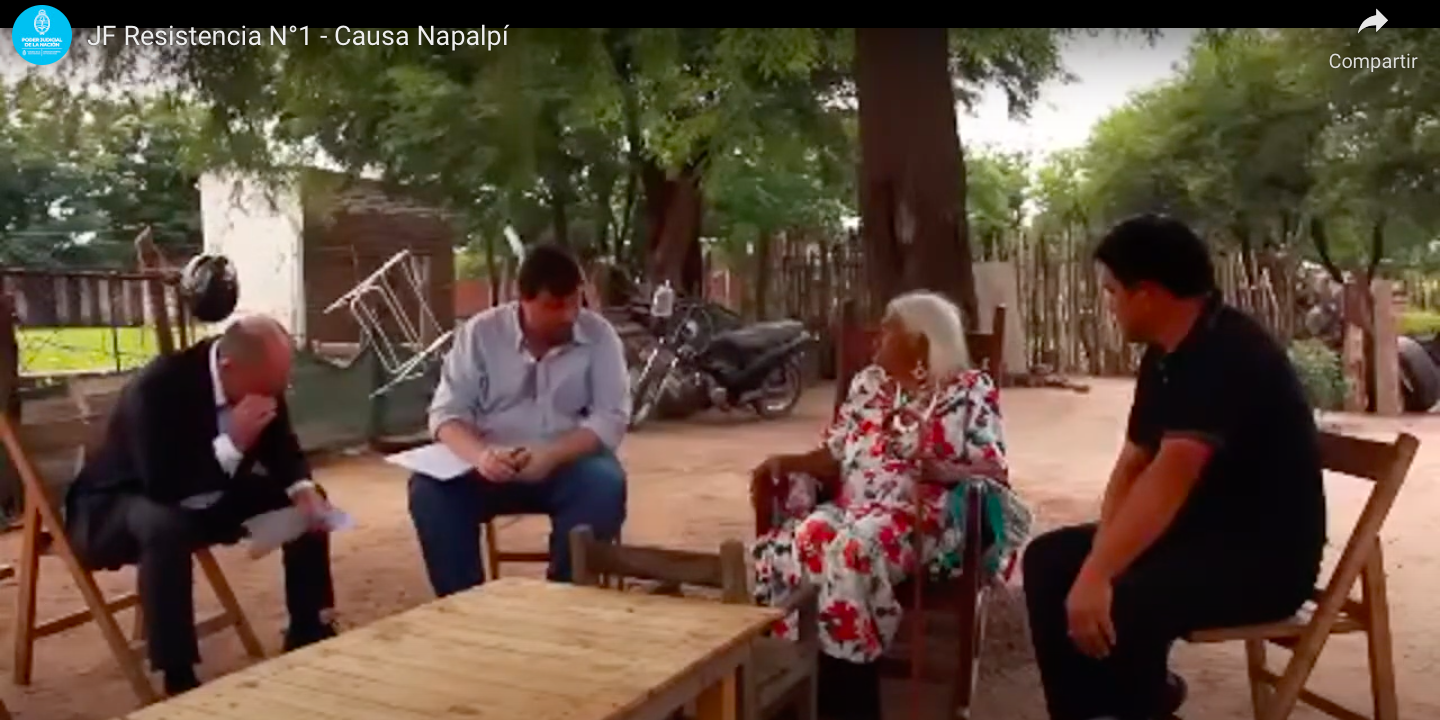
“It’s very sad for me because they killed my father, and I hardly want to remember it because it breaks my heart. A plane was dropping bags from above, and they would fall to the ground and be killed there. My grandfather and my mother were shouting, ‘Shoot! Shoot!’ I don’t know why they killed so many children and adults; there was so much suffering,” said Rosa Grilo, the only surviving Qom woman, 114 years old. She said this in an interview conducted by the Human Rights Unit of the Federal Prosecutor’s Office in Resistencia , which was played today as part of the evidence.
Pedro Balquinta, a survivor of the Napalpí and El Zapallar massacre and a member of the Moqoit people, now deceased, also gave a recorded testimony. “In the Napalpí settlement, they killed many. They buried them in a large pit, a single pit,” said the man, who remembers being between 10 and 12 years old at the time of the massacre.
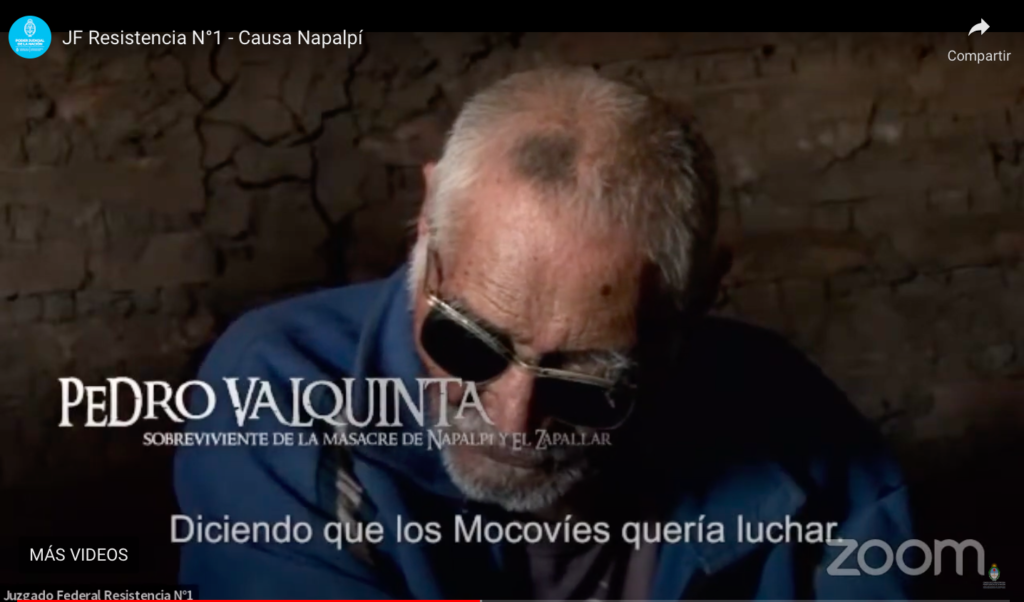
“There were many newly rich people, they were exploiting the forest. The Mocoví people arrived and started working, and that's when they were shot and killed,” he said in his native language, which was translated by his grandson's partner, Silvia Capanci.
It was not an isolated incident.
The plaintiffs, representing the Secretariat of Human Rights and Gender of the province of Chaco, asserted that “the Napalpí massacre was not an isolated incident.” They added during their opening statement that it was “one of the most visible and extreme episodes of violence suffered by the Indigenous peoples of our country. The war against Indigenous people, waged to seize their territory and cheap labor under conditions of semi-slavery, which reached its most shameful point in the Conquest of the Desert, also had a chapter of terror here in Chaco through the Napalpí massacre.”
The prosecution team in charge of the trial consists of Attorneys General Federico Carniel and Carlos Amad, Federal Prosecutor Patricio Sabadini, and ad hoc Prosecutor Diego Vigay. They are prosecuting the case "for the commission of the crime of aggravated homicide with cruelty, repeated acts, premeditated involvement of two or more people (Article 80, sections 2 and 6 of the Penal Code), and in real concurrence (Article 55 of the Penal Code)." Furthermore, these acts are classified as crimes against humanity, stated Prosecutor Carniel in his opening statement.
Who were the direct perpetrators of the genocide?
“In this debate, we, from this Public Prosecutor's Office, will demonstrate concretely who participated and who were directly and indirectly responsible for this genocide. We will also demonstrate that the proposed methodology is the most appropriate, given that those potentially responsible who emerge from the debate were deceased at the time the investigation began,” Carniel stated.
Since 2014, a search for records and testimonies has been underway, which constituted the preliminary investigation that now serves as evidence of the massacre and will be presented throughout the trial.
“The Colonia Aborigen community, together with the Napalpí Foundation, had been doing extensive work to reconstruct historical memory. We relied on that. There were multiple investigations into the massacre, and we incorporated several books, historical and scientific research by anthropologists, sociologists, and historians into our investigation,” prosecutor Diego Vigay explained to Presentes .
According to historian Juan Chico, who died in June 2021 from Covid-19, regarding human rights issues, “there is little information, or the archival data that exists is generally presented from a highly subjective perspective. But it certainly helps our work.” He acknowledged this in the recorded testimony that was broadcast during Tuesday’s hearing.
“In recent years, we realized that oral history gradually gained ground, seeking permission to be heard. The truth is that in the case of Napalpí, it played and continues to play a key role,” she explained. She also detailed that in their investigation of the massacre, they worked with both archival documentation and the stories of the elderly. “We say they are our living libraries,” she stated.
We are present
We are committed to journalism that delves into the territories and conducts thorough investigations, combined with new technologies and narrative formats. We want the protagonists, their stories, and their struggles to be present.
SUPPORT US

FOLLOW US
Related notes



We are present
This and other stories are not usually on the media agenda. Together we can bring them to light.