

2022 Census: The question on gender identity, a step forward targeted by TERFs
The question about gender identity, which will be included in the Argentine census for the first time, is a step towards addressing a long-standing issue. Trans-exclusionary groups are seeking to halt this progress.


Share

The inclusion of a gender identity question in this year's census in Argentina , is a victory for the country's LGBTTTNB+ communities. It also fulfills a long-standing commitment to the organizations that have worked tirelessly for years to register their communities. However, groups that identify as feminist are seeking to obstruct this progress in rights.
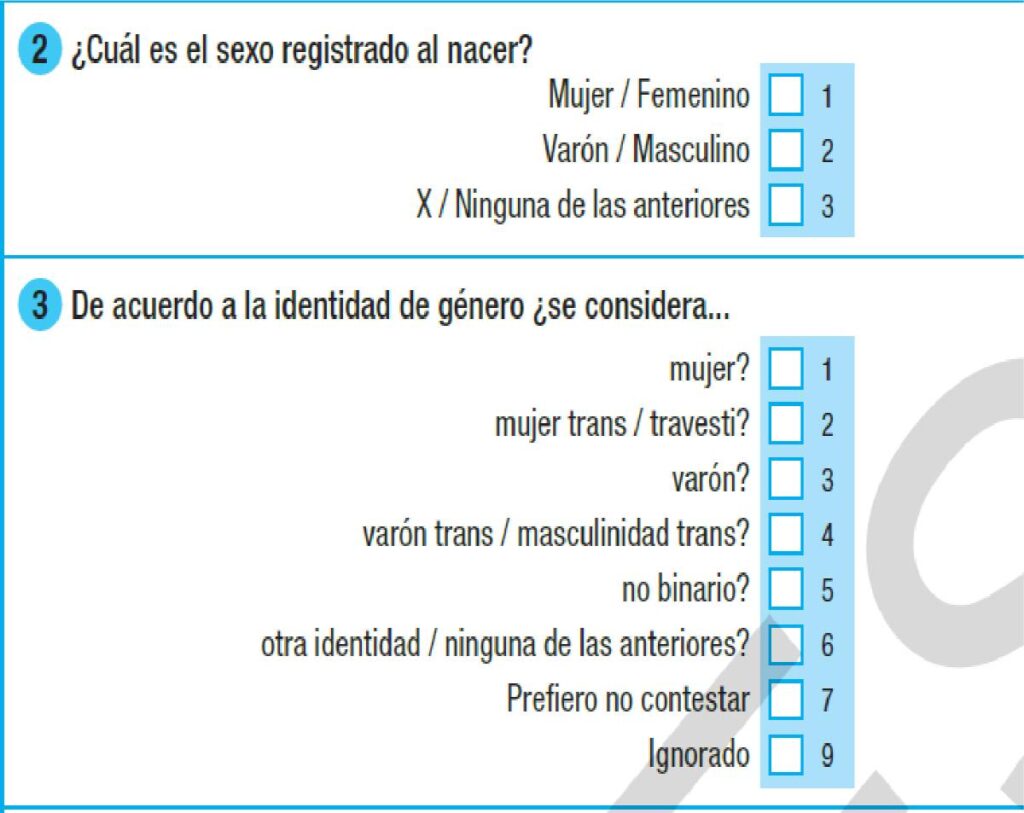
In terms of gender, the major advance in this 11th census of Argentina is the incorporation of question 3 in the "Population" section on gender identity.
Before getting to this question, the questionnaire asks about the “sex assigned at birth” and offers three answer options: female/feminine; male/masculine; and/none of the above.
Next comes the question: how do you identify with your gender identity? The answer has eight options: woman; trans woman/transvestite; man; trans man/trans masculinity; non-binary; other identity/none of the above; prefer not to answer; ignored.
Both questions are intended for the entire population counted in the census.
"I think it's a great step forward. It's something that aligns with the laws and regulations we have in Argentina. It's a consequence of all the previous legislation," SaSa Testa, a non-binary activist and Master in Gender Studies and Policies, Presentes
How does one arrive at the question of gender identity?
The 2010 census included a dichotomous question asking respondents whether they were male or female. This was an important step forward: it clearly stated that regardless of the census takers' opinions, each person's answer should be respected. Sources close to the census process told Presentes was the case. Prior to 2010, census takers would mark the option they "believed" to be correct based on observation.
This question was applied in 2010 to the entire population and yielded results of more than nineteen and a half million men (19,523,766) and more than twenty and a half million women (20,593,330), according to data from INDEC.
This year's census, which was delayed two years due to the pandemic, could not ignore history: the Equal Marriage Act (2010) and the Gender Identity Act (2012).
Many demographic studies, which form the basis of samples and post-census surveys, rely on the binary sex variable. Therefore, how to incorporate the question of gender identity was a point of contention within the census process . It was decided to continue with the question of "sex" while adding "assigned at birth," which allows for comparability with the results of previous censuses. The question of gender identity was then added.
“We need to know”
Alejandra Silvestre is a 32-year-old trans woman from Gualeguay, Entre Ríos, and president of Mujeres Trans Argentina (Trans Women Argentina ). She is also a professor of Political Science and a member of the advisory board of the Comprehensive Sex Education (ESI) Law Observatory of the National Ministry of Education. She considers this question "necessary" to understand the situation of the trans community and to develop public policies that guarantee their rights.
"First, it's important to define the objectives of a population census. It's not just about knowing how many people there are in a given territory, but much more : understanding the socioeconomic level of the population, their access to public services, their educational level, and so on. This data will give the government a perspective for the public policies that need to be implemented ," he stated.
Based on that premise, she said: "We believe it is extremely important to ask about a person's gender identity. We need to know how many transvestite and trans people there are in the country, where they are distributed, how many have migrated from the provinces, what their nationalities are, and how they live ."
She also emphasized: " It was the organizations that had to be tracking and counting where the transvestites were, place by place," all this time.

Legal challenge to this question
Despite this progress in rights, a group of women who consider themselves part of the feminist movement filed an injunction, which is being processed in the Federal Administrative Court No. 12, under Judge Macarena Marra Giménez, seeking to modify it, in the City of Buenos Aires.
The legal filing seeks to remove the categories "woman" and "man" from the gender identity question because they consider them sex categories. Therefore, they demand that "the option 'trans woman' be replaced by 'trans femininities'" and "the option 'trans man' be eliminated (leaving only the existing option 'trans masculinities')."
In the precautionary measure, the women present themselves "as women (females of the human species, human beings, and adult females)." And they consider themselves "entitled to claim effective protection to prevent the dissolution of the category of woman, which is being silently consummated through the enactment of norms that appear to be secondary but which, all together and simultaneously, lead to that result: the legal annulment of the category of woman."
Among the signatories are public officials and researchers from renowned institutions. They are María José Binetti, PhD in Philosophy from the University of Navarra, Spain, and a CONICET researcher based at the Interdisciplinary Institute for Gender Studies of the Faculty of Philosophy and Letters at the University of Buenos Aires, and Graciela Tejero Coni, historian, director of the Women's Museum, and member of the honorary Advisory Council of the Ministry of Women, Gender and Diversity.
Also Valentina Cruz, professor of philosophy and graduate in Psychology; Marisa Andrea Piumatti, director of the Institute of Legislative Studies of the Bar Association of La Plata and member of the group “Women in Law”; and Julieta Luisa Bandirali, president of the Women's Commission of the Association of Lawyers of Buenos Aires.
“These are people deeply involved in gender issues, and some of them even hold positions in the public sector. And from that position, they are questioning public policy because the census is an action that allows us to plan for future public policies. What kind of public policies can be developed when a sector of society is not included? Anything produced would be biased,” Testa argued.
For the president of Mujeres Trans Argentina, moreover, we cannot "return to biological debates that if you have a penis you are a man and if you have a vagina you are a woman ." "Those debates have already taken place in the most democratic body we have, which is the National Congress. We have a Gender Identity Law whose Article 2 states that gender identity will be determined by how a person self-perceives," she asserted.
Condemnation and call to gather signatures
Pride and Struggle Front also opposed this legal action . This Front, which brings together sexual diversity organizations from all over the country, launched a campaign warning: “2022 Census: The right to gender identity is a freedom for everyone and is under attack.”
The group considered the 2022 census to be "a fundamental step to end the cis-hetero-sexist binary in statistical records that have historically made invisible the existence of other gender identities and expressions that do not fit into the male/female binary ."
“We express our support for the gender identity question in the 2022 Census, and we repudiate as reactionary and unfounded the legal action against it being processed in the Federal Administrative Court No. 12. We have won the right to gender identity, registered and respected by the State and all institutions, and we will not take a single step back,” says the text where they invite people to add their signatures .
If the Judiciary grants the precautionary measure, "the rights of the entire population would be affected and it would constitute a direct attack on trans people almost ten years after the Gender Identity Law (26.743)," they pointed out.
They also questioned the arguments put forward by the women's group. "Under the guise of defending the category of 'woman' as biological and chromosomal, an act of profound transphobia is committed. It is absurd and an absolute fallacy to maintain that the recognition of the gender identities of all people, including trans people, erases the identity of 'woman' or that it conflicts with an instrument that is entirely consistent with this right, such as the Convention on the Elimination of All Forms of Discrimination against Women (CEDAW)."
The question: regarding access to rights
From Mujeres Trans Argentina (Trans Women Argentina), they believe that the binary, heteronormative, patriarchal legacy developed with great “naturalness,” adopting sex as a marker of identity, as a category of citizenship, where rights, services, and policies developed for the population based on these males and females are inscribed. They exemplify this by saying: “The impact and harm on the LGBTTTNB+ community is enormous. For example, in the context of the HIV pandemic, health policies regarding prevention, management, and development of the pandemic did not take into account the trans population, and the lack of data and specific resources meant that local and global organizations were the first to raise the alarm that this invisibility implies the direct death of one of the sectors most impoverished by a cisbinary, heterosexist system that only thinks in terms of men and women.”
The same trans women's organization explains that, as the demands of the LGBTTTNB+ community and the implications of the lack of public policies became more visible, efforts are underway to expand the registration of individuals in order to inform the design, prevention, and implementation of public policies. "In other words, the 2022 Census question about sex was problematized in terms of access to rights, specifically regarding the exercise of citizenship rights. The population census aims to do just that: to register the populations in our country. The problem with the TERF group in Argentina is that it seeks to restrict rights, not expand them. Their interest is not in preserving the category of women, but rather in preventing the broadening of the concept of women in relation to access to public policies ."
The pending census items
While the inclusion of the question of gender identity is a huge step forward, there are still pending issues and criticisms.
For Testa, for example, "even though we have the possibility of talking about our identities, the category of sex assigned at birth remains a binary category ."
"For me, the sex assigned at birth is a performative act based on the observation of a person's external genitalia. But it suddenly says nothing about their chromosomal makeup. That question bothers me," Testa said.
Furthermore, he considered that "if there is a word for male and female, it is strange that there is not one for 'x', such as 'intersex'. There again is an erasure."
The field "trans woman/transvestite" also raised concerns within the community, given that many people who identify as transvestites do not consider themselves trans women.
However, one thing is clear to the Pride and Struggle Front: "The 2022 Census is the first to survey gender identity nationwide, marking a milestone in dismantling patriarchal mechanisms that violate our bodies and identities."
We are present
We are committed to journalism that delves into the territories and conducts thorough investigations, combined with new technologies and narrative formats. We want the protagonists, their stories, and their struggles to be present.
SUPPORT US

FOLLOW US
Related notes


We are present
This and other stories are not usually on the media agenda. Together we can bring them to light.