

How diversity is reflected in the 2022 Census of Argentina
With the slogan “Recognizing ourselves”, the Census, suspended in 2020, begins. What progress has been made since the last census?


Share

BUENOS AIRES, Argentina. At the beginning of this year, the femicide of a Wichi girl in the indigenous community of Misión Kilómetro 2 (Salta)briefly shook the media agenda. Her community denounced the state's abandonment of them and the ongoing difficulties in accessing justice.
Months earlier, another Wichi girl, from the Pacará community, had died in the hospital at the age of 13.She was pregnant. One of the major demands of her community is the neglect of the healthcare system, a situation exacerbated by the difficulties posed by language barriers and travel on dirt roads during the rainy season.
Situations like these are frequent and raise concerns about the access to rights of Indigenous peoples in Argentina. However, how much do we really know about the Indigenous population in our country? Where do they live? How do they live? What languages do they speak?
In early February, the National Institute of Statistics and Censuses (INDEC) published the final questionnaire for the 2022 Census. Indigenous organizations and organizations representing people with disabilities challenged it and filed an injunction to halt the printing of the forms. What obstacles do they see, and what proposals have they developed?
Why talk about diversity?
“The foundation of any public policy design is based on numbers, not intentions or perceptions. The most important thing is that Argentina needs to look at itself and recognize that its Argentinian identity is composed of an interweaving of Indigenous Peoples destined to disappear in the country's design. The first step is to lower the level of racism in society. We need the data to show that Argentinians didn't arrive on ships. Argentinian citizenship is multiethnic,” explains Verónica Azpiroz Cleñan, a Mapuche member of the Indigenous Professionals Network.
“The census is an objective within an analysis of what public policies should be implemented to recover or restore the rights of a group that has been the victim of genocide. A genocide that has been denied. But we also understand it from a spiritual perspective as an exercise in collective healing. It is no coincidence that women are the majority in the Tejido. Because reparation is healing, and when it is collective, it is effective,” adds Lourdes Albornoz, a Diaguita woman and also a member of the Tejido.
“No official likes the idea that Indigenous Peoples, given their numbers, continue to demand the return of their lands, the regularization of possession, and continue to highlight that there is an unresolved problem in Argentina related to property ownership,” Verónica adds.
How did the last census go? What's new?
The last census was conducted in 2010, and the next one was scheduled for 2020, but it was suspended due to the health emergency through Presidential Decree 726/2020, dated September 9 of that year. The decree stated that INDEC (National Institute of Statistics and Censuses) would have up to 60 days after the “end of the public health emergency” to determine the date of the census operation for the 2020 round.
Finally, that date arrived, bringing with it some new developments. First, one related to the method of the operation. For the first time, the census can be conducted in two ways: in advance through an online questionnaire (Digital Census) or through in-person interviews at the home on Census Day.
The online census will be available starting March 16th. The in-person census will take place on Wednesday, May 18th, a date already designated as a national holiday.
Another new feature relates to questions linked to gender identity and ethnic self-identification.
Much more than woman or man
Regarding gender, the precedent in 2010 was the basic question between the options of male or female. It was applied to the entire population and yielded results of more than nineteen and a half million males (19,523,766) and more than twenty and a half million females (20,593,330), as published by INDEC in the 2010 Census.
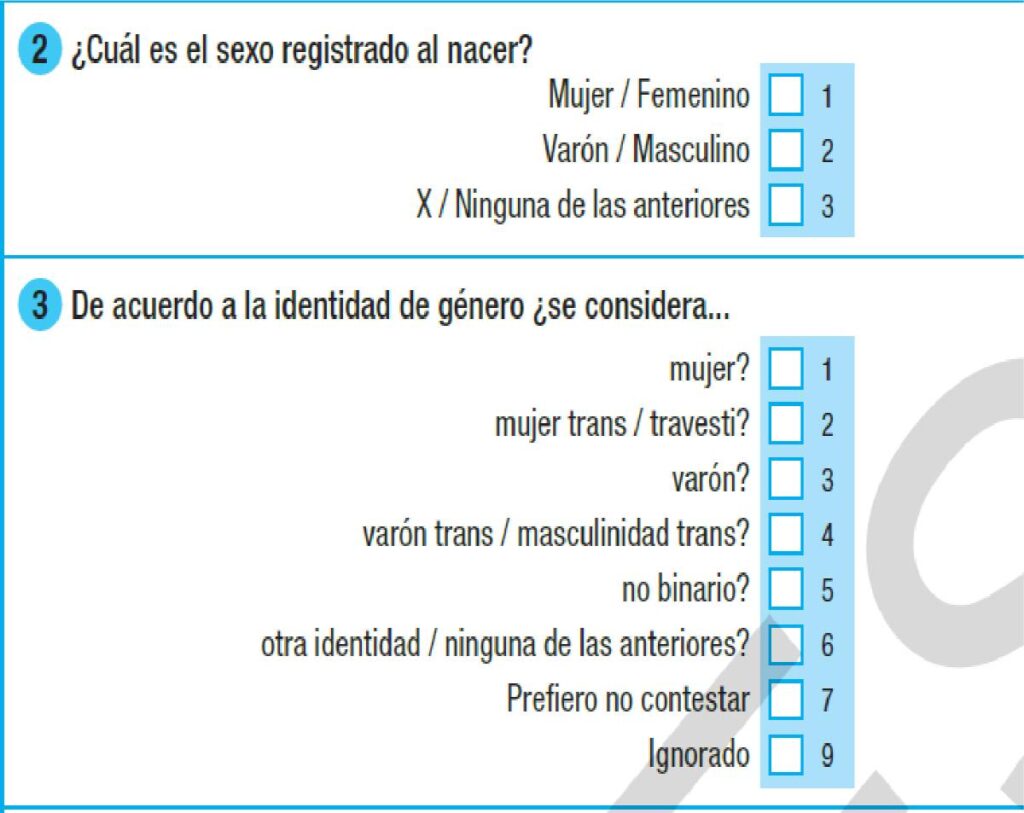
The major development in this year's census is the introduction of a first question (number 2 in the population section) about the sex assigned at birth, which offers three options: female/feminine; male/masculine; and/none of the above. A second question follows, asking how the person identifies according to their gender identity, with eight options: woman; trans woman/transvestite; man; trans man/trans masculinity; non-binary; other identity/none of the above; prefer not to answer; ignored. Both questions are intended for the entire census population.
Ethnic self-identification: a question for everyone
Regarding ethnic self-identification, the previous question was directed exclusively at a segment of the population, previously defined by the National Institute of Statistics and Censuses (INDEC). This year, however, the question is universal.
“Before, the question was only asked in marginalized populations or rural communities, and that has a racist bias. There are many people who identify as Indigenous and live in cities,” explains Lourdes Albornoz. She belongs to the Diaguita people of El Mollar (Tucumán province), is a social worker, and is a member of the Indigenous Professionals Network.
The reduction of the population consulted with this question in 2010 resulted in a set of results that INDEC clarifies, which "come from the expanded questionnaire, which was applied to a part of the population.
The values obtained are estimates from a sample and therefore include the so-called “sampling error”. This mechanism was applied to both the question about the indigenous population and the Afro-descendant population, yielding results of approximately 955,000 indigenous people or people of indigenous descent and almost 150,000 Afro-descendant people (Source: INDEC).
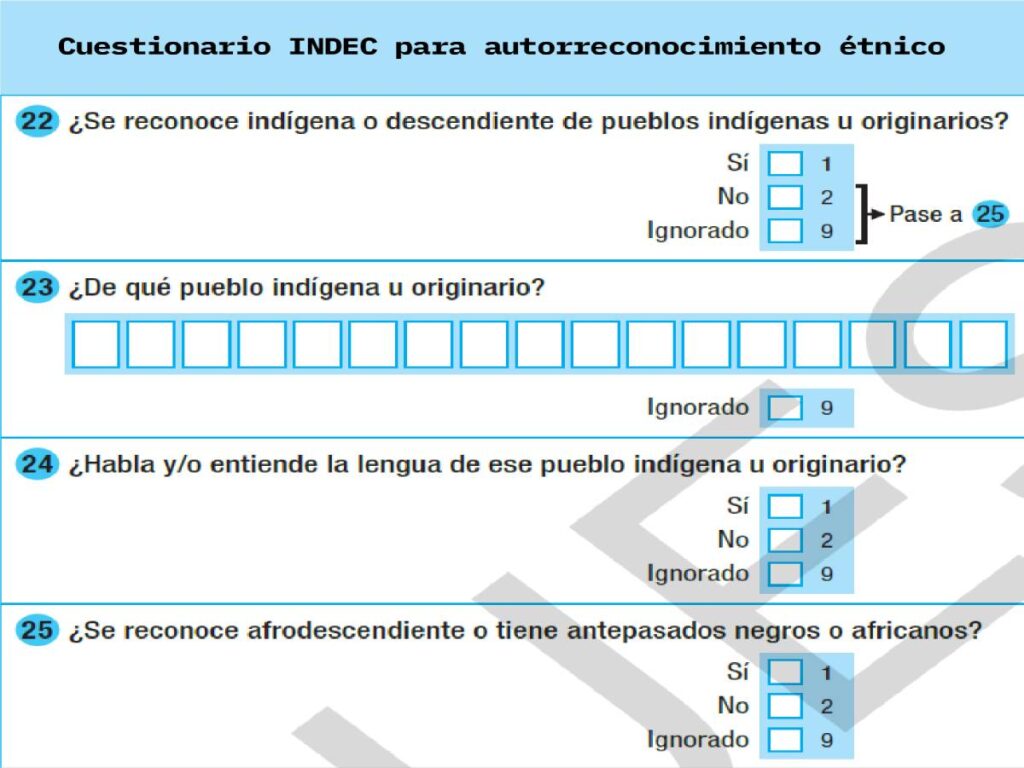
On that occasion, the options offered were to answer “yes”, “no”, or “ignored”. In the case of the indigenous population, a blank space was provided to manually fill in the name of the town in question.
Peoples and languages: a question for the few
While the inclusion of the universal question on ethnic self-identification represents a major step forward in this census, indigenous organizations and groups of researchers who have worked for the past four years to participate in the pre-census design—as indicated by United Nations recommendations—denounce that they have not been heard, since the final form presents at least two major drawbacks to generating a complete picture of this moment in history.
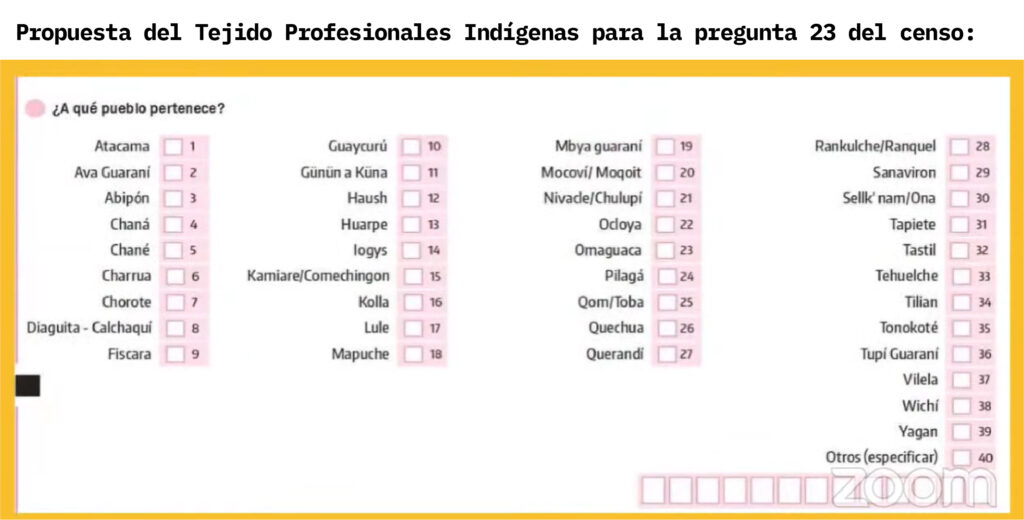
First, the questionnaire does not provide a list of the names of the recognized Indigenous peoples in Argentina. This forces census takers to write the names by hand and hinders the final count for each group.
Secondly, a question about indigenous languages was included for the first time, but it will not apply to the entire population.
Why is a list of towns important?
“We requested that they add the 39 names of the peoples recognized in the National Registry of Indigenous Communities (RENACI) because the names of these peoples, being languages with an oral tradition, don't have a single, uniform spelling. When data is analyzed, if the names aren't written consistently, it will cause errors. But they left the field blank. We call that statistical invisibility,” explains Lourdes Albornoz.
“Secondly, census takers often don’t have the time or the inclination to write down the name of the town, which can lead to it being left blank. There are also people who belong to more than one town. In Salta, for example, it happens a lot: there are some who are from bordering towns and it’s common for them to have a Churupí mother and a Chorote father, and they have to mark both, because they actively participate in both communities, and because it’s their self-perception and their right,” he adds.
What about the question about languages?
“This is the first time that questions about languages will be asked, but the problem with question 24 is that it won't apply to the entire population, but only to those who identify as part of indigenous communities. It won't provide a complete picture of Argentina in terms of multilingualism,” explains Verónica Aspiroz Cleñan, also a member of the Indigenous Professionals Network.
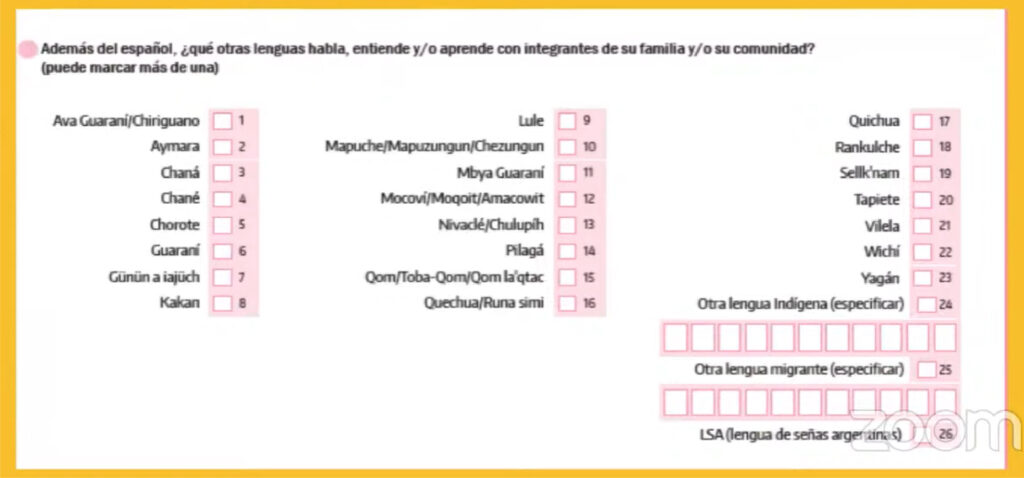
“This generates an erroneous result for several reasons: there are people who, without self-identifying as Indigenous, speak or learn Indigenous languages. Furthermore, there are people who speak more than one Indigenous language, a fact that cannot be reflected in the census form. Likewise, it does not allow us to understand the social uses and territorial distribution of Argentine Sign Language and migrant languages,” warns the Interdisciplinary Studies in Indigenous Education Area, the Intercultural Open Chair of the National University of Luján, and the Collective of Researchers in Indigenous Peoples and Languages, made up of specialists from the universities of Río Negro, Córdoba, Santiago del Estero, Buenos Aires, and La Plata, in a note sent to INDEC (National Institute of Statistics and Censuses).
“Thus, the census will not allow us to know in an obvious way the distribution of the use of indigenous languages in the country, it will only quantify the number of people who self-identify as members of an indigenous people and consider that they speak the language,” the researchers add.
On this last point, Lourdes Albornoz cites as an example the large number of speakers of Quechua (or Kichwa) in Santiago del Estero, who do not necessarily identify as an Indigenous population. According to data provided by the Anthropology Laboratory of the National University of Santiago del Estero, this language is still used in at least 14 of the 27 departments of that province. According to the Culture Department of the Santiago del Estero government, the population of Quechua speakers is estimated at between 80,000 and 160,000.
It is worth noting that the United Nations (UN) has established the International Decade of Indigenous Languages for the period 2022-2032, and that, within the 39 peoples recognized in Argentina, there are more than 1700 indigenous communities with great cultural and linguistic diversity.
It is estimated that there are currently 15 active indigenous languages and 9 undergoing revitalization. Another 12 languages are believed to be extinct. In 2019, the University Language Center created a map of indigenous languages based on these figures, as part of the International Year of Indigenous Languages. This map used data from UNESCO, the 2010 Census, and the Complementary Survey of Indigenous Peoples (a survey conducted between 2004 and 2005).
What the Tejido proposes is that the real progress for the 2022 census would be to ask the entire population if they speak, understand or learn an indigenous language, in order to observe the current situation in a complete and up-to-date way.
“We know these are languages that have been silenced. Because of racism, or because there was nowhere to speak them. There are other recovery processes underway. That's precisely where policies should be focused: to revitalize those languages that still have some remnants but are in danger of extinction. also asked that they inquire about sign languages and migrant languages, both for people who speak Guarani, Aymara, and Quechua, and for those who speak the languages of the migrations of the last century. We don't have that racist prejudice of saying 'only us' or 'only my language.' The idea is to highlight diversity,” Lourdes affirms.
The proposals
The Network of Indigenous Professionals designed and sent to INDEC a proposal to address the complexity of questions about self-identification and indigenous languages.
In them, they offer the list of the 39 indigenous peoples and open the question about languages to the entire population, in addition to considering migrant languages and sign languages.
The answers from INDEC
When consulted by Presentes, sources at INDEC reported that the question about languages “is asked of the population that identifies as indigenous or native. This is because the inclusion of each question in the census questionnaire implies an increase in interview time, which impacts the number of census takers, the time required to train human resources, the time needed to scan and interpret the questions, and the processing.”
On the other hand, “from a technical-operational point of view, the paper census questionnaire does not have the physical space required for the list of indigenous peoples.”
Therefore, they explained, “in the digital census, a person being counted who identifies as indigenous will be shown a list of 64 names of indigenous peoples prepared in conjunction with the National Institute of Indigenous Affairs (INAI).”
According to this information, the digital census will have an option that is not included in the in-person census.
Knitting with others
“For the state to take into account that there are languages in decline or being displaced by Spanish—which was orchestrated by the state—it is necessary to produce data. Census data, statistics, or sources of information,” explains Verónica Aspiroz Cleñan.
Verónica is Mapuche, from Los Toldos (Buenos Aires province). A political scientist by profession, she specialized in public health and is currently researching Mapuche ethnoepidemiology in Buenos Aires province. This path led her to seek statistical information, and she encountered significant difficulties. “The ethnic variable is not incorporated into the epidemiological surveillance system. It’s an issue that the public agenda hasn’t included in information systems, or in the national government’s data sources and records,” she explains.
“You can see it in the Permanent Household Survey, where unemployment is measured. You can look at the economic census, the agricultural census, and in all of these instruments, the ethnic variable is not included. So, in Lavagna's speech (head of INDEC), he says that the variable is a priority for INDEC. But if you look at the spreadsheets or forms, the questionnaires, of the instruments they use, it doesn't reflect that,” he explains.
In 2018, Verónica promoted the formation of the Indigenous Professionals Network, based on the need to meet and connect with other indigenous people who had been through the university space.
“At university, where everything seems fine and progressive, there is also racism. Initially, the idea was to come together to find common ground: we've been through university and have remained who we are without regretting who we are or what our history is. And we've fought battles within classrooms, with the authorities, and in student unions. We needed to articulate, concentrate, and highlight the knowledge gained from that experience,” she adds.
“That’s why our motto is dialogue of knowledge: between the knowledge carried by the Eurocentric, whitewashed academy, all the positivism that we already know, no matter how much we try to overcome it, is the profile that describes the Argentine university. And our knowledge. In that back and forth, we wanted to position ourselves politically in relation to INDEC, so that we could participate in the pre-census design.”
Currently, the Tejido (Weaving Network) conducts Indigenous Language Seminars, campaigns, and open talks. It is comprised mostly of women, and the most recent talk about the census included members of the Kolla, Diaguita, Mocoví, Mapuche, Qom, and Chicha peoples, as well as Indigenous and Afro-descendant individuals.
The limitations on naming
Organizations of people with disabilities also objected to the form presented by INDEC, mainly because it referred to "difficulties or limitations" without mentioning the disability.
“Having difficulty climbing stairs or understanding what is being said to you doesn’t necessarily imply a disability,” explains Mónica Bianchi. She is severely hearing impaired and is the founder of the Disability Advisory Council, one of the ten organizations that submitted formal proposals to INDEC (the National Institute of Statistics and Censuses) to reformulate the disability questionnaire. They also included more than 2,300 signatures from across the country with their requests.
“While the 2010 Census also asked about difficulties, the truth is that in 12 years the situation and visibility of people with disabilities (PwD) has changed a great deal thanks to the Convention on the Rights of Persons with Disabilities (CRPD), which the Argentine State ratified before the UN during the government of Néstor Kirchner. Today our goal is to stop being invisible,” he adds.
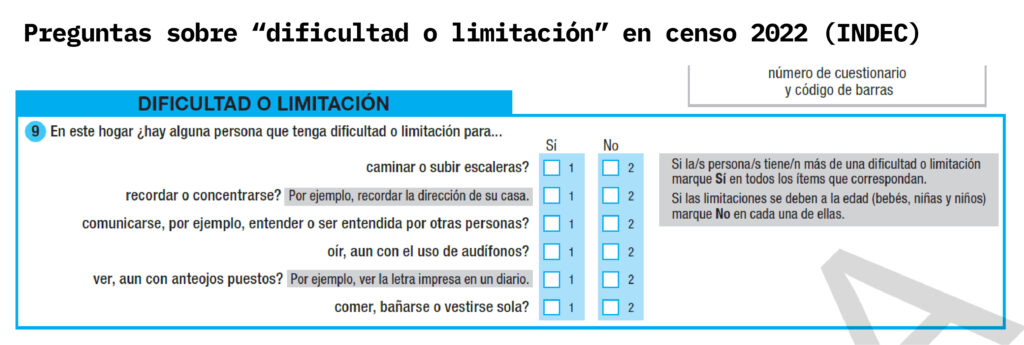
When consulted by Presentes, sources from INDEC responded that "with the incorporation of this question for the entire population, a census sample of households with difficulties or limitations will be collected as broadly as possible, which can then be broken down in detail in a subsequent specific survey."
Meanwhile, the National Disability Agencyresponded that “Disability in our country is determined in a process that culminates in the single disability certificate (CUD), which also indicates the type and other conditions.
Therefore, for statistical purposes, the National Disability Agency maintains this registry, which is very rich in data. This census inquires about the difficulty or limitation in performing certain actions, primarily because it aims to broaden the scope and because the word "disability" is characterized by its polysemy and even its stigmatization.
Regarding the development of a subsequent survey, “we maintain that this census form excludes numerous people with disabilities, which will prevent us from identifying the households where the subsequent National Survey will be conducted. For example, a person with mild or moderate Down syndrome can climb stairs, remember their home address, read, work, listen, understand, eat, bathe, and dress themselves,” explains Mónica.
To conclude, we asked her if she considered disability as another form of diversity. “Yes, of course, as someone once told me: if we teach girls and boys to respect difference, we would be talking about diversity, not inclusion,” she replied.
We are present
We are committed to journalism that delves into the territories and conducts thorough investigations, combined with new technologies and narrative formats. We want the protagonists, their stories, and their struggles to be present.
SUPPORT US

FOLLOW US
Related notes

We are present
This and other stories are not usually on the media agenda. Together we can bring them to light.