

20,000 indigenous and peasant people took to the streets to secure an Emergency Law in Paraguay
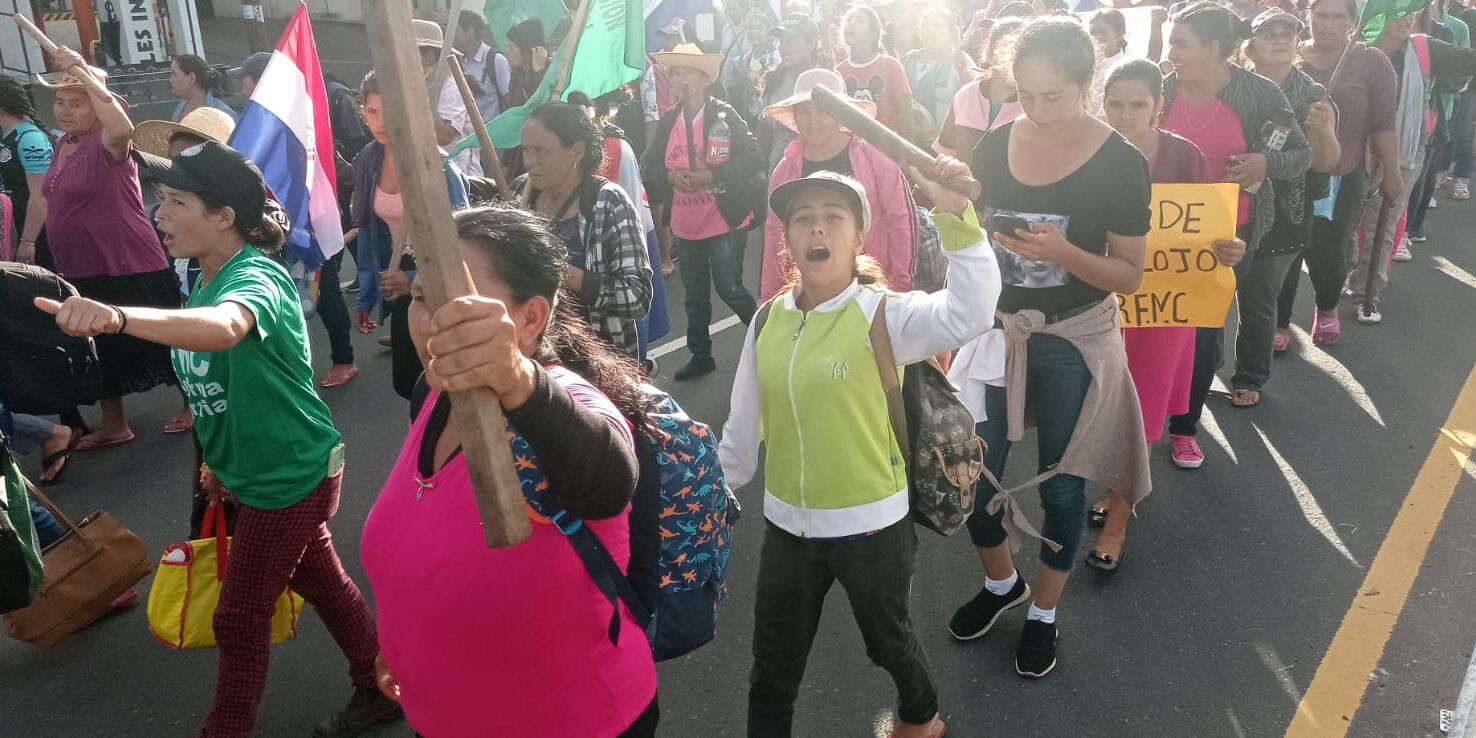
It was a historic march because of its massive size: 20,000 indigenous and peasant people mobilized in Asunción to demand action from the State regarding evictions and the lack of aid due to droughts.


Share

It was a historic march because of its massive size: 20,000 indigenous and peasant people mobilized in Asunción to demand action from the State regarding evictions and the lack of aid due to droughts.
The National Peasant, Indigenous, and Popular Assembly had begun the #ProlongedStruggle 16 days prior with a sit-in at O'Leary Square in Asunción, where the organizations had set up camp. They demanded the repeal of the Zavala-Riera Law, which criminalizes resistance, but this was not achieved. Instead, the Senate passed an Emergency Law due to drought. The struggle was put on hold.
On Thursday the 24th, before dawn, the organizations moved from the Plaza to the former Metropolitan Seminary, the meeting point of the XXVIII Peasant March.
With the characteristic joy of demonstrations and the specially prepared breakfast of cocido (a traditional Paraguayan stew), thousands of people prepared to march 4 km. The slogans, displayed on signs and t-shirts, included: repeal of the Zavala-Riera law and impeachment of Sandra Quiñonez, the State Attorney General.
With greater support from the urban population
The march proceeded peacefully, accompanied by chants and shouts of command. After a long hiatus, the support of Asunción's citizens was also evident, with honking horns, people appearing on balconies, leaving their workplaces to greet the marchers, and in some cases, even offering words of encouragement.
Gabina González, leader of the Guaraní People, from the department of Caaguazu, is one of the historical activists of the Organization of Peasant and Indigenous Women Conamuri.
“We Indigenous people are taking to the streets to protest because we see that the situation is bad, and we are also suffering greatly in our communities; every day is harder. Everything we eat is very expensive, and I feel that many of my Indigenous brothers and sisters are also suffering because they live in poverty. We are demanding political justice because we are demanding a better life, to be seen, to be recognized. We, as peasant and Indigenous women, are going through the same situation,” the leader said in Guarani.
The marchers occupied two of the central squares (there are 4 in total): most of them in O'Leary Square and the Pantheon of Heroes Square.
A popular festival took place there, featuring Paraguayan polkas and poetry readings in Guaraní, while tereré was prepared to quench the heat and continue the festivities. Meanwhile, the Senate debated the possibility of repealing the Zavala-Riera Law. It was not repealed.
Senators Zavala and Riera, the authors of the law, took the floor and reiterated their position. Along with other senators, they defend agribusiness interests and labeled those who remain on the land as criminals, focusing the debate on respect for private property.
“This government has neither the courage nor the ability to manage the land.”
After the repeal process failed, the organizations marched again to Parliament and returned to O'Leary Square to speak at the main event.
At the event, Bernarda Pesoa, a Qom leader, spoke. She highlighted the participation in the mobilizations that brought social struggles to light. “The struggle and resistance of these 16 days reminds me that the struggle of Indigenous peoples has lasted 520 years, during which they have been victims of murder, discrimination, neglect, and persecution. This government has neither the courage nor the capacity to manage the land. It is acting against the Paraguayan people and seeks to hand it over to foreign interests.”
Teodolina Villalba, a peasant leader, general secretary of the National Peasant Federation, and a member of the leadership of the #ProlongedStruggle, also spoke. She highlighted several injustices they face, including the lack of opportunities for young people, the violence women suffer as a consequence of the pandemic, the effects of deforestation and its environmental consequences, the excessive external debt that will burden the population, the violation of Paraguayan sovereignty in the handling of binational hydroelectric projects, corruption in Congress and the Attorney General's Office, and the rise of drug-related politics.
He also condemned the policies created to criminalize the struggle for land, the manipulation of state institutions that protect large landowners, mainly foreigners, possessors of ill-gotten land, and agribusiness drug traffickers.
Villalba announced that the #ProlongedStruggle is going into recess, returning to the communities to evaluate the 16 days, organize an emergency plan and return to the mobilizations again, because the struggle will only end when the entire population achieves a dignified life in Paraguay.
He questioned the policies of criminalizing the struggle for land, and the manipulation of state institutions to protect large landowners, foreigners, possessors of ill-gotten land, and drug traffickers in agribusiness.
Organizations comprising the National Peasant, Indigenous and Popular Assembly: National Peasant Federation (FNC); Organization for the Struggle for Land (OLT); Independent Agrarian Movement (MAI); Paraguayan Peasant Movement (MCP); Alto Paraná Social Forum; Coordinator of Peasant and Urban Workers (CTCU); Organization of Peasant and Indigenous Women (Conamuri); Regina Mareco Cooperative; Apaiga UPA; Pojoaju Association; Cultiva Paraguay; Coordinator of Social Organizations of San Pedro; Peasant Resistance Movement (MCR); March 1st Settlement of Ypané.
We are present
We are committed to journalism that delves into the territories and conducts thorough investigations, combined with new technologies and narrative formats. We want the protagonists, their stories, and their struggles to be present.
SUPPORT US

FOLLOW US
Related notes



We are present
This and other stories are not usually on the media agenda. Together we can bring them to light.