

A gay couple was attacked at a taco stand in Mexico City.
The couple shared the beating on social media and reported the incident to the Specialized Agency for Attention to LGBTI+ People of the local Prosecutor's Office.


Share

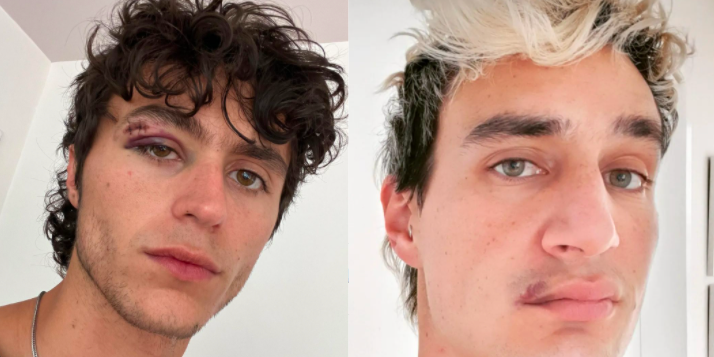
In the early hours of Saturday, January 15, three men assaulted Andrés de Miguel and Fernando Cattori at a taco stand in Mexico City. The couple shared the attack on social media and reported the incident to the Specialized Agency for Attention to LGBTI+ Persons of the local Prosecutor's Office.
Andrés and Fernando went to El Vilsito taco stand, located in the Narvarte neighborhood of Mexico City, around 12:30 a.m. on Saturday. While they were waiting to be served, Andrés approached Fernando, hugged him, and asked him if he thought it was okay to kiss in that place.
“As an LGBTIQ+ person, you learn to interpret the environment because you never know,” Fernando said on social media.
This is in addition to Andrés also noticing the gaze of a man around 30 years old who says, “He kept looking at me with a very particular gaze, one that women and LGBT people know well, a gaze I have learned to identify in which it is not easy to distinguish hatred and repulsion from desire or a mixture of both. It is a dangerous gaze that I have encountered before and that I did not want to lose sight of.”

According to the latest survey on discrimination in Mexico City , gay men are the fourth most discriminated-against population group. Furthermore, in the National Survey on Discrimination Based on Sexual Orientation and Gender Identity ( ENDOSIG, 2018 ), 81.4% of gay men who responded said they were afraid to show affection to their partner in public, and 72.6% avoid freely expressing their sexual orientation.
The attack
While the couple and their friends were having dinner, a man lunged at Andrés, violently pushing him and saying, "Why are you looking at me like that? What are you looking at? What the hell are you looking at?" Andrés replied that he wasn't looking at him and asked him to leave him alone to eat his dinner.
The attacker responded by punching Andrés in the face, opening his mouth. Faced with this initial attack, the couple and their friends decided not to leave.
“We decided to end our dinner because we weren’t going to let them take that space away from us, especially not like that,” Fernando wrote. He added, “Today I recommend that if you don’t feel safe in a place, leave. There are other kinds of struggle and resistance.”
By the time the aggressor and the two men accompanying him were paying their bill; and Andrés and Fernando were still having dinner with their friends, the aggressor again intimidated them with homophobic insults and approached them.
Fernando felt the man getting closer to Andrés and, to stop the attack, decided to step in front of him. One of the first attacker's companions pushed him from behind against a lamppost, cutting his eyebrow. His friends were also assaulted.
The men who attacked them left the scene while the first aggressor shouted, "fucking faggot I'm going to eat you whole."
“Nobody did anything”
Andrés and Fernando say that only their friends and some waiters tried to stop the attack, but they claim that most of the diners did not act to stop it.
“Beyond the facts, I wanted to share the mixture of helplessness, anger, and sadness I felt. Nobody did anything; the other diners watched us walk away bleeding, as if we were leaving humiliated, as if there were no value in the integrity with which we rejected violence at all times.”
Andrés added that it is important for his friends and acquaintances to recognize the violence that LGBT people experience.
“The violence that LGBT people experience is systemic; it is a constant possibility that exists on multiple levels. This latent violence is in the fear a macho man feels when he can see and penetrate with his gaze, but cannot be seen. He can intimidate, but he feels violated when he is seen in return. There is violence in physical aggression, there is violence in the words chosen, in the fact that we have to question whether we can show affection, there is violence in the passivity of those who saw and did not act, in the fact that my writing has to make it clear that I did not bring this on myself.”
“We want to ensure that this does not go unpunished.”
In the early hours of Monday, January 17, Andrés and Fernando filed a complaint with the Specialized Agency for Attention to LGBTI+ People of the Mexico City Prosecutor's Office, which handles cases of discrimination and attacks based on prejudice against non-normative sexual orientations and gender identities.
“We are looking into the next steps, following the guidelines we have been given, and ensuring that at least this is recorded and doesn't go unpunished. It seems that we will only be able to appeal it as an administrative infraction, but that will be enough to make it known that these things cannot simply be ignored,” Andrés explained in a statement to Presentes.
“We kept the love”
The attack suffered by Andrés and Fernando occurs in a context where other LGBT+ people have been victims of transphobic, lesbophobic and homophobic attacks in recent weeks, such as the attempted transfeminicide of activist Natalia Lane , the attack on a lesbian couple for kissing in Chinatown and the discrimination experienced by two gay men for kissing at Six Flags.
Faced with this panorama of violence against LGBT people and what Andrés and Fernando experienced, both told Presentes that they prefer to focus on the networks of love and support that have been generated.
“What I’ve been discussing with Fer these past few days is how impressive the networks of love and support that have been created are, and how much stronger and more powerful that is—affection and connection—than fear. So we’ve decided to hold on to that and generate change from there,” Andrés added in an interview.
“I prefer to focus on love, on us staying in love. The response from the community, beyond my acquaintances—and I mean far beyond my acquaintances—has been overwhelmingly positive. At one point, I doubted that a community even existed, but these events have clearly shown me that it does,” Fernando concluded during his conversation with Presentes.
We are present
We are committed to journalism that delves into the territories and conducts thorough investigations, combined with new technologies and narrative formats. We want the protagonists, their stories, and their struggles to be present.
SUPPORT US

FOLLOW US
Related notes



We are present
This and other stories are not usually on the media agenda. Together we can bring them to light.