

Amorales, the collective that uses art to denounce gender violence in El Salvador
Artists, poets, and musicians formed the Amorales collective, which is responsible for denouncing and demanding women's rights in El Salvador.


Share

SAN SALVADOR, El Salvador.
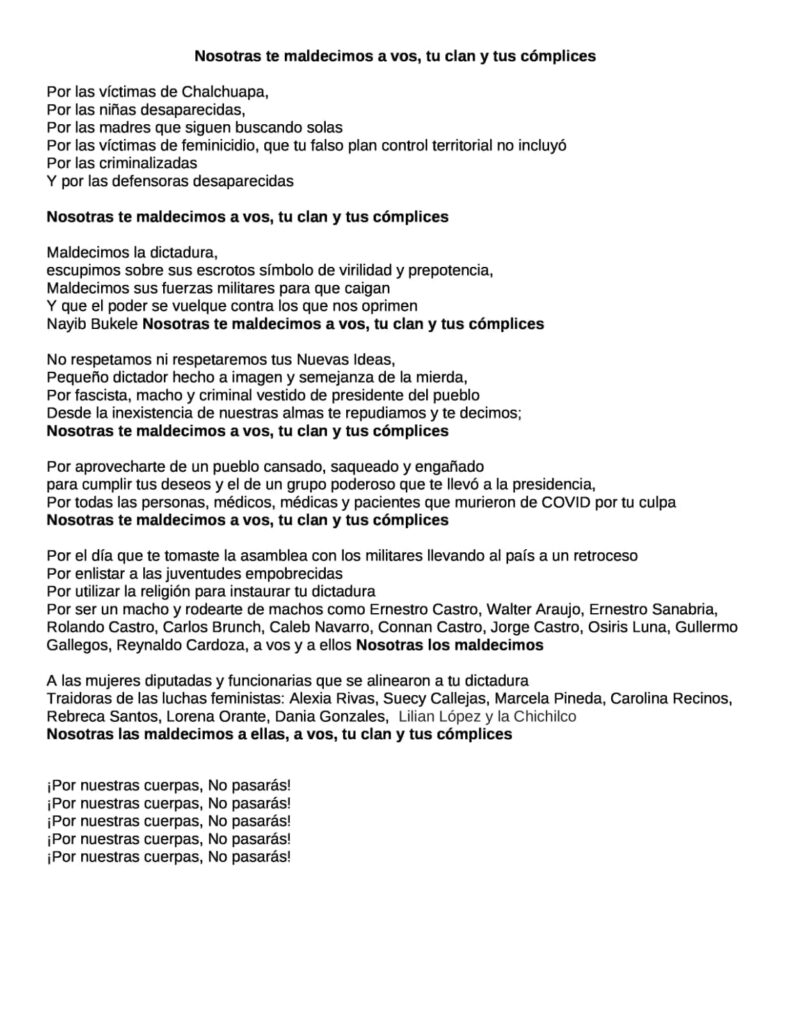
“We curse you, your clan and your accomplices,” a group of women chanted during a protest at a monument in El Salvador’s capital, as they sprinkled a handful of salt on a photograph of the popular president, Nayib Bukele.
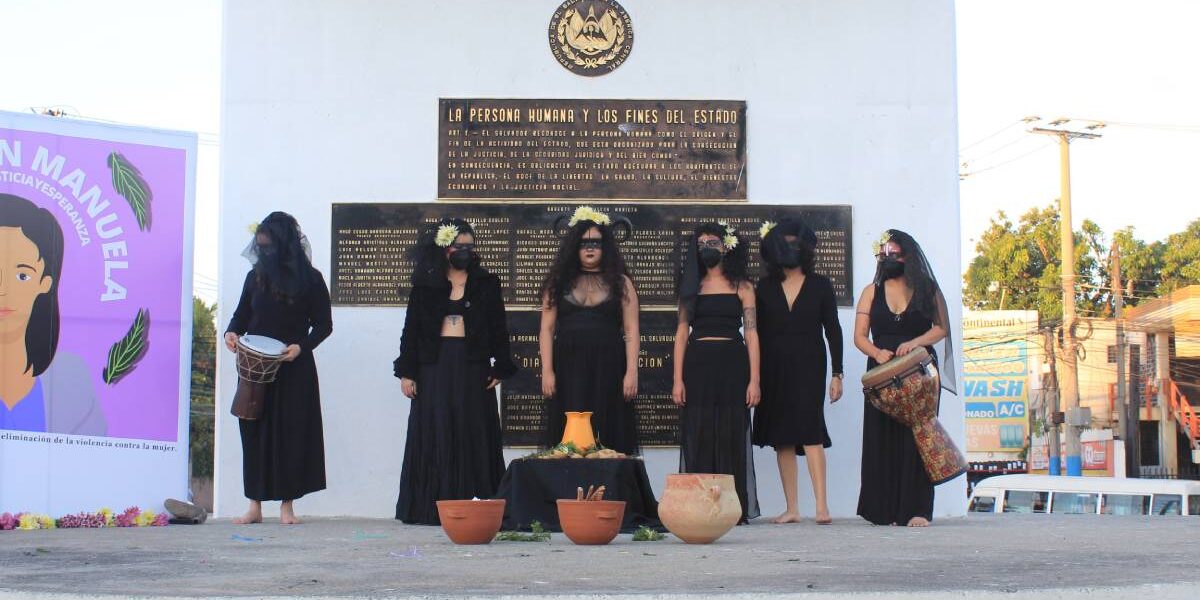
On the afternoon of Sunday, September 5th, the women members of the feminist collective Las Amorales were dressed in dark suits and their faces were covered with black scarves. Their hands beat a drum as they performed a piece called "The Curse of the Dictatorship."
"For the victims (murdered) of Chalchuapa. For the disappeared girls (...) We curse the dictatorship, we spit on its scrotums, symbol of virility and arrogance," they said in the ritual performed at the monument to the Constitution.
They were referring to a specific case. In early May, police discovered a house in the municipality of Chalchuapa , 79 kilometers west of the capital. There they found seven graves containing the bodies of at least 30 victims, mostly women and children. The Bukele government attempted to downplay the number of bodies found.
But Las Amorales, made up of artists willing to break everything to defend the victims and the rights of women in the impoverished Central American country, were not willing to remain silent.
Her provocative artistic interventions are full of symbolism in denouncing sexual violence, disappearances, impunity, and authoritarian government policies.
“The curse of the dictatorship” caused such a media stir that it prompted millennial President Bukele to post the video of the action on his official Twitter account, accompanied by a paragraph from Psalm 91.
A target of repeated violence
The president's tweet was accompanied by hundreds of replies and posts from his political allies who labeled the activity as "witchcraft" or its participants as "infernal witches."
The attacks went beyond social media. At Amorales' headquarters, they threw garbage and excrement and repeatedly called his phone with death threats against those who "dared to attack the president."
“They call us saying they’re going to come looking for us. That they’re going to rape us and impale us. And then there’s the issue of God punishing us. That God is watching us, that God knows what we’re doing, and that God tells them what we’re doing. It’s sickening and a little scary,” Keyla Cáceres, one of the members of Amorales, Presentes
From January to September of this year, 63 women were murdered, according to official figures from the Attorney General's Office. This represents a 31.2% increase compared to the same period last year.
Bukele has used social media to lash out at, defame, and belittle those who oppose his controversial policies. Twitter has become a battleground where hordes of supporters and fake accounts aligned with the government attack to intimidate dissenting voices.
Who are the Immoral Ones?
From a sociological perspective, amorality is understood as the absence of morality. In El Salvador, a group of women artists adopted the name Amorales to fight against the values imposed by a conservative and patriarchal society: they are prepared to fight.
In 2010, the members organized themselves in a small theater named after the poet Roque Dalton , who was murdered in May 1975 by his comrades in the People's Revolutionary Army (ERP), accused of allegedly belonging to the CIA during the years of the military dictatorship.
Her initial motivations were the reports of sexual harassment within the state-run University of El Salvador that went unheeded by academic authorities.
For that reason, they used theater to show the impunity that victims had to face.
According to the Attorney General's Office, between January and September 2021, they documented 3,122 reports of sexual harassment, about 13 cases per day. Sixty percent of the victims are girls under 17 years old.
A place to scream
For them, the theater became a space where they could create without fear of being discriminated against or abused.
For several of them, their acting studies took place in sexist environments that operated with complete impunity. This hostile environment became the catalyst for their organization.
In addition to the work they did in the theater, they felt that feminist organizations did not include the voices of young women in their agendas.
Following the signing of the Peace Agreement between the government and the former guerrilla group Farabundo Martí National Liberation Front (FMLN), ex-combatants formed non-governmental organizations to defend the rights denied during the military dictatorship and the armed conflict (1980 – 1992).
Amorales believes that between 2000 and 2009, there were few voices of young women in the public discussion of rights . The 2000s became a time of great problems for the Central American country: gangs, dollarization, privatization, unemployment, and countless crises that overshadowed the fight for women's rights.
“Amorales emerged precisely to address the situation that young women face. To bring to the forefront issues that no one wanted to touch or that they weren't yet ready to discuss. Amorales' first project was to use art as a means of social impact on issues of sexual and reproductive rights,” said Cáceres, one of the seven members of Amorales.
Currently, the group consists of poets, a historian, theater actresses, musicians, and academics.
Persecuted for speaking out
Paintings simulating blood, black dresses, balaclavas, and sit-ins outside the courthouses shouting the names of those accused were actions that brought them into the public eye. It also encouraged more victims to come forward. They claim it was an avalanche of cases committed within the institution.
In 2019, they were denounced by one of the professors accused of sexually assaulting female students at the public university. He filed a lawsuit against two members of Amorales for the alleged crimes of slander and defamation. He demanded $150,000 in civil damages.
The judge in the case acquitted one of them, but convicted the other of defamation. She had to pay two thousand dollars. The sentence was appealed and is still awaiting a final ruling.
The perpetrator was not prosecuted despite having been reported for sexual assault since 1996. Since then, university authorities have done nothing.
After presenting the play "Old Circus" where they denounced officials, television presenters and public figures who opposed women's rights, their Facebook began to accumulate hundreds of women victims who dared for the first time to name their aggressor.
Confronting authoritarianism
Nayib Bukele, who calls himself "The CEO of El Salvador," showed his controversial way of governing from the beginning of his administration in June 2019.
He eliminated the social inclusion secretariat that served vulnerable populations such as indigenous and LGBTI communities. He stormed Congress with the military, dismissed magistrates and judges of the Supreme Court, and the attorney general.
His government was accused by the United States of making deals with gangs to receive electoral support in the legislative and municipal elections of February in exchange for economic benefits.
Bukele denied access to justice to victims of the El Mozote massacre, one of the largest committed on the continent during the armed conflict.
Despite the attack and threats, Amorales asserts that they will continue to denounce the government's authoritarian actions from the streets. They are not willing to become "cannon fodder" for the opposition.
“We don’t want to be martyrs, we’re clear about that. Our collective is made up of women who are mothers, young women. So, yes, we have a lot to lose. We don’t want to go through life looking for someone to kill us so that we’ll be remembered in this country with its selective memory,” Keyla said.
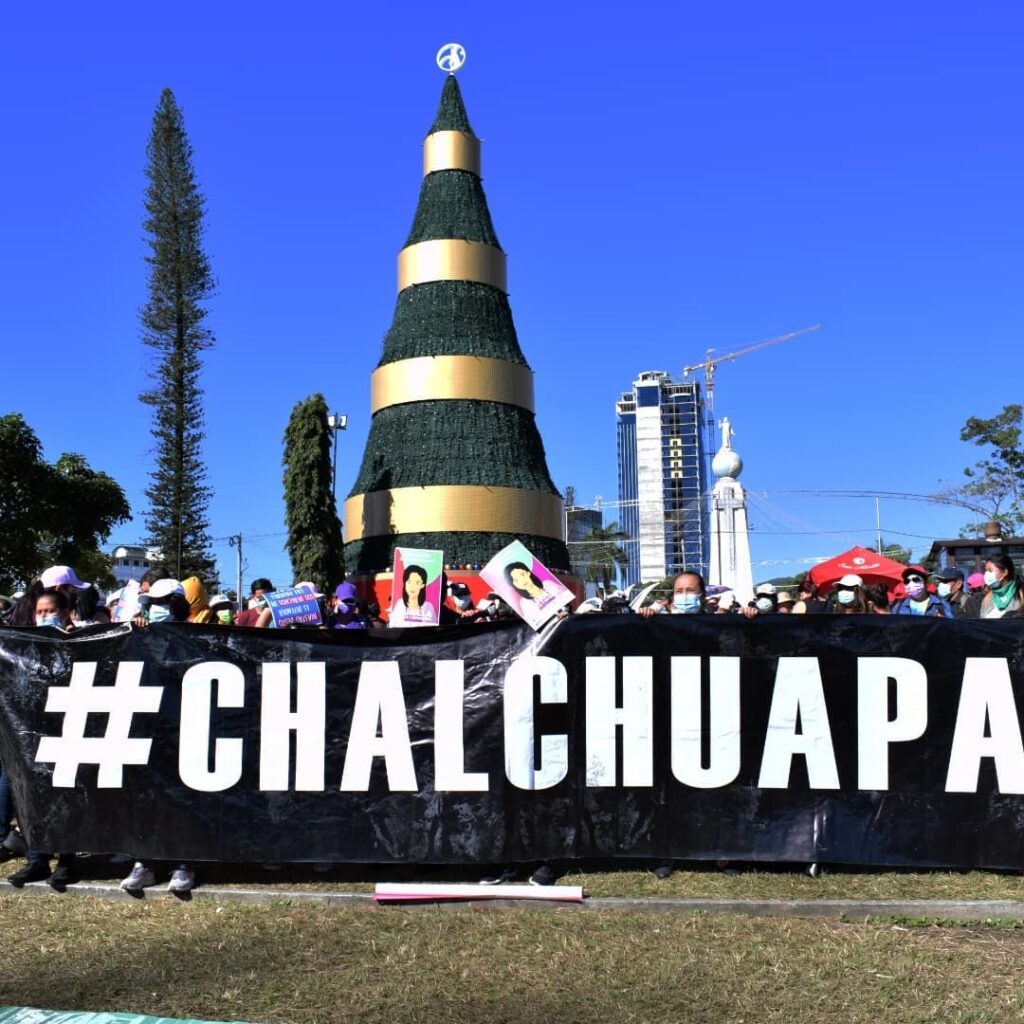
Photo: Colectiva Amorales (Facebook)
We are present
We are committed to journalism that delves into the territories and conducts thorough investigations, combined with new technologies and narrative formats. We want the protagonists, their stories, and their struggles to be present.
SUPPORT US

FOLLOW US
Related notes



We are present
This and other stories are not usually on the media agenda. Together we can bring them to light.
1 Comment