

Trans women in Ensenada fear trans femicide perpetrators at large
Activists and transgender people marched in Ensenada to protest violence against the LGBT community. They also demanded recognition of gender identity.



Share

The transfeminicide of activist Alicia Díaz, known as Tita, in the municipality of Ensenada, in Baja California, raised alarms among trans women who protested in front of the State Attorney General's Office (FGE).
With 320 intentional homicides and 80 unintentional homicides so far this year, the port of Ensenada is the second most violent in the state after Tijuana. None of these cases are being investigated as transfemicides because the authorities do not recognize gender identity.
The murder of 22-year-old Tita is a hate crime and should be investigated as such , her friends asserted during the demonstration. However, the Attorney General's Office (FGE) has classified it as manslaughter because they identify the victim as male.
Tita's body was found in an advanced state of decomposition four days after her mother reported her missing. She was covered in blood and inside her home, located in a marginalized area on Socolov Boulevard in the Munguia neighborhood.
According to information from the investigation, before his murder he received a threat through social media and was also beaten.
Like this one, there are other cases of impunity and judicial omissions in preventing abuses against women.
Arturo Serratos, Secretary of the Trans Ensenada Una Lucha Association, reported that for years LGBT people have suffered the indifference of the authorities.
“This has been their response to the numerous complaints. They send you packing, they send you packing, they tell you to call them, come back later, and when we finally arrive at the prosecutor's office, nobody answers the phone ,” he described.
While they celebrate small advances for the community in the country, such as recognizing same-sex marriage or the openness of the authorities to take to the streets to protest, the murders against the trans community in Baja California remain invisible.
Police abuses
A year ago, Melisa was working as a sex worker on Second Street between Gastelum and Miramar, in the tourist area, when a client requested her services, but when they got into the vehicle an agent from the Municipal Public Security Directorate (DSPM) stopped them.
The police officer questioned the customer about whether he knew the person next to him was homosexual and assured him that this action was grounds for a fine or other penalty. The entire incident was documented in a complaint filed with the Human Rights Commission and the Municipal Ombudsman's Office.
He then asked Melisa to get out of the vehicle, but when she refused, the officer returned to the patrol car to take out a long gun, chambered a round, and pointed it at her.
The police officer's partner had to intervene to stop the abuse, as the victim herself told Presentes . This incident occurred in November 2020 during the COVID-19 pandemic.
“Come over here, you bastard…” the officer yelled at her. She responded to the verbal and physical aggression with insults in self-defense. Days after this incident, the officer continued to harass Melissa in the streets.
As a result of the incident , Melissa left the city because she considers it unsafe, and moved to Tijuana where she feels freer to express her sexuality.
If the authorities had done their job, it would have been enough to review the security cameras of nearby stores, since it is a commercial area in the heart of Ensenada and one of the busiest.
“In Tijuana I feel a little calmer and safer because the authorities don’t bother anyone,” she replied, uneasy because her friends in Ensenada continue to experience that violence.
Although the events were reported to the State Human Rights Commission in Baja California and the Municipal Ombudsman, no authority called for a hearing.
Regarding this case, and a dozen others reported by transgender women since 2016, Griselda Vizcarra Durán, delegate of the State Human Rights Commission, acknowledged that the local agency is aware of the human rights violations against the community. “Rest assured that every case will be investigated,” she pledged.
He added that complaints submitted by the community during previous administrations will also be considered by his staff to initiate the necessary investigations.
The invisible crimes
For Jey Fernández, an activist for diversity rights, violence against the community is directly related to three factors: lack of identity, precarity, and machismo .
According to national statistics, 3% of the population consider themselves trans men or women, which is why the authorities must legislate to create sanctions against those who commit discrimination.
In legislative matters, the Law to Prevent and Eliminate Discrimination was harmonized in 2012, but it is not working and therefore a reform is urgently needed. “We have a terrible loophole, and it is a problem for girls who cannot have these rights,” she stated.
She spoke of the marginalization her colleagues experience in the workplace, since due to the lack of official identification from the National Electoral Institute (INE), some are forced to work as sex workers or in organized crime.
“The work situation is complicated because of physical appearance, and there are no accessible bathrooms in factories or maquiladoras, where they are denied work for these reasons,” he mentioned.
She explained how young men and women travel from the U.S. border to Mexico City to complete the necessary paperwork, which is denied to them by Baja California authorities. Those who cannot afford to travel prefer to renounce their identity.
As part of their work with the civil organization, they have identified a homicide committed in March against a transgender woman in Ensenada. The State Attorney General's Office (FGE) is also investigating this case as if the victim were a man.
The Secretary of Inclusion in Baja California, Miriam Cano Nuñez, assured that they are working to recognize the identity of trans women in documentation, access to health and training for officials.
However, for now the Gender Identity Law Initiative is being led by Representatives Dunnia Montserrat Murillo and Evelyn Sánchez.
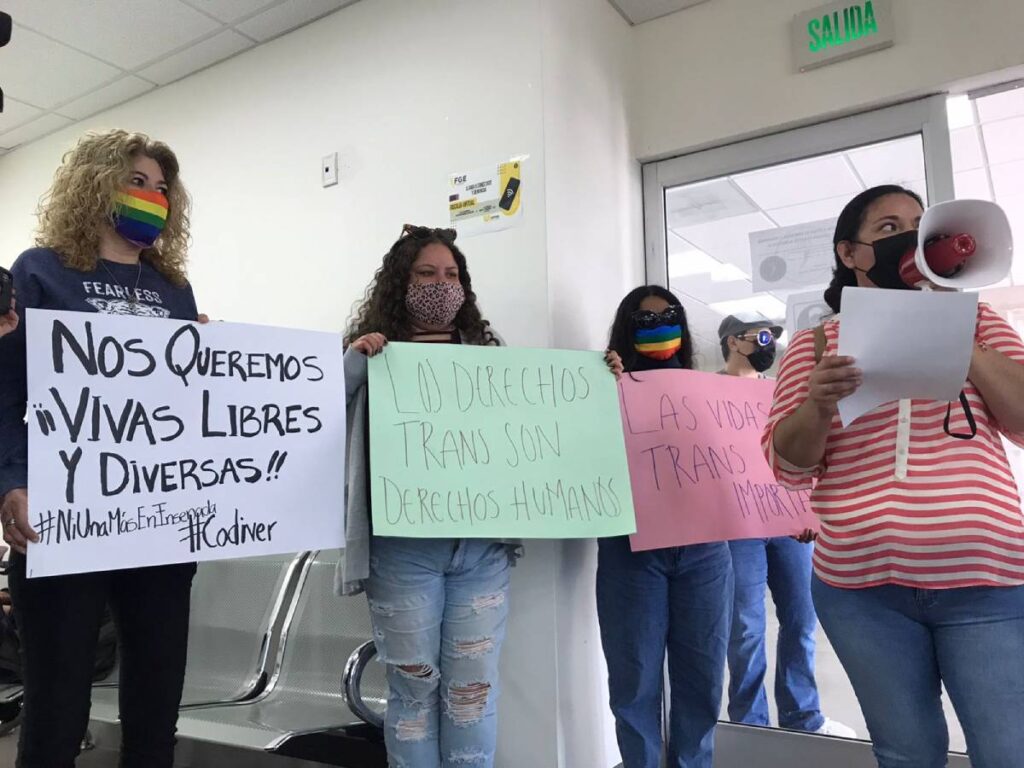
“We are not synonymous with laughter”
Jacqueline Aguilar de Escamilla, from the association Trans Ensenada Una Lucha con Valor (Trans Ensenada: A Courageous Struggle), considered recognizing gender identity a priority . Currently, there are approximately 60 transgender women who engage in sex work because they have no other options.
This was declared on Friday, November 19, when they marched from Macheros Street and Costero Boulevard, in front of the Civic Plaza of the Fatherland, to the FGE building.
The group waited for over an hour, chanting slogans, to be received by the head of the agency, Rafael Orozco Vargas. “This happens every day; we go out into the streets and are ridiculed,” commented one of the protesters.
She described in detail how she and her friends feel in their daily lives, when they arrive at a business, a public service office, or even on the street. “It’s not just physical violence, but also psychological violence. When you enter a place, the person serving you might say to whoever is next to them, ‘They’re talking to you’ or ‘There’s the faggot.’ That’s violence too,” she pointed out.
There is an urgent need for human rights legislation to punish those who coerce or abuse women. Currently, when women complain of abuse, they often end up arrested or paying fines and bail .
Due to the government's indifference to the large number of cases, they have stopped filing complaints with human rights organizations.
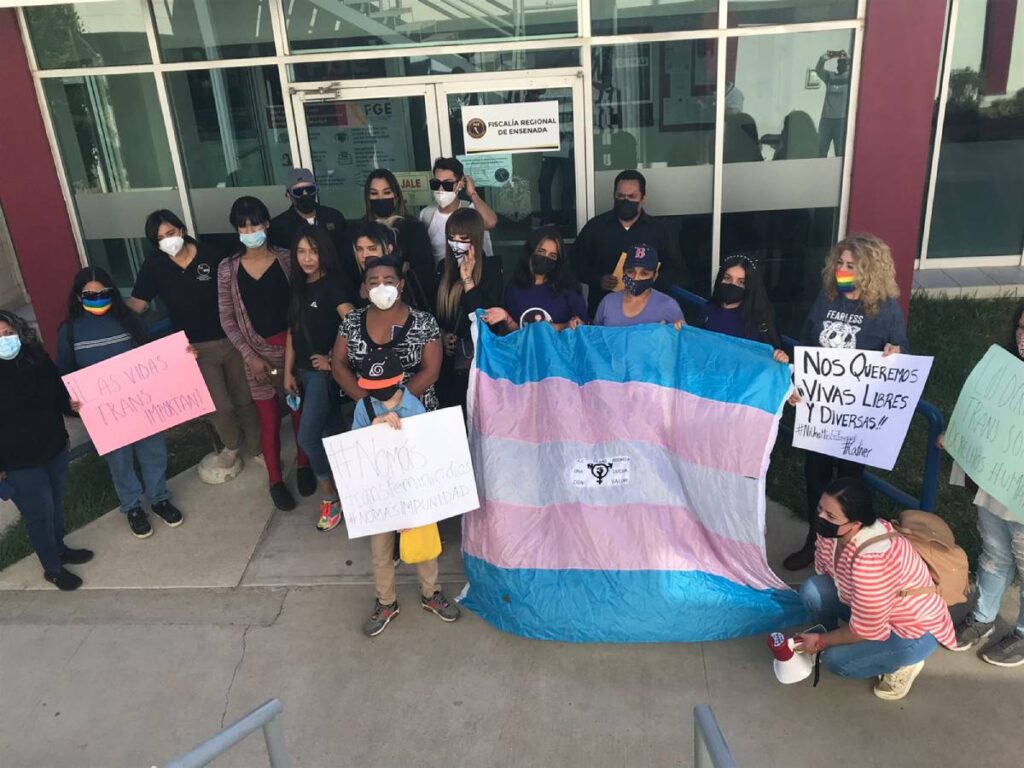
Emblematic cases where the perpetrators are free:
Jazmín Vega Guzman, known as Gudelia, was a star of the entertainment industry. On June 6, 2010, she was found dead on the side of the Ensenada-Ojos Negros highway. Her killer was arrested and sentenced to 25 years in prison. He appealed the sentence and is now free.
-Karla Macías was found in an illegal dump located near the Villas del Sol subdivision on February 25, 2017. Her death was not investigated because her family never filed a complaint.
-Alicia Díaz Tita, on November 3rd her body was found in a state of decomposition in a house in the Munguía neighborhood. For a week they searched for her throughout the city.
-In March, a person was murdered and groups suspect a possible transfeminicide which is being investigated as manslaughter.
We are present
We are committed to journalism that delves into the territories and conducts thorough investigations, combined with new technologies and narrative formats. We want the protagonists, their stories, and their struggles to be present.
SUPPORT US

FOLLOW US
Related notes



We are present
This and other stories are not usually on the media agenda. Together we can bring them to light.