

A dissident front was formed in Corrientes to fight for the rights of diversity.
One month before the Pride March in Corrientes, the Corrientes Travesti, Trans, Marica - Non-Binarie Force was formed to fight for rights.


Share

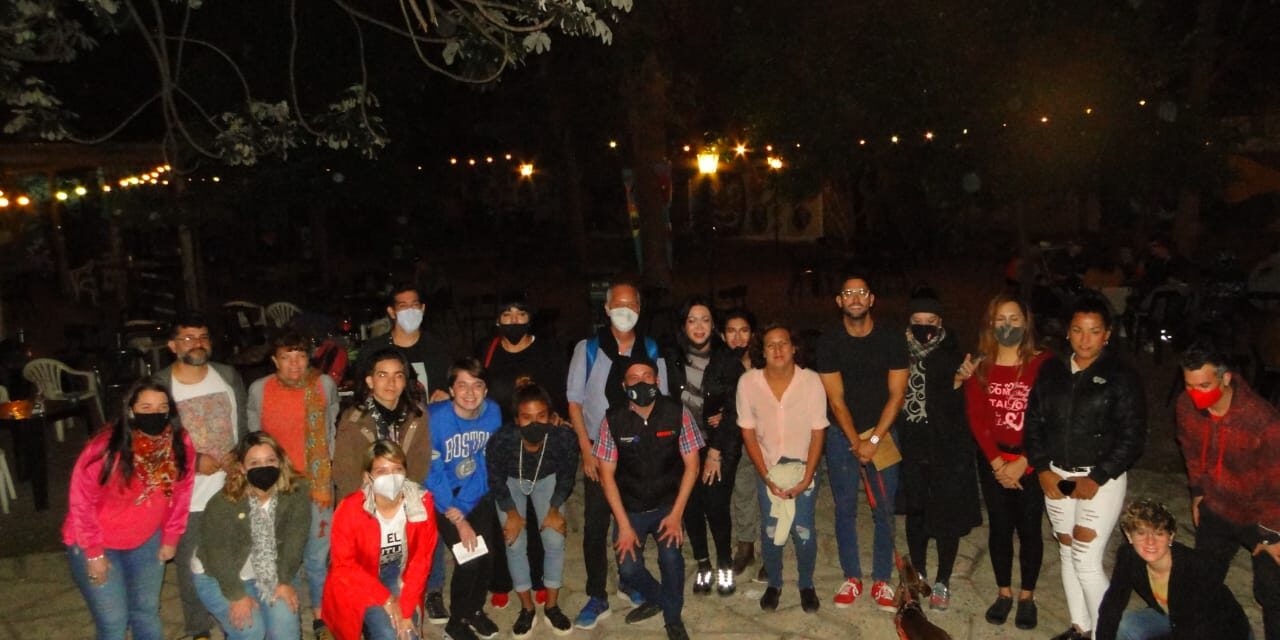
Social organizations, human rights groups, and self-organized LGBTQ+ activists and activists from the arts and culture scene in Corrientes have formed a coalition called “La Fuerza Travesti, Trans, Marica – No Binarie Correntina” (The Corrientes Transvestite, Trans, Queer – Non-Binary Force). This group emerged a month before the local LGBTQ+ Pride March, which will take place on Sunday, November 7th in Corrientes City.
According to statements from activists and supporters, the goal of the gathering was to organize meetings to develop a shared agenda to address the province's shortcomings in terms of rights, inclusion, and integration for the LGBTQ+ community. They met at Espacio Mariño in the provincial capital under the slogan "Unity is strength."
Demir Hannah, the activist, singer, songwriter, and producer of "United for Music," told Presentes: "Corrientes has a very closed system, linked to religious sectors. To date, efforts to promote diversity within the government are minimal, which is why the meeting was to unify a joint request, with the goodwill of all parties, in order to be able to advocate and obtain results."
“The idea arose collectively from conversations among activists from the LGBTIQ+ community who met in various places such as the beach, the plaza, the street, cultural spaces; and in those conversations and shared experiences we agreed on the backwardness that Corrientes has in terms of rights for the community,” said another of its members.
To make this possible, some differences between spaces were set aside, prioritizing and focusing on common points.
“We appealed to listening to experiences and opinions through dialogue and reflection, taking note of common points to highlight them in the local diversity agenda,” its members explained.
Demir Hannah's participation was linked to the possibility of collectively reflecting on inclusion and access to art. She stated that her role in the discussion involved articulating and circulating ideas, and affirmed that being an art activist in her province requires "a lot of effort" and is a challenge.
Among the points agreed upon were demands for the treatment of adherence to the Trans Employment Quota at both the provincial and municipal levels, the transition to permanent positions for all Trans Identities who are working in the State in a precarious manner under a scholarship system, provincial adherence to the Gender Identity Law and compliance with its article 11 on access to health, and the Comprehensive Trans Law.
It was also agreed to formalize, in response to the request for Historical Reparation to the Transvestite and Trans community who were persecuted under the dictatorship and in democracy, the creation of the Social Council for Public Policies on Gender and Diversity at the provincial and municipal levels, made up of LGBTIQ+ community organizations, the creation of Municipal Working Groups on Gender and Diversity Policies, access to Housing, compliance with the Comprehensive Sexual Education Law, from a trans and non-binary perspective, and equality before the right to culture and freedom of expression.
Why is Corrientes “backward”?
The Government of Corrientes has the Directorate of Gender Diversity, which reports to the Ministry of Social Development. According to the official website, its objective is "the protection of groups of people who are in a situation of social vulnerability" with "the idea that they feel supported by the provincial government."
“The State does not have public policies conceived, designed, and built from and for diversity, from the organizations that have the voice and work in the territories. We need to rethink the state structure with the organizations inside, who, based on the dialogue, have stated that we are the ones who should be thinking, designing, and developing the public policies that will affect us,” said the Front.
For her part, Patricia Natividad Ramírez, a member of ATTTA (Association of Transvestites, Transsexuals, and Transgender People of Argentina ) , activist with the Transversal Front, stated: “The State denies the diverse LGBTIQ+ community, and its absence is total, and this is even more pronounced for transvestites and trans people. There is no real response, no solutions to the various problems our community faces. They are always there when it comes to election time, using us.”
In this regard, she pointed out that as a consequence of this absence of the State, “very young women die, exposed in the red zones to sexually transmitted diseases, extreme climates, very low temperatures, violence, among others”; and she immediately brought to mind two of her colleagues named Magalí Bermúdez, 34 years old, and Paris Queen, 32 years old, who died less than three months ago.
Corrientes Pride March
The march is scheduled to take place on November 7th at 5 PM. To make it happen, it was collectively decided that the government and traditional parties would not intervene because this is one of the main reasons why unity of criteria is difficult.
The gathering was scheduled for Punta Tacuara on the Costanera Norte (North Riverfront), from where participants would march along the entire waterfront to the General Manuel Belgrano Bridge. There, a rally will be held where the final document outlining the demands and grievances will be read. This demonstration is traditionally held on June 28th, but due to the pandemic, it could not take place on that date and was rescheduled for this season.
“We’ve been working on organizing and coordinating the Pride March with various associations and organizations, some with years of experience and others just starting out. We have high hopes of making it a success,” said Natanaela Aytana Ramírez, coordinator of ATTTA’s Corrientes branch. It’s worth noting that the event is being organized by activists and public sector workers from various fields, including education, labor, health, arts, and culture. Organizations from not only the capital city but also cities throughout the province are participating.
We are present
We are committed to journalism that delves into the territories and conducts thorough investigations, combined with new technologies and narrative formats. We want the protagonists, their stories, and their struggles to be present.
SUPPORT US

FOLLOW US
Related notes



We are present
This and other stories are not usually on the media agenda. Together we can bring them to light.