

Franco Torchia: “There is a subcutaneous Christianity that continues to dictate our lives”
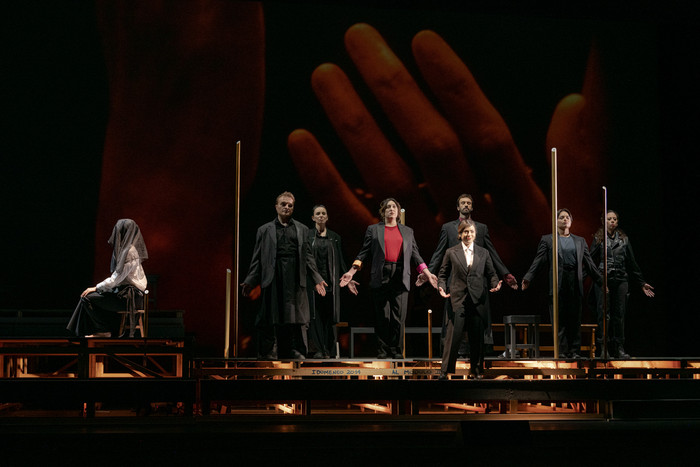
Franco Torchia is committed to promoting the work of Marcella Althaus-Reid, an Argentine queer theologian, through his work on "Theodora," a stage version of Handel's oratorio, directed by Alejandro Tantanian and recently premiered at the Teatro Colón.



Share

Writer, journalist, screenwriter, activist, and host of the radio program "You Can't Live on Love" on the public radio of the City of Buenos Aires, Franco Torchia is now betting on the dissemination of the work of Marcella Althaus-Reid, an Argentine queer theologian, through his work in "Theodora," a stage version of Handel's oratorio, directed by Alejandro Tantanian and recently premiered at the Teatro Colón.
-How was that operation of crossing these two texts, Handel's Theodora with the work Marcella Althaus-Reid, understanding the distance of the temporalities?
Many years ago, I read an article in the Soy supplement of Página/12, written by Dolores Curia, about Marcella. I didn't know her, and it struck me that her work was not only unknown in Argentina but also unknown within the LGBTQ+ community and feminist movements. I was perplexed that such a woman, with such a profound message, wasn't known in the country where she was born, raised, educated, and then left. Some time later, I interviewed the Colombian visual artist Carlos Mota, who creates performance art based on Marcella's work (he works with shibari, and Marcella has a section of her work linked to her bondage practice and its relationship to suffering, sacrifice, and pleasure). At that point, I started researching her, not knowing why, and that was that. When Alejandro Tantanian called me in March and proposed updating or giving a more contemporary perspective to Theodora, a Handel oratorio about a 4th-century Christian martyr I wasn't familiar with, I suggested working with Marcella's work. I saw the possible connections; of course, we had to sit down and establish them. It wasn't easy, but it was possible, and above all because I felt that this was a very opportune moment for Argentina to get to know a feminist intellectual that most people ignore.
-How did they achieve that cross-pollination between languages? What was that process of updating the work like?
-Regarding the text, I establish a fundamental connection, let's say, between that 4th-century martyr (Theodora) and Marcella, the self-proclaimed "indecent" Argentine theologian of the 20th and 21st centuries, who died in 2009 at the age of 53 in Scotland from an illness, and who lived embracing the cause of an "indecent" theology until her last breath. Who were considered indecent in the 4th century, when Christianity was seen as a sect and when the Roman Empire, in a very decadent phase, intensified its methods of torture and persecuted those deemed different? And who are considered indecent in this part of the 20th century, or at least during the latter part? This is a first interpretive dimension of the production. Later, after reading Marcella extensively, I discovered that she wrote to flood the walls, to paint the cathedral, with a vandalistic, poetic style of writing. All the languages present in her work serve our purpose: to bring Marcella's work to the attention of gender and sexual minorities and feminist movements. I believe her work has an impeccable foundation. There have been and are other dissident theologians in Argentina, but we are not in a country where dissident theologies have had much influence, and that's something to consider.
-What would the defense of virtue be today as it appears in Theodora, but from the postulates of Marcella's work?
I think it would be a defense of insurgency, a defense of disobedience, of defiance, of nonconformity. Sometimes I've wondered what Marcella would be saying today, and it's always a rather pointless question, because sadly she's dead, but I'm sure she would be appealing to nonconformity. Her proposal is so profound that it addresses, in any case, the Christianity that resides in our bodies even beyond how we manage them or beyond what we want or don't want to do. That is to say, what was previously called Judeo-Christian morality, to put it very succinctly, today we can point to a subcutaneous Christianity that, without us realizing it, continues to dictate our lives, relationships, affections, our existence. It is the triumph of a Christianity that completely forgot its sectarian and persecuted character, as in Theodora, which, upon becoming institutionalized in certain regions of the world, such as Argentina, came to govern subjectivities at a truly profound level and is difficult to dismantle. I am certain that Marcella's strength today lies in those of us gathered together, not alone, trying to dismantle that which resides within us and which depends not only on political administration or the state, but rather on collective organizations. At the same time, I believe she would be very focused on the right to faith.
-There is a phrase by Marcella that challenges that right to faith and at the same time asks about the " resurrection from the different deaths, returning to life because we love it ".
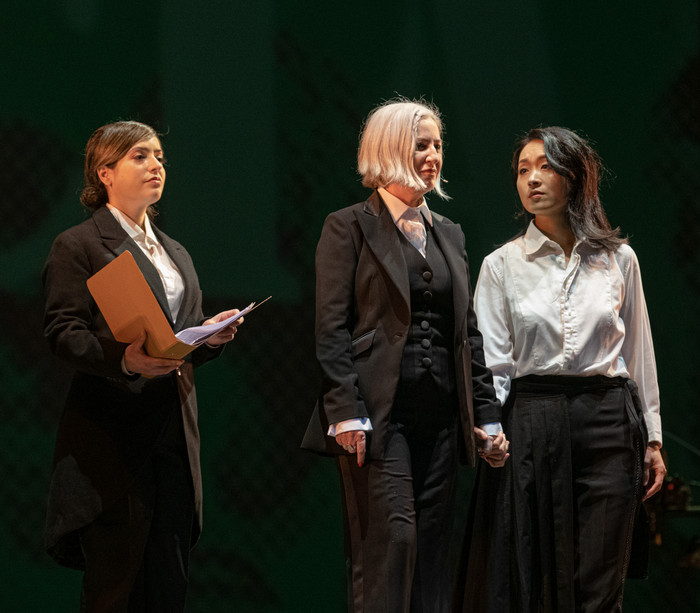
Like Jesus. Today we can ask ourselves who exactly are the resurrected ones. How many resurrections do some of us experience, and not others? I'm referring to the congregation because in Theodora, the role of the choir, as seen in other productions around the world, was massive, and its role is fascinating: Christians who are being persecuted but who never cease to offer their prayers or waver in their faith, which, of course, they are forced to obey. Marcella always thought in terms of congregation, always in terms of groups, in collective action. Just look at how she is known in the rest of the world, and we find dissenting Catholics who discuss her, who reflect on her; this doesn't happen here. Perhaps we need to sit down and think about why. It seems to me that, moreover, in this moment of the pandemic, the question about God, the question about the transcendent, about the meaning of existence, was also very relevant. On the other hand, globally, dissent exists outside of all religions, to a greater or lesser degree. Of course, Judaism has its expressions, but they aren't recognized, and the same is true in so many other religions. Today, seventy countries criminalize homosexuality and dissent, and six of them impose the death penalty. I find it very stimulating to rethink the right to faith, for a gay God.
-Marcella's work invites an "indecent theology." What would that be?
I think the category of indecency can take hold. Rethinking ourselves from that perspective has a lot to do with welcoming misconduct. Marcella turns indecency into a verb that isn't recognized by the Royal Spanish Academy but is nonetheless interesting, and she proposes being able to "indecentize" our bodies with our expressions, with our aesthetics. It could also be said that we must never stop disturbing others or trying to undermine the norms. And I repeat, we must try to completely eradicate a Catholicism that is so deeply embedded in things we don't even perceive. Or, at the very least, to make this Christianity within us a subversive Christianity that doesn't necessarily lead us to become enemies of God or Jesus Christ.
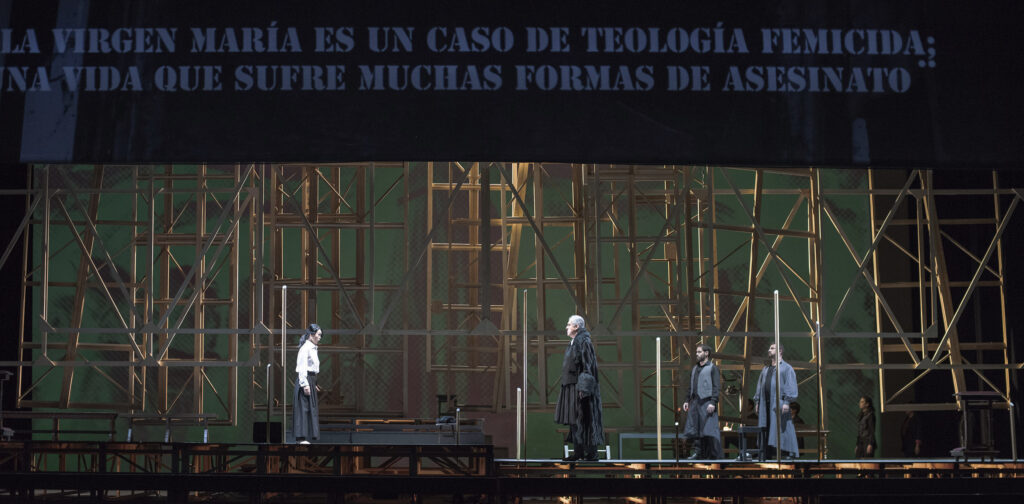
The four scheduled performances will take place on Tuesday, September 28 and Wednesday, September 29 at 8 p.m., Friday, October 1 at 8 p.m., and will conclude on Sunday, October 3 at 5 p.m.
To learn more about the work of Marcella Althaus-Reid:
Thursdays in October at 6:00 PM at Tierra Violeta
Is the Virgin Mary the mummy of the poor?
Coordinated by Franco Torchia along with guests.
We are present
We are committed to journalism that delves into the territories and conducts thorough investigations, combined with new technologies and narrative formats. We want the protagonists, their stories, and their struggles to be present.
SUPPORT US

FOLLOW US
Related notes


We are present
This and other stories are not usually on the media agenda. Together we can bring them to light.