

Almost a century later, Peru's first lesbian novel resurfaces
"Confessions of Dorish Dam", by Delia Colmenares, was published in 1929 and has an explicit lesbian theme in a modernist style.



Share

It is believed that the first lesbian novel in Peru was published in 1929. Delia Colmenares, an author who published her last book of poems in 1950, was silenced for decades. She died in 1968, and her work fell into oblivion. Today, thanks to the work of the feminist publishing house Gafas Moradas , her novel Confessions of Dorish Dam is being republished.
According to Lizbeth Alvarado, founder of the publishing house, there were only two copies of that novel in the world: one in the National Library of Peru, available only to researchers, and the other in the Library of Wisconsin in the United States. Thanks to the support of writer Claudia Salazar, based in the United States, who had studied Colmenares's work, she was able to obtain the book.
“ Confessions of Dorish Dam is a foundational Peruvian novel with a homosexual theme (along with Duque , by José Diez Canseco). At Gafas Moradas, we want to do justice to a classic of Peruvian literature that deserves to be back in bookstores. That is the main objective of supporting this novel. Beyond that, I find the novel incredible. Not only the story, but the way Colmenares approaches the narrative, the details he includes, and how he portrays each of the characters, their feelings, and their realities,” Alvarado told Presentes.
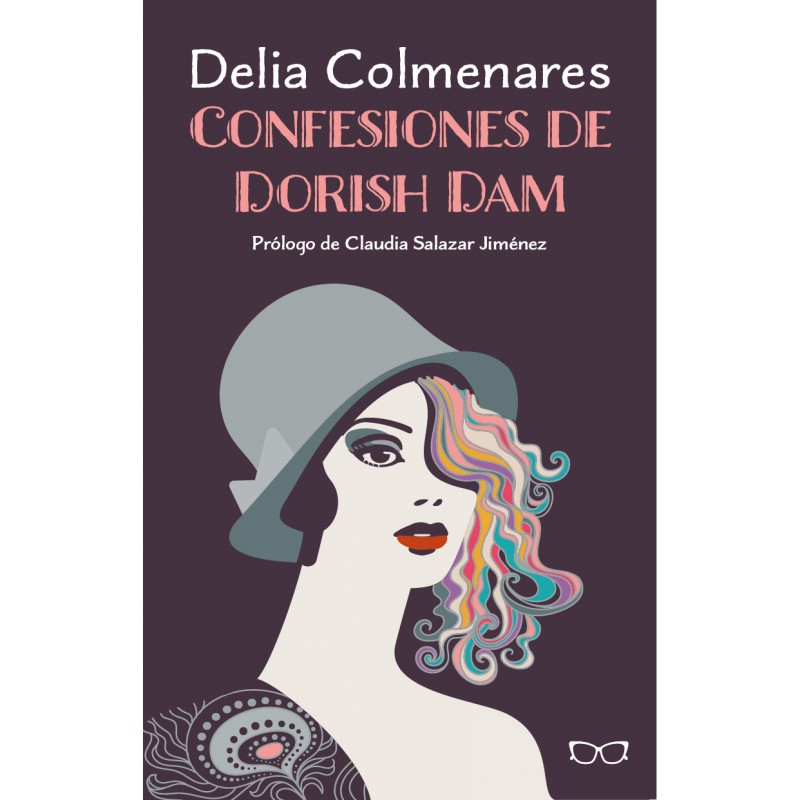
Given the book's obscurity, securing the rights was bound to take time. Alvarado explains: “It was a huge undertaking, months of work and adventure, because I had no contact with the family. I did countless inquiries and, after much searching, finally managed to get in touch with Delia Colmenares' great-grandson. He gave me the contact information for his mother, Delia's granddaughter, and she was crucial in getting the contract signed. She spoke with her siblings, and they all agreed. It wasn't easy, but it was worth it.”
Journalist, poet, and avant-garde woman
But who was Delia Colmenares? Little is known about her, but her biography reveals a woman of the avant-garde. Born in 1887 in Piura, she began her career as a journalist for the magazine Lulú and later for La Prensa . She wrote plays that were staged ( La fuerza del amor , La mecanógrafa Teresa Vernier ), three books of poetry ( Iniciación ; Meteoro: versos; Colapsos ), and two novels in which she captured the pulse of Peruvian society in the 1920s.
Confessions of Dorish Dam is a transgressive work: its female characters exude freedom and pleasure. With refined modernist language, it portrays Lima in the early decades of the 20th century, especially the upper class of the time, and their lives filled with luxury and desires in pursuit of satisfaction.
Colmenares, without a doubt, was a woman of her time (and influenced by Christian morality) but her writing sometimes escapes her sentimental education to portray, with an enormous erotic charge, strong, adventurous women with a license to live the life they wanted.
In 1928, a year before this novel was published, three seminal lesbian novels appeared: The Well of Loneliness (Radclyffe Hall), The Ladies' Almanac (Djuna Barnes), and Orlando (Virginia Woolf). Confessions of Dorish Dam is Peru's contribution to this long legacy of writing about and for lesbians in a time when silence was the norm.
And just as last year feminism rescued Miguelina Acosta; and from cinema the work of critic María Wiesse and director María Barea was revalued, as pioneers of their time who were later made invisible, the rescue of Delia Colmenares brings to light an extraordinary mind with every right to belong to the literary canon that has kept her hidden for so long.
Passages of explicit lesbianism in a modernist style
From the preface, the novel presents itself as a manuscript that Dorish Dam gives to a writer she meets on a ship during a voyage across the Pacific. These writings are “a confession” of her exotic and cosmopolitan experiences. From this initial exchange, the lesbian attraction becomes evident: “The beautiful figure of this woman captivated me greatly. She seemed like the sublime and devilish creation of a Leonardo da Vinci print. There was something extraordinary of life and mystery in her horizon-blue eyes.”
When Dorish Dam explains her relationship with the Baroness of Suleiman to a party guest: “Don’t you know? I’m going to be honest with you, I’m going to speak plainly. I’m not ashamed; I’m more ashamed of being a hypocrite. Yes… the Baroness is my great love, or rather: she makes love to me. It’s enchanting! When she first met me, she was constantly showering me with flowers, perfumes, chocolates… I went everywhere with her; then she would kiss me, saying very sweet things, like I was so good and so beautiful that she admired and loved me for that reason… Just like a man in love with a woman. Then came the sensual part: wanting to see my body to caress it, and from the caress came the vertigo and the spasm…”
A sexual encounter between the Baroness and Dorish: “And the Baroness’s lustful desire was revealed in the eager gaze she had to see and touch my breasts again, which I brought out into view to convince myself of what she was going to do. Immediately her hands took hold of them and caressed them. And then she kissed them.”
We are present
We are committed to journalism that delves into the territories and conducts thorough investigations, combined with new technologies and narrative formats. We want the protagonists, their stories, and their struggles to be present.
SUPPORT US

FOLLOW US
Related notes



We are present
This and other stories are not usually on the media agenda. Together we can bring them to light.