

The future is now: we must unite in our diversity and fight against climate collapse
The new IPCC report sounds the alarm for humanity, emitting apocalyptic chants that in their verses sing of irreversible changes for centuries and millennia.


Share

Today, once again, the scientific evidence regarding the socio-climatic and ecological collapse on a planetary scale is becoming increasingly compelling. The big question is: how much more evidence is needed to diagnose the situation before we move to action, to acknowledge the crisis as such and act accordingly?
A new scientific report from the IPCC (Intergovernmental Panel on Climate Change, the highest-ranking scientific body on climate has just been published . The study, prepared by 234 experts from 66 countries, including Argentine scientists, is a summary of what we have been seeing on social media these past few weeks: Turkey evacuated, ravaged by wildfires; Russia in a state of emergency due to unprecedented fires in Siberia; more fires in Italy, Greece, and Spain; snow in southern Brazil; heat waves in Canada; more fires and evacuations today in California; deaths and disappearances in Germany and Belgium due to the worst storms of the century; an avalanche in Japan; floods in China and London; and a historic low water level in the Paraná River in Argentina. And to top it all off, the Amazon, the former lung of the planet, is emitting more carbon dioxide than it is able to accumulate, due to the increasing destruction to which it is being subjected, along with all its inhabitants.
A dizzying domino effect is unfolding, where globalized colonial capitalism, deeply extractive in its survival practices, has created the game and flipped the first piece long ago. The last? The imminent abyss of a possible extinction of almost all life forms on the planet, including human life, of course. Isn't it time to put a stop to it?
The new IPCC report sounds the alarm for humanity, issuing apocalyptic pronouncements that foretell irreversible changes over centuries and millennia. It concludes that even if countries began drastically reducing their emissions today, global warming would very likely increase by about 1.5 degrees Celsius in the next two decades, meaning the dangers we face will increase considerably.
The future is now
Nearly one billion people worldwide would be forced to live in areas of desertification and water stress, endangering their lives and leading to mass migrations and struggles for survival, compounded by the intensification of extreme weather events. A vast majority of animal and plant species would continue to face extinction, further fracturing ecosystems and drastically worsening the global situation and the planet's regenerative resilience.
Today, due to human activity, the concentration of carbon dioxide (CO₂) in the atmosphere is the highest it has been in the last 2 million years. This is compounded by the concentrations of methane and nitrous oxide—the other two major greenhouse gas (GHG) contributors to global warming. As a direct consequence, the increase in average global temperature is already 1.1 degrees Celsius above pre-industrial levels, and the rate of global warming is unprecedented in the last 2,000 years. The report's conclusion is that we have so long postponed reducing fossil fuel emissions that we can no longer avoid the intensification and uncertainty of the climate-ecological social breakdown (the ongoing collapse), but we still have time to avert the worst consequences.
It's worth noting that the IPCC's final reports typically use conservative language because they must be approved by consensus among the representatives of the 195 countries participating in climate negotiations at the UN. This suggests that the situation could be even worse.
However, it would be strategic to categorically refuse to succumb to the inevitable disaster, to the apocalyptic idea as our only destiny—a notion so convenient for that corporate 1% that brought us to this point—because that would represent collective suicide, an avalanche of our ideas, desires, capacities, creativity, pluralities of action, and potential . Taking the reins of a paradigmatic transition is urgent. What is at stake is who will face this new civilizational stage and how; under what dynamics will we create a just transition, slowing the collapse, and cultivating profound relational and communal resilience. Before it is too late, before the hegemonic powers impose their own.
We can no longer delay action. We are witnessing an unprecedented social and ecological massacre that reveals the planet's limits and, consequently, also marks the limits of capitalism. We need to organize, to weave ourselves into networks of intersectional care, to unite our struggles under a common horizon or foundation of socio-environmental justice. It is not just about keeping the planet below certain global warming thresholds. We are fighting for the continuation of life as we know it on this precious planet. I want to refuse (and I want you to refuse) to yield to its total destruction by a predatory, scavenging, and fundamentally abusive system. I want us to stand up in defense of Life as if there were no more time, because there isn't. The imminent future is at stake, and the field of action is today, urgently. The responsibility of the adult world cannot be postponed in the hope of new generations. If there is love for those who are to come, the time to act vehemently is now.
What Indigenous Peoples Have to Say
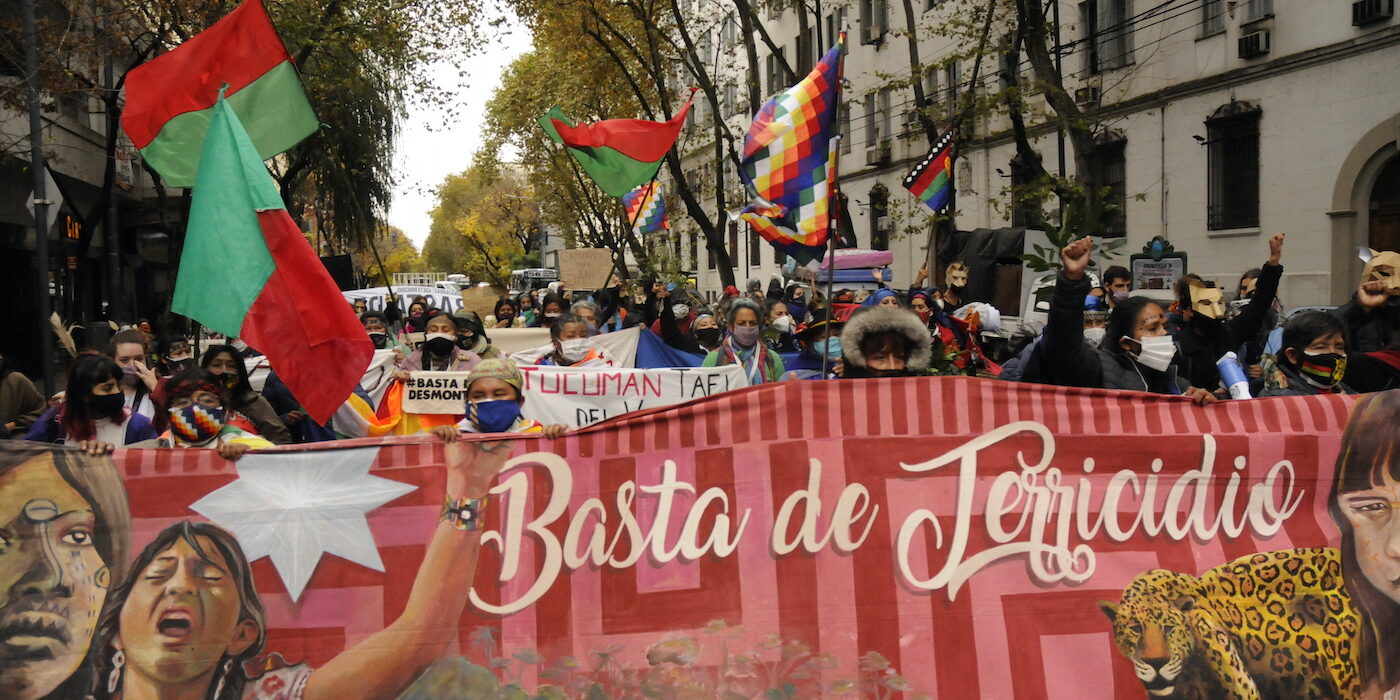
Finally, whether by chance or not, the new IPCC report emerges on the International Day of the World's Indigenous Peoples. This is a profound reminder to our urban communities that turning our gaze, attention, support, accompaniment, spaces, and struggles toward Indigenous nations in their territories is essential. The resilience of Indigenous Nations in the face of extermination is historical, as is their capacity to coexist for millennia in reciprocity with other forms of life. We can learn much from the unfolding of the ancestral path toward good living and good dying , from the plurality of non-Western cultures and epistemologies. Let us unite in our diversity to ensure a dignified, possible, and vibrant future. In the words of Moira Millan, Mapuche Weychafe: “Ultimately, we are all the peoples of the world, all beings on the planet and the forces that inhabit it share a single identity: earthlings. That is why Terricide must end. And we are not alone in this task; the wisdom of the land, the Mapu, is our main ally.”
Let's wake up.
Share
We are present
We are committed to journalism that delves into the territories and conducts thorough investigations, combined with new technologies and narrative formats. We want the protagonists, their stories, and their struggles to be present.
SUPPORT US

FOLLOW US
Related notes


We are present
This and other stories are not usually on the media agenda. Together we can bring them to light.
1 Comment