

Transfeminists and indigenous women protest violence and health issues in Paraguay
Amid Paraguay's social unrest against the government, LGBT+ people, feminists, and indigenous women are making their demands for urgent needs exacerbated by the pandemic.

Share

By Juliana Quintana, from Asunción
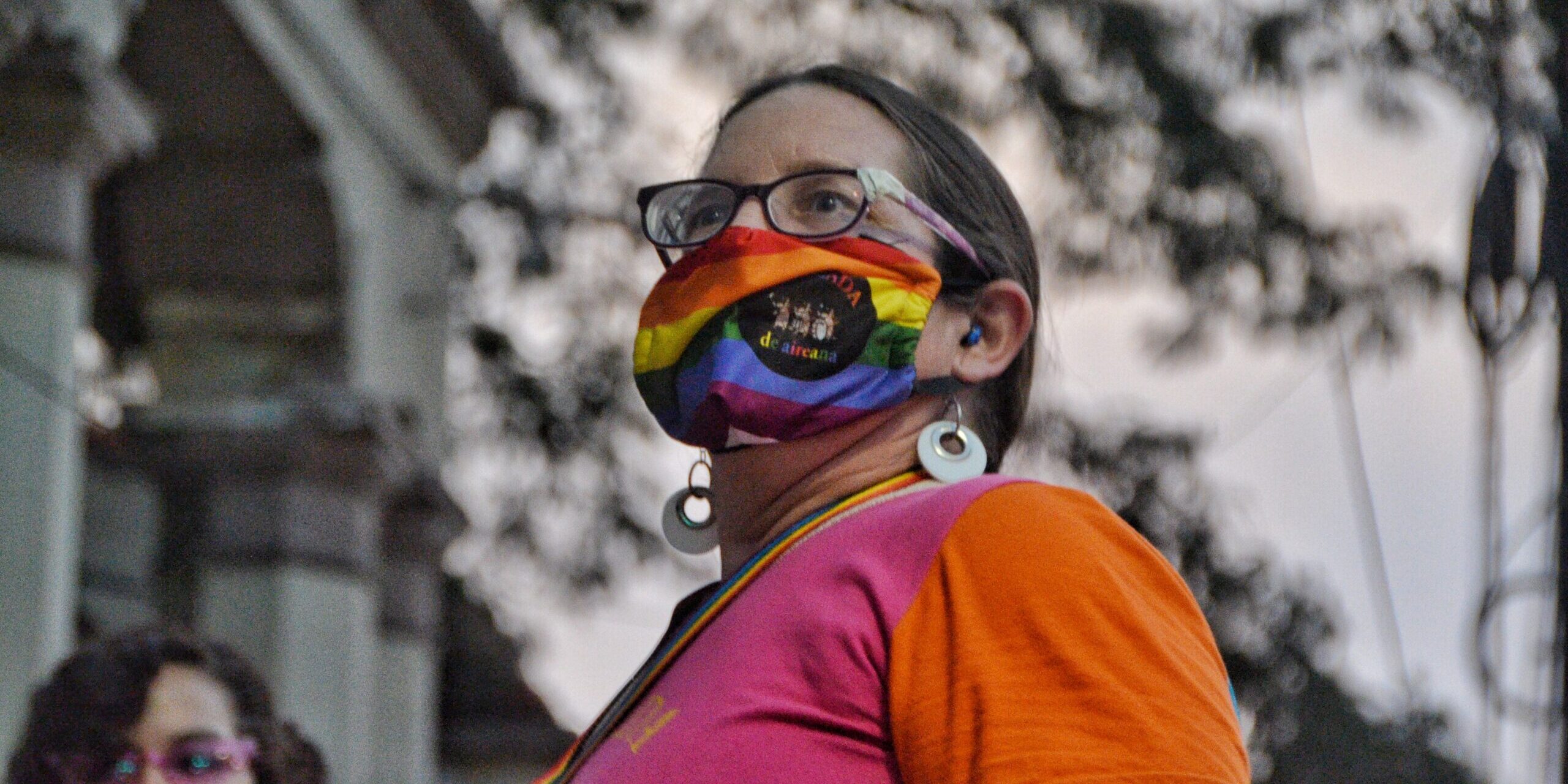
Photo: Jess Insfrán
Chanting “Out with Marito” and “Marito, you’re trash, you’re the dictatorship,” citizens in Asunción have been demonstrating against corruption for three days. Since Friday, March 5, people have been mobilizing in the city center in response to the health, social, and economic crisis caused by the pandemic, which has been neglected by the authorities. Today, under the slogan “Alive, diverse, and with rights,” the feminist organization Paro Mujeres Paraguay (Women's Strike Paraguay) called for a mobilization for #8MPy (International Women's Day).
Exclusion of the LGBT population intensified during the first year of the Covid-19 pandemic. Last year, Rohendu , a lesbian advocacy group, handled 200 cases, including reports of violence and requests for counseling and psychological support. Between March and August 2020, the period of strict restrictions due to the health emergency, the number of calls requesting help for panic attacks, anxiety, or suicidal thoughts increased by 55% compared to 2019.
“What happens with young people is that their only escape is being with their friends. Leaving the house allows them to feel safe and secure in a context of discrimination and violence. Forcing people to stay locked up meant there was no respite, and this was reflected in the calls to Rohendu ,” says Rosa Posa, an activist with Aireana.
Trans people and health
Regarding access to healthcare for transgender people, activist and human rights defender Yren Rotela explains that state neglect has worsened. There is no official data on transgender people with COVID-19, on those who have recovered, or even an indicator of how many are living in conditions of health emergency. “If there aren’t enough supplies for the entire population, imagine a transgender woman arriving at a health center in critical condition. Without medication, how will she survive?” she says.
Health has always been a crucial issue for the trans community. Having been expelled from their families, many live in shelters and must find ways to get through isolation. “We take care of ourselves as best we can. We wear masks, we sanitize, but we are in danger because we never stopped doing sex work. We are exposed, on the street, because we have to live, eat, and pay rent. We believe it is necessary that there be medication for everyone without any distinction,” Yren points out.
Indigenous women
According to Perla Álvarez Brítez, a member of Conamuri, the Organization of Peasant and Indigenous Women, the Ministry of Health's COVID-19 prevention protocol for Indigenous communities and peoples was developed without consulting them and without considering their cultural practices, threatening even their food security. “Public policies often fail to protect the rights of communities. At one point, they prohibited people from going out to fish or hunt due to the risk of infection,” she observes.
Some consequences of the lack of state protection in rural communities included an increase in unwanted pregnancies, especially among girls; a lack of attention from the relevant authorities to reports of gender-based violence; and health complications for women due to a lack of supplies to treat underlying illnesses, such as cancer . “In this situation of misrule that we still have, in these circumstances of a total inability to propose effective solutions in health matters,” Perla believes.
Six femicides in the first months of 2021
According to records from the Ministry of Women's 137 SOS hotline, gender-based violence increased during the quarantine, exceeding 80 reports per day in March of last year alone. In 2020, 36 femicides were recorded, leaving 51 children orphaned, and so far in 2021, there have been 6 murders of women due to their gender.
Michi Moragas, a lawyer and feminist activist, explained that the femicides recorded by the prosecutor's office are not all that occur, and that there are femicides that the State does not recognize as such. In many cases, femicides are not counted because the perpetrator commits suicide immediately after killing the woman, or an investigation is not opened.
“There is a discrepancy between their data and ours because we also include transfemicides and femicides of Paraguayan women that occurred abroad. Obviously, that doesn't matter to the State, but it does to us,” she says.
One of the issues that concerns the feminist movement is the lack of effective responses from the judicial system. From January to February 2021, in 5 out of 10 attempted femicides, the women had already reported their aggressors for violence. Two of the six femicide victims had also filed reports.
“The justice system ignores reports of violence. They don't take domestic violence seriously because they don't consider it a serious matter. When you call the police about a case of violence, they don't help the victim. You have a better chance of being heard if you report a robbery than if you report a case of violence ,” Michi points out.
In Paraguay, Law No. 5,777/16 “On comprehensive protection of women against all forms of violence” incorporates femicide as a form of violence and classifies it in article 50 with a prison sentence of 10 to 30 years.
Comprehensive Sexuality Education and Gender Perspective
The pandemic relegated people who were already discriminated against to a situation of greater vulnerability. Including lesbians in the gender perspective means that they must be present in all measures to eradicate and prevent violence against women. Rosa Posa points out that it is very difficult to implement gender policies in all ministries with a government that denies even the word "gender."
“What we want is for the government to care about everyone, and for us to be included in that care. We want everyone to have access to healthcare, and obviously, neither sexual orientation, nor gender identity, nor gender expression should be an obstacle to accessing it,” Rosa says.
“Comprehensive Sexuality Education (CSE) is fundamental. We can’t keep talking about escaping violence if we don’t have an education policy,” Michi argues. “ This policy has to eliminate the social foundations that sustain violence, such as sexism. It’s a social foundation that justifies, legitimizes, and condones violence. It’s a long-term project, but we have to start. If we don’t start, we’ll never get there.”
Police repression and media cover-up
The resignation of Health Minister Julio Mazzoleni on Friday was followed by calls for the resignation of anti-rights Education Minister Eduardo Petta, Chief of Staff Juan Ernesto Villamayor, who is linked to several corruption cases , and Minister of Women Nilda Romero.
From day one, the police repressed and persecuted citizens. On Friday, they fired rubber bullets and tear gas on El Paraguayo Independiente and 14 de Mayo streets. There was also a demonstration in front of the National Republican Association (ANR-PC) headquarters, where people held a peaceful sit-in and demanded that “they all leave.”
Yesterday, self-organized groups arrived at the home of former President Horacio Cartes, leader of the Honor Colorado movement. Starting at 11:00 PM, police again used tear gas and rubber bullets to disperse the protesters. At least five people were reported injured.
The main reason for the protests was the widespread complaint about the lack of supplies and medications in hospitals, which forces relatives of Covid patients to buy them on their own. In a country where the healthcare system operates through raffles and chicken dinners organized by its residents, and where few earn the minimum wage (G. 2,192,839, about US$329), the cost of some medications, such as Atracurium, can reach up to 115,000 guaraníes (US$22.51).
The mobilization, which has been trending on social media for 3 days with the hashtags #EstoyParaElMarzo2021 and #QueSeVayanTodos, in some cases, calls for the resignation of President Mario Abdo Benítez and his line of succession, and in others also demands that the position not be occupied by any more members of the Colorado Party, which has dominated the political scene for more than 70 years.

We are present
We are committed to journalism that delves into the territories and conducts thorough investigations, combined with new technologies and narrative formats. We want the protagonists, their stories, and their struggles to be present.
SUPPORT US

FOLLOW US
Related notes

We are present
This and other stories are not usually on the media agenda. Together we can bring them to light.