

How the Guatemalan state excludes trans people from the healthcare system
Although Guatemala approved a healthcare protocol for trans people in 2015, this investigation includes reports of mistreatment and exclusion in health centers and hospitals.

Share

In 2015, the government approved a healthcare protocol for transgender people. The idea was to provide comprehensive care for their common illnesses, as well as psychological and hormone replacement therapy, but it only existed on paper. No money has been invested in training and awareness programs for medical staff. Transgender groups report mistreatment and exclusion in health centers and hospitals.
Research team in Guatemala: Saira Ramos, Morena Joachin and Pilar Salazar / Photos: Morena Pérez Joachin *
A hypertensive crisis, gastrointestinal bleeding, severe anemia, and kidney failure led Melany Rivera to Roosevelt Hospital in Guatemala City for the second time that year on August 19, 2020. Doctors admitted her to the shock unit of the adult emergency department. Her condition was so critical that she fell into a coma. The following day, she was transferred to Intensive Care Unit 1, which has a capacity for 14 patients. She spent her final hours connected to a ventilator. She died on September 13 at 1:00 p.m. She had all the illnesses she was admitted with, plus pneumonia.
Melany would have turned 31 last Wednesday, January 27th. She was born in the capital and worked as a nursing assistant. She was dark-haired, with a strong and robust build. We met her in early March 2020; she was friendly. She was creative, always looking to organize educational talks for her neighbors and colleagues, and she had leadership qualities. She was the vice president of the Trébol collective, an association of transgender sex workers who live in the Trébol area, a noisy place frequented by people involved in illicit activities. She also founded an Alcoholics Anonymous group for transgender women, says Jeaneth Contreras, the collective's current president.

Melany made one of her last calls with her. Contreras is the main witness to what her companion suffered during the 25 days she was hospitalized. She maintains that the medical staff did not respect her gender identity . They treated her as a man. She believes that the main cause of her death was the coronavirus infection, aggravated by her pre-existing conditions.
Marco Antonio Barrientos, director of Roosevelt Hospital, denies the spread of the virus. He says that only Intensive Care Unit 2 is for Covid-19 patients. In a telephone interview, the gynecologist asserts that the hospital has beds for both women and men, but that if a transgender person needs to be admitted, the center has rooms available for them.
The head of Roosevelt admits that Melany never reached the place she was supposed to be: “She was never in a normal bed. Melany, as you call her, came in a critical condition and when she was admitted, she was registered as Carlos González” —her name assigned at birth—.
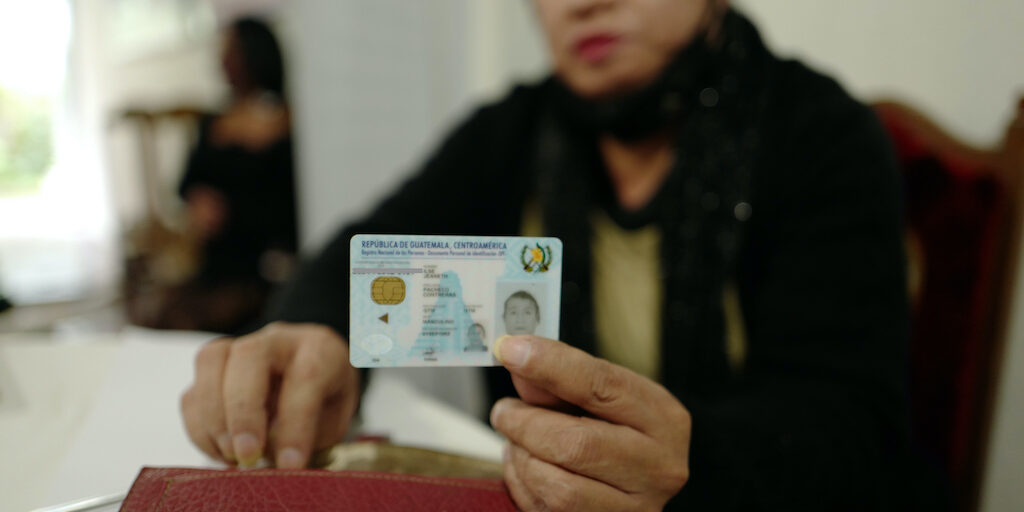
The gynecologist justifies his actions by saying that Melany's identification document stated " male ." "We tried to implement the strategy," he said, "but given the severity of the situation, our obligation is to safeguard her life. Our suggestion is that she go to the civil registry (Renap) as soon as possible to change her gender marker so that her identification document reflects her gender and allows us to identify her." What the doctor ignores is that in Guatemala, a transgender person can change their name, but not their gender marker on the registry he's referring to.
The transphobia that Jeaneth denounces—discrimination against trans people—in Guatemala's healthcare system has a reason. In 2015, the Ministry of Health approved a landmark measure: the first Comprehensive and Differentiated Healthcare Strategy for trans people . This public policy, led by the ministry's Gender Unit, was responsible for training healthcare personnel to recognize and respect trans gender identity.
The public policy was distributed throughout the healthcare system, but medical personnel have not been trained to implement the document or understand the context of stigma and discrimination against transgender people . Although the strategy explains the context of the transgender population, it does not include protocols, guidelines, or training for healthcare staff. That was the next step, but it never happened. The strategy was never implemented.

Jeaneth sits at a round table covered with a white tablecloth. She taps a pen on the table. She's upset. Behind her hangs the five-striped flag—two light blue, two pink, and one white in the center—that represents the trans community worldwide. Between August 17 and September 13, Jeaneth didn't stay still. She spoke with the Office of the Ombudsman for Sexual Diversity at the Human Rights Ombudsman's Office (PDH) and with civil society organizations. The response was unanimous: they couldn't go to the hospital because of the risk of Covid-19 infection.
Nearly 5,000 trans people discriminated against
In Guatemala, as of 2015, there were approximately 4,840 transgender women. Guatemala City had the highest concentration of them. Thirty-five percent were engaged in sex work, 30% worked in the beauty and arts industries, 42% were employed or owned their own businesses, and 7% were unemployed. The majority, 61%, reported incomes below the minimum wage (3,075 quetzales), according to the latest report by Hivos, an international cooperation organization.

The ministry took five more years to design a communication strategy to raise awareness among professionals in the sector, but it is still not being implemented. This is a difficult objective when the government has not allocated a budget to the model. Healthcare personnel remain unprepared to respond to the basic needs of the trans community, such as hormone replacement therapy, chronic illnesses, gynecological care, mammograms, and infections caused by injecting mineral oils and silicones anywhere in the body, because the ministry does not perform gender reassignment surgeries .

Jeaneth settles into a wooden chair, touches her hair, and frowns. She asserts that the healthcare system neglected Melany. If the strategy were working, she says, her friend would have attended her medical appointments without fear of discrimination and before her health deteriorated. She indicates that she documented the case, doing so because of a lack of records that are the State's responsibility.
In 2009, the organization Otrans Reinas de la Noche began working on public health policy for transgender people, recognizing the need for comprehensive care, not only for sexually transmitted infections, HIV testing, and condom distribution, but also for drug problems and common illnesses. This was the prelude to the current strategy, a joint effort by civil society and international cooperation, prompted by the government's apparent lack of interest in the health of this population.
In 2015, Mariano Rayo—who had previously served as a congressman for the right-wing conservative Unionist Party—was Minister of Health in the transitional government following the government crisis of former president Otto Pérez, who was imprisoned at the time. He was the one who approved the comprehensive health strategy, which had been shelved for four years, he recalled in 2020.
From his home, seated in an executive chair, Rayo gestures extensively to express himself. He says he became convinced after reading and hearing about cases of stigma and discrimination within the public healthcare system. Rayo signed the authorization and dissemination of the strategy after Astrid Grissel López, then head of the Gender Unit, explained its contents to him. He did so in an hour, weeks after the economist assumed the position of minister. At this point, the health strategy had passed through two different administrations without success. Rayo sips his coffee. He rejects the notion that the strategy's failure is due to transphobia. There are "other daily needs," he says.
The devil harassed Jeaneth
Jeaneth is 55 years old. She is one of the pioneers of the trans movement in Guatemala. She likes to wear red lipstick, long necklaces, and powder her face. She was born in Santa Rosa, in the southeast of the country. With her family, she migrated to El Gallito, one of the most violent neighborhoods in the capital, in Zone 3, very close to the General Cemetery. As a child, her father and one of her brothers wanted to “correct” her feminine behavior. A teacher raped her when she was eight years old.

In a voice message, she recounts the latest death threat. It occurred on January 16, 2021, when a man working as a security guard at the hotels in El Trébol pulled out a gun and pointed it at her head. He told her he would kill her if the thirty members of the collective didn't pay 15 quetzales a day for their protection. The situation has impacted her health; she suffers from diabetes and hypertension. It has also affected her income, which has decreased because she hasn't been able to work and has had to sell some of her belongings to buy her medication and survive. She fears being murdered and doesn't want to leave her daughter, grandchildren, and nephews alone.

El Trébol is located at the intersection of Bolívar Avenue and Liberación Boulevard, two major thoroughfares in the city. It is the area where transgender women from the community, who have historically been excluded from employment opportunities, live and work as sex workers. During the day, the El Guarda market, a bus station with routes to western Venezuela, a soccer stadium, several hotels, bars, and cantinas operate there. At night, the sirens of police cars and ambulances can be heard. Roosevelt Hospital, where Melany died, is located one kilometer away.
In a guesthouse, the members of the Trébol collective rent a space each time they meet; the fee is 100 quetzales. It's Thursday, November 5th, three in the afternoon. They have to elect their board of directors. Jeaneth pauses, asking for her companions' attention. She recalls that they first organized in 2010. They sought to protect themselves from the threats and extortion, of which they are once again victims. Applause fills the room; it's for the new board, made up of five of them. They prepare coffee to share among everyone. They read aloud the agreements and arguments they want to discuss to ensure their rights are upheld. Following that, they participate in a Bible reading about preventing alcohol addiction. Some laugh, and others talk aloud about their life experiences.

Jeaneth sits on a brown sofa in the living room, the setting sun shining on her face. She talks about her experience at the General Hospital, where she underwent three surgeries to remove the mineral oils that were causing infections in her breasts. The last one was in 2016. She remembers a doctor telling her that “the devil had tormented her” and that this had led her to inject herself with those substances. Meanwhile, a nurse assured her that this happened because she “put things into herself that are for women.” Her birth name was written on the headboard of her bed. They called her “Don Roberto.” She corrected them, but it was no use.
She feels that those who performed the surgery punished her for disagreeing with her sex work and gender identity . She says this because they left her with large scars that make it impossible to find what remains of her breasts. She can't prove it.
On the night of January 18, 2021, two days after the death threat, Jeaneth sent another voice message, explaining that she had tested positive for Covid-19 a month earlier. Her recovery had been slow, and she still suffered from the physical effects of the illness. She didn't want to go to the hospital. She was afraid of experiencing something similar to what Melany had. She preferred to die at home.
The woman the doctor found disgusting
The noise comes from the numerous mechanics and carpentry workshops. They surround the clinic that most trans people who need to see a doctor in the public system go to, like almost all the women in the Trébol collective.
The area specializing in sexually transmitted infections (STIs) is next to the Zone 3 health center. It's where trans women go because most of the women who visit the area are sex workers. The healthcare system has traditionally assumed they go there for STIs and HIV. In theory, they should go to any center for any other illness, but that's not the case. It's located next to the General Cemetery, where Melany is buried.
In 2011, doctors specializing in STIs began reaching out to transgender women to understand their health needs and learn about their context. Jeannette Gutiérrez de Ochomogo, the current director and a physician, speaks from her home via Zoom.
She recounts that Debby Maya Linares—one of the founders of the trans movement in Guatemala—led the meetings with healthcare personnel. The result was the establishment of the technical committee that currently leads the Gender Unit, and where the need to create the current health strategy arose.
Gutiérrez de Ochomogo is empathetic and demonstrates a willingness to serve the trans community. She believes it's essential for all staff to be permanent at the specialized center, since when there's a staff change or transfer, it's difficult for new personnel to arrive trained and sensitive. " Many people don't stay on; they leave because they don't feel comfortable with the trans population ," the doctor admits, pausing to sigh.
She adjusts her glasses and explains that she's on leave, a concept used in the healthcare system that allows those with chronic illnesses to work from home and avoid Covid-19 infection. She recalls that before the pandemic, at the initiative of the administration, they were training medical students from the state university . "So they would know how to treat the trans population, something we weren't taught in our time," she says.
It also indicates that patients are assigned a number, which they use when attending to patients at the clinics. This prevents medical and administrative staff from calling them by a name that doesn't align with their gender identity . Even so, Jeaneth Contreras says that the administrative staff in the STI area discriminate: they call trans women by the name they were assigned at birth and delay processing their files for outpatient appointments . While filling a glass of water and taking her blood pressure medication, she explains that she was able to buy it through a fundraiser . She has been going to the specialized area for over two decades.
She recalls when, 15 years ago, she defended one of her colleagues from the Trébol collective who had arrived for a routine HIV checkup. “They left her for last. First, they attended to the women who, based on their physical appearance, were born with female sexual organs, whom they understood to be women. So I went into the clinic and asked Dr. Delia Cuellar: ‘Why don’t you want to see her?’ She told me that she was disgusted by her and because she always arrived dirty,” which, given her attitude, would be transphobia .
Following the complaint, an administrative procedure was initiated against Cuellar, which resulted in her transfer to another health area. Her misconduct was not serious enough to warrant dismissal.
“We are creating a new group of people free from stigma and discrimination. We have told the trans population to be patient with us because the new staff have worked with common illnesses, not with trans people,” said the director of the STI specialist area.
Alondra's STI cream
Wednesday, November 11, almost four in the afternoon. Alondra Castellanos and five other members of the Trébol collective want to take advantage of the last rays of the sun to have a photo session, the one that accompanies this report, in the different environments of the house they rent to hold their meetings.


Alondra, with her dark skin and slender build, is a trans woman and Tz'utujil indigenous woman from the department of Sololá, in the Guatemalan highlands. While brushing her hair, she says she is 18 years old and arrived in the capital two years ago, where she lives with her mother, with whom she moved. Between nervous laughs and sighs, she mentions that she found advice and support within the community. She dreams of traveling to Mexico. She wants to have surgery to achieve a physical appearance that aligns with her gender identity.
As a minor, Alondra went to the specialized center in Zone 3. She was diagnosed with an STI. She cried a lot. The doctor who treated her told her to “forget what happened, rest, and apply creams and medical treatment to the wounds.” That was the first and last time she used the public health system. The system didn't respond to Alondra then. Nor did it respond to Melany Rivera years later, according to Jeaneth Contreras.
There are no funds, no established pathways, and no clear answers from the authorities regarding the needs of Guatemala's nearly five thousand transgender women. Alejandra Estrada, the current head of the Gender Unit, remains silent, refusing to discuss the project despite it being her responsibility. She declined to provide information on the strategy's progress and delegated it to the communications department, who then put us in contact with the National Program for Sexually Transmitted Infections (STIs) and HIV/AIDS.
Juan Carlos Fonseca, the program director, admits he's not entirely sure why he's the one speaking about the strategy. But he attempts to explain: he's been working on the document since 2019 to train healthcare professionals on how to treat transgender people. Gutiérrez de Ochomogo, the director of the STI center, also doesn't know why the program has been assigned this role.
When the ministry was asked why the National Program was leading the implementation process of the document to train healthcare personnel on how to treat transgender people, the public information unit responded that the program was not leading the process. The responsibility lies with the entire public healthcare system.
its responsibility for the health of trans people .

On November 25, the Trébol collective participated in the march for the International Day for the Elimination of Violence against Women. Alondra was at the march. She never left Jeaneth's side. She sees her as a guide, the voice of the collective, a leader. That day, Alondra dressed differently, wearing pants, a t-shirt, and a cap. She had to look for work.
On a pink poster, adorned with flowers, they affixed Melany's photograph. It was almost noon when, in front of the Government Palace, they shouted in unison: "Justice!" The death of the former vice president of the Trébol collective went unreported because there is no trust in the justice system .
Melany was buried in the General Cemetery. On September 14th, at eleven in the morning, in niche 14,809. Due to pandemic restrictions, none of her colleagues from the collective were able to attend.
Melany Rivera's tombstone reads "Carlos González," the name she was given at birth and at death.
*This report was produced with the support of the International Women's Media Foundation (IWMF) as part of its Express Yourself! initiative in Latin America.

We are present
We are committed to journalism that delves into the territories and conducts thorough investigations, combined with new technologies and narrative formats. We want the protagonists, their stories, and their struggles to be present.
SUPPORT US

FOLLOW US
Related notes



We are present
This and other stories are not usually on the media agenda. Together we can bring them to light.