

Trans imaginaries in rites of passage: symbolism and power
"Valuing and protecting people who build bridges, tear down borders, mend tears and heal cracks is something we should learn from other cultures."

Share

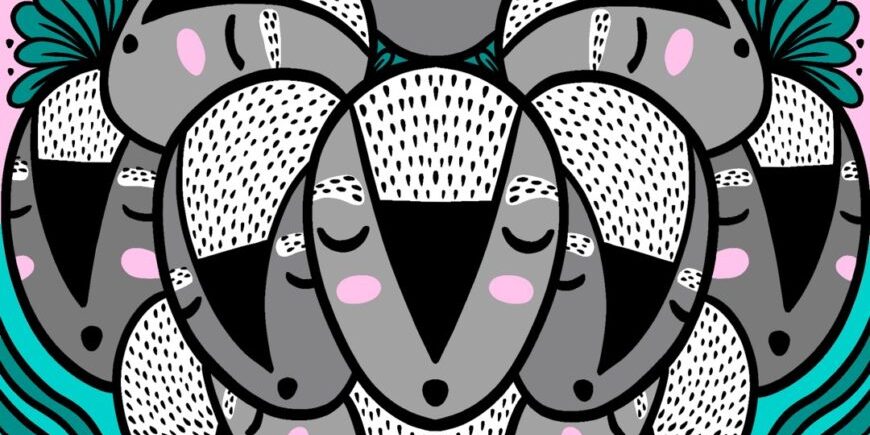
By DEA Illustration by Julia Villarrubia Pinés (Pulgui Esmeralda) for Pikara Magazine*.
We use the verb 'to transition' to refer to the specific transgender experience, but the truth is that all human beings, without exception, transition throughout their lives. We undergo profound endocrine changes that make us hardly resemble the person we left behind . Some examples of this could be puberty, pregnancy, aging, and menopause. These rites of passage are not without artifice. During this time, we voluntarily enroll in chemical hormone treatments, prostheses, surgeries, laser hair removal, grafts, incisions, and excisions. In most cases, we emotionally disconnect from these changes or experience them with a good dose of self-loathing. Society, meanwhile, ignores, renders invisible, or judges them.
If these changes are related to sexuality, they generate even more terror. Thus, we tiptoe around the possibility of experiencing and radiating social transformation, of taking the part for the whole, transforming our capacity for physical change into a social force. There is no society without a symbolic imaginary, and for this reason, it is urgent to begin incorporating powerful models of personal evolution into our development as individuals. What better way to do this than through the transgender experience? The capacity to fill that empty space between boundaries, to cross them, to go “between” something, is reflected in the Latin prefix trans- .
Valuing and protecting those who build bridges, tear down borders, mend tears, and heal rifts is something we should learn from other cultures. We must recognize the worth of those who dedicate their lives to adding the prefix "trans- " to every fundamental verb in life's actions: transmute, transgress, transplant, transition.
Many communities, beyond the monolithic modern Western paradigm, have respected the power of personal change. Sometimes, ceremonies have been maintained that protect and honor the various types of metamorphosis, as well as their rites of passage, understood as a significant life moment that, ideally, is accompanied by intergenerational care and public recognition of progress on life's path.
In these societies, some of their members choose to embody the latent force of transformation through their intensity and courage. They are known by different names. Here and now, we call them trans and attack them without considering that those who manage to break free from the dark tradition of the gender binary and rise above that social prison represent, for everyone, the power to emerge like no other social agent.
When a trans person decides to take the step of becoming visible as such, they embody an extraordinary power: the belief in the power of change. As a society with a horizon of justice to aspire to, the presence of this power should be a point of reference for us, a transgressive politics that creates knowledge from the body. And this is how other communities with a less impoverished, and therefore much more interesting, framework of thought than our own understand it. Here I offer only three examples, but there are many more: the Fa'afafine in Samoa, the Omeguid of the Kuna people of Panama, and the Bugis in Sulawesi , among others.
The trans power of the American peoples
We in the West are still far from showing due respect for the trans power exhibited by some Indigenous peoples of the Americas. For the Mojave Nation, the so-called “two-spirit” people embody sacred balance, the driving force of creation, and the cradle of their cosmogony . For this reason, they have specific rituals for transitioning, such as performative menstruation. In 1990, this tradition was updated by coining the term “two-spirit” at the Third Annual Convention of Indigenous/First Nations Gays and Lesbians in Canada. The summit's objective was to protect the tradition of respect for those who are both men and women and to reaffirm resistance to colonization, which includes the fight against transphobia imposed by Europe.
Therefore, emphasis was placed on gender binarism as yet another form of cultural violence perpetrated by imperialism . To further explore how Indigenous peoples of North America understood gender, Serena Nanda , *Gender Diversity: Crosscultural Variations * (1999), is highly recommended. It also addresses the violence that harmful European labels of "normal," "natural," and "moral" have inflicted around the world. Two-spirit beliefs symbolically embrace dual unity and, therefore, balance within contradiction.
The hijras of India
In India, perhaps the country richest in trans traditions , we find the hijra . Some identify as women or men, while others remain non-binary. Although the level of acceptance they have in their communities is unclear, the hijra : the daima , who provide specialized care for castrations and sacred orchiectomies, including feeding, prayer, and rest.
The deity to whom hijras is Bahuchara Mata, who is intimately linked to fertility, since it is understood that those who transition to hijra offer the goddess their reproductive capacity, which she then transmutes into increased power. The families of those who, once called, do not transition are punished with impotence for generations. Hijras represent two interesting facets of creation: transmuting the fertility of human procreation into personal creative power.
The muxhes, Zapotec third sex
Perhaps better known in Hispanic studies are the muxes , the Zapotec third gender. Children who transition to muxes do not experience discrimination; their neighbors do not abuse them, but rather accompany them, making their rite of passage a moment of collective support.
The problem arises when they must leave their community to study or work. That's where they are pressured to conform to their sex assigned at birth, and where they face discrimination and aggression. In December 2019, Vogue dedicated its cover in Mexico and the United Kingdom to the muxhes , and in a way, it undertook a unique exercise in transcultural exchange among Britons, who were surprised by the vitality of Zapotec trans inclusion and the ancestral hypersensuality of the muxhe . A muxhe can be seen as a bridge connecting new struggles with a cultural root much deeper and older than modern Europe.
The antiquity of trans rites of passage is documented as far back as the Sumerian civilization, which practiced the "head-turning ceremony," where a man became a woman and a woman a man. This ceremony is currently studied by Betty De Shong Meador as part of the cult of the goddess Inanna. Those who turned their heads were known as the reed people , representing the intermediate space between the swamp and the land. Kurgarra and Galatur, myths of transsexuality, held sacred locations in the temple of Inanna, as they were the ones who had rescued her from the Underworld as sacred beings, capable of inhabiting this in-between space. The reed people symbolize an interesting intersection between life and death, embodying the idea of transness as a privileged space, a bridge between two realities.
Obviously, the trans experience and LGBTQ+ identities are neither monolithic nor standardized. There are as many ways to transition as there are people, and for many, there is no mirror to look into or tradition to draw upon. Likewise, those fortunate enough to belong to the many trans-inclusive cultures may feel that Western activism is distant and alienating. If we could, in an exercise of synthesis, learn one lesson from respected and supported transitions, it is that we need them. We need that transgressive power of total trust in change right here and now, whoever you are, because when transitions of any kind come, their symbolism will be an invaluable aid. Many may still think that being trans affects them from afar or not at all. This is more of a mental habit than a reality, a habit I will challenge with the following example to conclude.
If it's still unclear why or how transitioning speaks directly to all of us, let's consider the next common rite of passage for women born female. This involves an endocrine change, takes place in an operating room, entails surgery, has to do with removing an internal element (not hated but desired), often provokes some kind of dysphoria (though not specifically gender dysphoria), and is censored; sometimes, persecuted. I'm describing a voluntary termination of pregnancy, a scene that, described in this way, focused on the moment of the procedure, shares certain similarities with some transitions. If we, as a society, could imbue these moments with a symbolism that embraced contradiction ( two-spirits ), the transmutation of fertility into personal power ( hijra ), the ancestral nature of the practice ( muxhes ), and a balanced relationship with the life/death crossroads ( people of the cane ), we would transform the self-hatred that the West instills in these life transitions into a much deeper moment, even into an integrated understanding of personal evolution.
That is why we need to defend the trans experience, its mythology, traditions, rituals, strength, and courage, right here and now. That is why no one living under the unjust and short-sighted framework of contemporary Western thought can afford to disregard the language, power, and experience of the trans movement in any of its forms. It is not only trans people who need a history, tradition, and symbolic imagery of reference; we can all find in the act of transitioning a moment of great strength and beauty to incorporate into our vocabulary for personal survival and social justice. Respecting transgender change means protecting all the transitions we have undergone and will undergo, since this is the most challenging and courageous for a society as terrified, prudish, and limiting in its affections and celebrations of life as ours.

*This article was originally published in Pikara. To learn more about our partnership with this publication, click here .
We are present
We are committed to journalism that delves into the territories and conducts thorough investigations, combined with new technologies and narrative formats. We want the protagonists, their stories, and their struggles to be present.
SUPPORT US

FOLLOW US
Related notes



We are present
This and other stories are not usually on the media agenda. Together we can bring them to light.