

Kendra Jordany: What it's like to be trans in Honduras, one of the most dangerous countries for LGBT+ people
Interview with Kendra Jordany, LGBT+ activist, journalism student and former candidate for deputy of the Central American Parliament.


Share

Text: Dunia Orellana, from San Pedro Sula, Honduras. Photos: DO
Kendra Stephany Jordany, a trans-feminist activist from Honduras, aspired to be the first trans candidate for deputy to the Central American Parliament (PARLACEN). Although she was not elected, she made history.
“It all started when I was 19,” says Kendra Jordany Stephany, 31, referring to her transition to a trans woman in the city of San Pedro Sula, in northern Honduras. Like many trans Honduran women, Kendra has had to face rejection in an environment where churches and politicians encourage sexist rhetoric.
Kendra lives with her mother and nephews in a small house on the slopes of the El Merendón mountain range. To get there, you have to take steep dirt roads through the area's dense vegetation, under a light drizzle. The community has gradually accepted her, although the neighbors still call her by a diminutive of her legal name.
From Kendra's neighborhood, the buildings of San Pedro Sula look like small, colorful boxes through the smog and rain. Her nephews play ball in the street with the neighbors while she explains that although she likes being at home, the coronavirus pandemic "exaggerated" things a bit and has forced her to stay indoors. "I hope everything goes back to normal," she says.
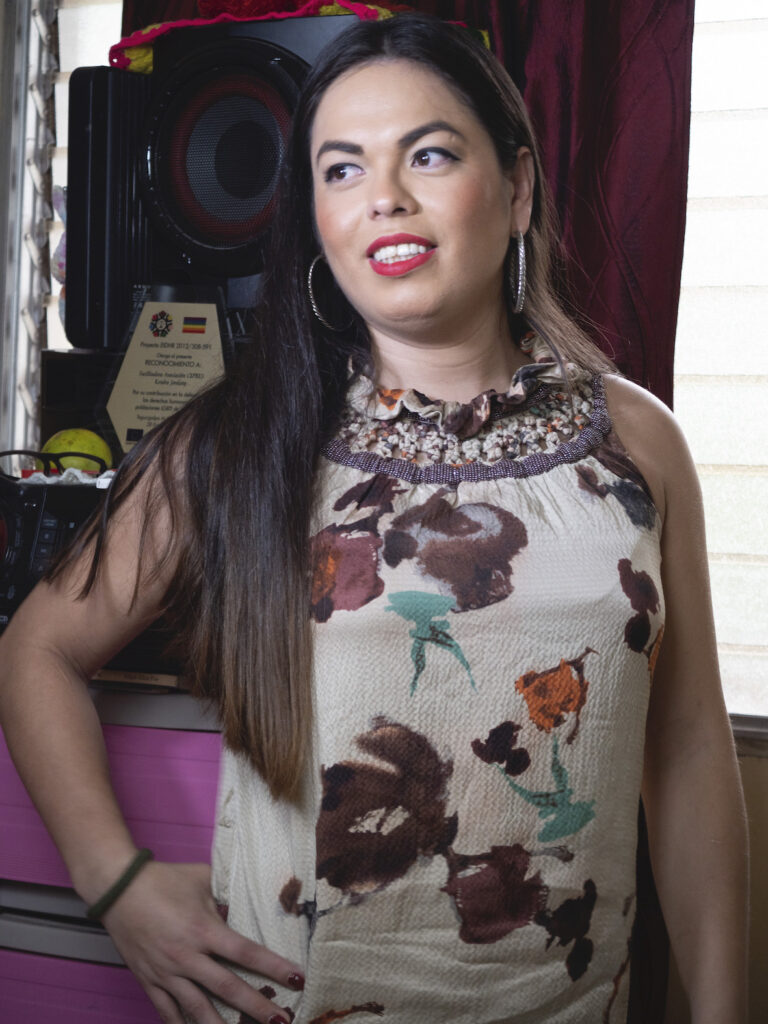
For her, normalcy means returning to her job with the international organization Doctors Without Borders in a nearby city, where she advocates for the rights of the LGBTIQ+ population in Honduras. It also means resuming her Journalism studies at the University of the Sula Valley, located in the vast and fertile region where Kendra's hometown is situated.
Dealing with families
Kendra's transition began when "I was already of legal age: nobody could say anything to me and I had a job. The first thing as a trans woman was the growth of my hair, the feminization of my body. Changing all the clothes I used to wear. Facing my family for all these changes."
Dealing with family is a crucial aspect of life for most people in the LGBTI+ community. In Honduras, the obstacles and rejection faced by trans women like Kendra often begin at home.
Traditionalist ideas within Honduran families are becoming more entrenched due to the prevailing machismo in the country and the prejudiced sermons delivered from the pulpits by the "apostles" of the main churches. An example of anti-LGBTIQ+ religious discourse in Honduras is the infamous sermon broadcast on the program Primer Impacto. In it, evangelical pastor Evelio Reyes asked his congregation "not to vote for gay or lesbian candidates ." Reyes was sued for his statements against LGBTQ+ groups.
Politicians are joining the discriminatory crusade of preachers, such as presidential candidate and game show host Salvador Nasralla, who said in an interview that he is against gay marriage .
Kendra's first step at home "was at 15 when I told my mom 'I'm gay.' Because before, she says, being homosexual was for everyone; there was no LGBTQ+ classification. Transphobia, she knows, begins at home. Many families tell 'we accept you as long as you don't go around dressed as a woman.'"
Over the course of more than 15 years, Kendra's relatives have come to accept her new identity. "I feel good about my daughter," says her mother, hugging her as they sit on the floral sofa in the living room. "I like everything she does, and I love her." Her nephews also enjoy playing with Kendra, hugging her, and talking to her.

For Kendra, the transition has been risky, as it has been for many other trans women in Honduras, where they face discrimination at every turn and lack medical support. One of the needs for trans women is access to hormones that help them feminize. Kendra underwent hormone therapy that affected her health, although she now says she feels better than before.
She started using hormones at the age of 22, after “asking other trans women how they managed to look so beautiful. It was hard on my body because my nails turned purple, my heart raced, and I got chills so bad I would throw ten blankets over myself and feel that intense cold.”
After experimenting with various hormones, she finally found one that didn't cause her so many health problems and helped her feel better about her body. Kendra and other Honduran trans women can't find counseling at the health institutions they could go to for guidance on the procedures to follow in their transition, so many prefer to risk self-medicating with life-threatening procedures or injecting oils to accelerate the feminization process. Many of them also survive by engaging in sex work, having been excluded from the formal job market. And they want to have attractive bodies to draw the attention of their potential clients.
“I feel very good this way. Completely good,” says Kendra. From acceptance at home, Kendra moved on to acceptance in her neighborhood. “In my neighborhood, they respect me,” she says, “they know my parents. I remember once I was riding a minibus and the driver told his assistant, ‘Treat her well because she’s an advocate.’”
For many trans people, it's just about a physical change, but for Kendra, it's also about a change in mindset that she says took place from the moment she started getting involved with human rights and LGBTQ+ rights organizations. Her perspective changed with the talks, courses, and workshops. “I started deconstructing everything, even the use of makeup. I remember a boss telling me I came to work hungover, but what really happened was that I went to work without makeup that day. A lot of people also tell me to tone down my voice a little, but I don't fake my voice.”
A few years ago, when she started university, she kept her hair short to draw less attention. Back then, when she wanted to revert to her trans appearance, she would "wear wigs to disguise it a bit," but she's stopped doing that and now has long hair that she often touches when she speaks.
Transfeminist activism
She says that the organizations have given her the opportunity to develop as a trans person and as part of collectives and communities. Sometimes, in her work within institutions, the fear of rejection has made her "back down."
Kendra realized she was a trans feminist when she attended a meeting in Choloma, north of San Pedro Sula. “There I realized that, because of everything that was happening to me, I was already a feminist. I began to empower myself. Back then, you didn't hear about these issues. There weren't the categories of feminism that exist now. Here in Honduras, I don't know many trans feminist women.”
Her candidacy for the Central American Parliament (PARLACEN) from a left-wing party sparked widespread discussion, even though some questioned the participation of diverse groups in politics, considering them to be minorities.
“My self-esteem has changed,” Kendra adds. She continues to dream big. Today, one of her biggest goals is to build a shelter where Honduran trans women have a space where they can be themselves.
We are present
We are committed to journalism that delves into the territories and conducts thorough investigations, combined with new technologies and narrative formats. We want the protagonists, their stories, and their struggles to be present.
SUPPORT US

FOLLOW US
Related notes


We are present
This and other stories are not usually on the media agenda. Together we can bring them to light.