

The region's education system discriminates against and expels LGBTI+ people
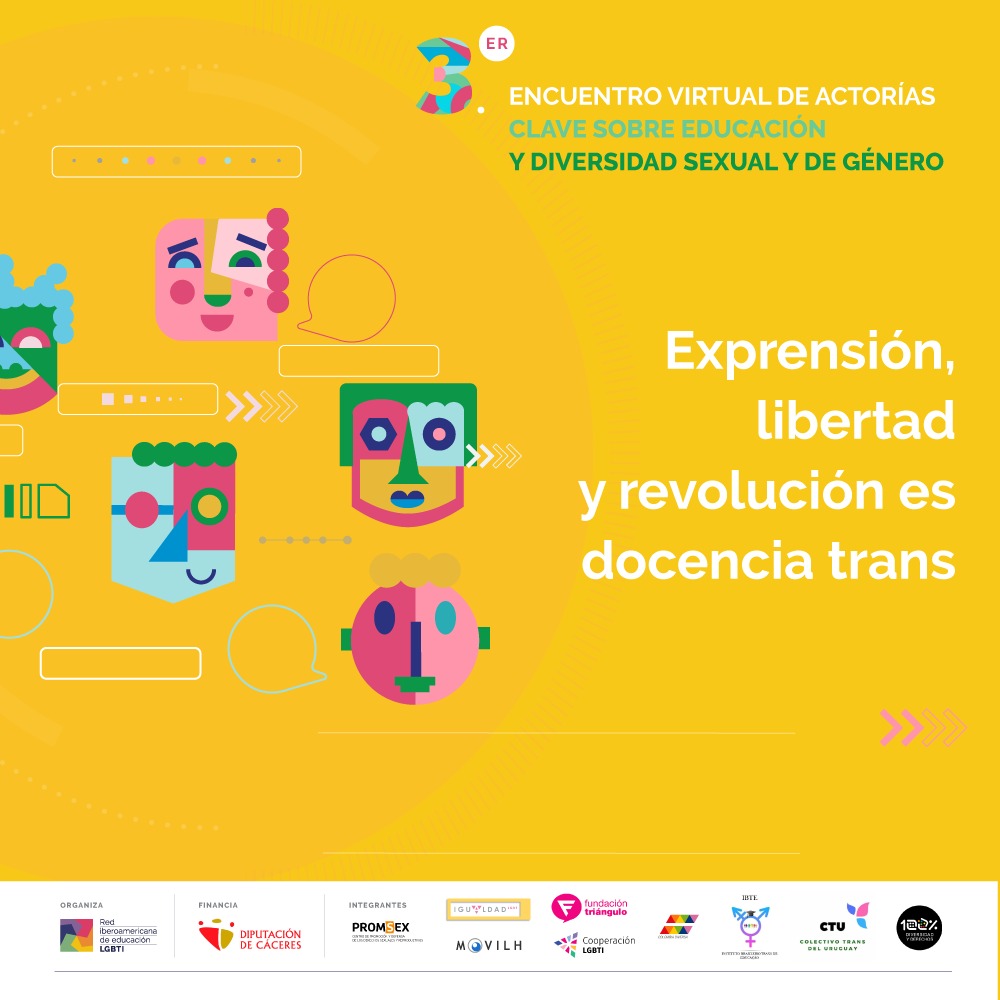
Trans teachers and researchers from Ibero-America shared their educational experiences at the 3rd Meeting of Key Actors of the Ibero-American Network of Education (RIE) LGBTI.


Share

By Rosario Marina
What were the experiences of transgender people within the education system? How can educational spaces be transformed into places free of discrimination? These were some of the questions raised at the 3rd Meeting of Key Actors of the Ibero-American LGBTI Education Network (RIE). At this meeting, transgender teachers and researchers from various Ibero-American countries shared their educational experiences, both as educators and students.
“The discrimination and expulsion of us, who identify under another gender expression, is very explicit ,” said Alba Rueda, president of Mujeres Trans Argentina and current Undersecretary of Diversity Policies of the Nation in Argentina , at this 3rd Meeting that took place virtually from November 26 to 28.

The goal of the Ibero-American LGBTI Education Network (RIE) is to promote and respect the human rights of lesbian, gay, bisexual, trans, and intersex people in the educational sphere. The platform comprises various trans organizations from Ibero-America: 100% Diversity and Rights (Argentina), Colombia Diversa (Colombia), the Uruguayan Trans Collective (CTU), the LGBT Equality Foundation (Bolivia), the Triángulo Foundation (Spain), the Brazilian Trans Education Institute (Brazil), MOVILH (Chile), and Promsex (Peru).
“Completing secondary education is a huge challenge ,” stated Alba Rueda. This aligns with the findings of various studies, including the report “Out in the Open.” The report indicates that in many countries, 85% of gay, lesbian, bisexual, and transgender (LGBT) students are victims of homophobic and transphobic violence in schools, and 45% of transgender students drop out .
Alex, a story of trans masculinity in Guatemala
Alex Castillo is the founder of the trans men's collective Trans-Formación in Guatemala. For 43 of his 49 years, he was unable to live as Alex. At the meeting, he shared his experience of how difficult it is to be a trans person in the education system.

“ Most trans people who manage to get an education usually mortgage their identities . A very delicate part of Alex’s life was during his adolescence, in a religious school. No matter how much I cross-dressed, my transsexuality was very obvious,” says Alex, mixing the third and first person, as if the person before wasn’t him.
“I spent 43 years in drag: a cisgender transvestite. That's what I had to do to suffer a little less bullying, less violence, less expulsion,” he said at the Ibero-American LGBT Education Network meeting. And he shared his experience as a teenager.
“A nun kissed me and tried to abuse me. I think this happens a lot to LGBTQ+ people; they think we want to sleep with everyone. It was a huge shock that led to my expulsion when I was a year away from graduating. Obviously, my parents turned against me; I couldn't continue supporting my studies. I was a year away from completing a bachelor's degree, and because I said no to this attempted abuse, I was condemned as the one who provoked the situation ,” he said.
After that abuse, Alex continued to hide his identity. “ Letting my name and pronouns be violated was the only way I could continue studying ,” he says. He also witnesses how several trans men in his country experience something similar: “It’s the only way that young people in the community who want to continue studying have right now.”
Alex is a business administrator with fifteen years of experience in banking. He worked for the Guatemalan government for four years. But when he changed his name, they made him feel as if that experience had vanished. “When I asked these institutions for references using my current name, they just kept saying I never worked for them,” he told Presentes last year .
Named, but without gender
In Guatemala, one can legally change their name through a formal procedure, but not their gender. “Any person can submit a name change request to a Notary Public of the Civil Registry, pursuant to Articles 18 to 20 of the Law Regulating Matters of Voluntary Jurisdiction, Decree No. 54/1977 (approved by the National Congress),” explains the ILGA Trans Legal Mapping report.
By February 2018, 55 transgender people in Guatemala had managed to change the photo and name on their identity documents. But none could, and still cannot, change the "sex" indicator on their identity documents.
“Trans people are starting to enter university. And even though we’ve changed our names, they put the gender assigned at birth on our degrees ,” says Alex. “Even though you complete all your studies, the degree they give you doesn’t represent you,” he insists.
Uruguay: the critical age for trans people in the education system
For several months in 2019, the Uruguayan Trans Collective (CTU), led by teacher Alejandra Collette Spinetti, conducted research to understand the educational transitions of transgender people in Uruguay. One of the most important aspects of the report is that it was produced by members of the transgender community.
In Uruguay, according to the research , of all those surveyed, “32.4% revealed that they dropped out of school due to bullying by classmates; 11.3% said they suffered bullying from the teaching staff; 4.2% said it was due to bullying by the school administration. In addition, 47.9% of dropouts during their educational journey are recognized by the individuals themselves as being due to bullying,” the research indicates.
“While in our country, the regulatory framework of recent years has achieved the recognition of rights, there are still institutions such as education, health and others that have not undergone structural or philosophical change, as well as the objectives, plans, programs and teacher training, with few exceptions, continue to be the same or very similar to other historical, social-economic-cultural and political contexts of the country,” the report explains.
According to these results, in Uruguay most of these individuals drop out of school due to bullying in their fourth year of secondary education. “If we consider that we are around 15 years old, which is when the expression of gender identity begins, we realize that this is where there is a barrier regarding respect for and treatment of the expression of gender identity, and this, combined with family problems, leads people to give up on continuing in the education system .”
Brazil: transphobic violence
The Brazilian Trans Institute of Education, directed by Andreia Lais Cantelli and Sayonara NB Nogueira, conducted a report titled “The Frontiers of Education: The Reality of Trans Students in Brazil.” The survey was carried out electronically at the end of 2018, among 250 transgender or non-binary individuals who were still in basic or higher education.
Half of them said they had dropped out of school at some point. Among their main reasons were: transphobia, depression, financial hardship, and family exclusion.
Regarding the question of having experienced violence in the school environment, 52% of those interviewed responded affirmatively. In the latest National Survey on the Educational Environment in Brazil, published in 2016, 43% of students aged 13 to 21 said they feel unsafe in the school environment because of their gender identity. “ Transphobic violence has a direct impact on students' presence in school ,” the report concludes.
Two of the goals proposed at the meeting were to work on strengthening and mobilizing trans teachers for sexual and gender diversity, as a driving force for change in the educational context and as a positive and visible role model for LGBTI children and adolescents in the region. Another goal was to share positive experiences of trans teachers, highlighting them as a tool for change and raising awareness.
Share
We are present
We are committed to journalism that delves into the territories and conducts thorough investigations, combined with new technologies and narrative formats. We want the protagonists, their stories, and their struggles to be present.
SUPPORT US

FOLLOW US
Related notes


We are present
This and other stories are not usually on the media agenda. Together we can bring them to light.