

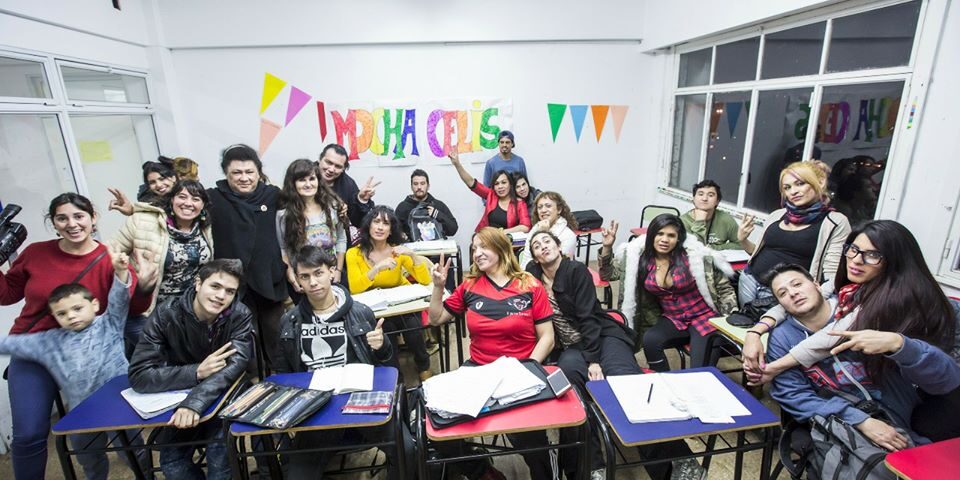
Transphobic media violence against a classmate at the Trans High School Mocha Celis
In an act of profound injustice, these media outlets decided to illustrate a news story about a crime with the ID photo of a trans person with no connection to the incident.

Share

By Manu Mireles and Matías Soich*
On November 15th, several digital media outlets published a story with the headline “ MAN ARRESTED FOR USING STOLEN IDENTITIES TO RENT APARTMENTS AND OPEN BANK ACCOUNTS.” The articles claimed that this person “used an image of himself dressed as a woman” and that “in his personal life he cross-dresses” (sic). The articles were illustrated with an image of a National Identity Document in which the face of our colleague Viviana González, a graduate of the Mocha Celis Transgender Popular High School, is clearly recognizable. Obviously, the use of her image was without her authorization and has no connection whatsoever to the news story . The image was originally published by Viviana months ago, on the anniversary of the enactment of the Gender Identity Law.
In an act of profound injustice, these media outlets chose to illustrate a news story about a crime with the ID photo of a trans person who has no connection whatsoever to the incident. The unauthorized use of Viviana's image creates a false association between her identity and that of the person under investigation for the crimes. Furthermore, the details regarding this person's "dressing as a woman"—completely irrelevant to the issue—reinforce the stereotypical association between cross-dressing and crime. Thus, both the wording of the news story and the use of the image criminalize trans identity .
This is a clear act of media violence based on gender , as it disseminates images and stereotypes that, by constructing sociocultural patterns that reproduce inequality and legitimize violence, directly affect one of the most vulnerable gender groups in Argentine society, namely trans people.
“I feel horrible. I feel like this is an act of transphobia. On top of that, they published my ID. I feel very vulnerable, hurt, and harmed because people who saw the news are going to believe it's real. Even though some media outlets took down the photos after I complained, I think the damage is done. They didn't even have the empathy to apologize,” says Viviana .
Mass communication and stereotypes
Once again, mass media constructs and reproduces gender stereotypes that inscribe different types of violence on our bodies and identities. The impunity with which mass media operate regarding the social and personal consequences of their actions, as well as the lack of awareness among a large part of society regarding these issues, are unacceptable.
Today it happened to Viviana, who has a network of support, love, and activism. But we ask ourselves: what happens when the same thing happens to a trans woman who doesn't have those resources? What will happen to the next trans person whose image is arbitrarily used to illustrate a news story about crimes they have nothing to do with? We know for certain that they will be more exposed to verbal abuse and physical violence, to harassment and beatings, even to being put in a police car and ending up in a cell or disappearing. Structural violence against trans people is not an abstraction, but a concrete chain of actions and omissions with serious consequences for people's lives . Irresponsible communication and the dissemination of stereotypes that criminalize trans identities constitute one of its links.
Viviana González is a former president of the Mocha Celis High School Student Center, a Literature teacher training student, and a feminist self-defense instructor. As part of her activism at Mocha, she has given countless interviews and first-person accounts to the media and at public events, and has performed "La Karateka," a play that tells her life story, on various stages.
From Mocha Celis, we publicly condemn this act and are supporting Viviana in filing a complaint for media violence. As a minimum measure of redress, we demand a public apology and immediate gender perspective training for the journalists responsible..
*Teachers from the Mocha Celis High School and activists
We are present
We are committed to journalism that delves into the territories and conducts thorough investigations, combined with new technologies and narrative formats. We want the protagonists, their stories, and their struggles to be present.
SUPPORT US

FOLLOW US
Related notes

We are present
This and other stories are not usually on the media agenda. Together we can bring them to light.