

Trump is leaving, but the anti-rights groups are staying
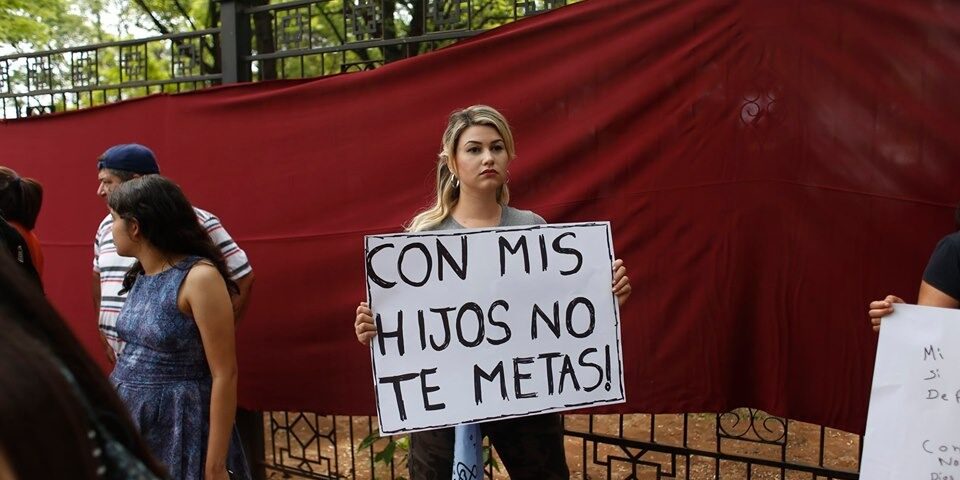
By Diana Cariboni* Photo: Presentes Archive/Paraguay Beyond the outcome of the US elections, the religious and conservative sectors that forged close alliances with the Donald Trump administration will continue to use their influence and money abroad to modify laws and policies they perceive as threats to their worldview. “We cannot allow…”

Share

By Diana Cariboni*
Photo: Presentes Archive/Paraguay
Regardless of the outcome of the US elections, religious and conservative sectors that forged close alliances with the Donald Trump administration will continue to use influence and money abroad to modify laws and policies that they see as threats to their worldview.
“We cannot allow regions like Africa, Latin America, or Eastern Europe to become secularized. We must ensure… bastions of the culture of life, of the family, and of religious freedom in those regions. We don’t live in a world apart. What we do abroad will help us here in the United States.” This is what Alfonso Aguilar, an anti-abortion Christian activist, said last March at a meeting of ultraconservative Hispanics in the US.
Aguilar, a fervent supporter of Trump, was at the time a member of the board of the powerful Christian lawyers group Alliance Defending Freedom (ADF), in addition to presiding over the International Human Rights Group.
These are two of the 28 US entities that, according to an investigation we published in openDemocracy last week, sent at least $280 million to different regions of the world in the last decade to promote their strict vision of the traditional family, which is opposed to abortion, sex education, and equality for LGBTI people.
Trump's lawyer
In the last 10 days, Polish women have taken to the streets en masse to protest the Constitutional Court's decision to ban abortion even in cases of serious fetal malformations (the cause of the vast majority of legal abortions that were performed until now in that country).
One of the groups that promoted this ruling in Poland is the American Center for Law and Justice (ACLJ), headed by Trump's personal lawyer, Jay Sekulow, who defended the president in the impeachment trial and is coordinating with Rudy Giuliani the legal complaints to challenge the result of the US election.
What does a Trump lawyer have to do with the uteruses of Polish women?
The European branch of the ACLJ intervened before the Constitutional Court and presented legal arguments to prohibit the termination of pregnancy due to fetal abnormalities.
Mónika, a Polish woman who asked to remain anonymous, said that if this ruling had been issued six months earlier, it would have put her in the “tragic situation” of carrying her pregnancy to term despite a diagnosis of a fetal abnormality incompatible with life. Mónika had a legal abortion in February.
The European branch of the ACLJ is defending the Polish government before the European Court of Human Rights (ECHR) in another case brought by a woman who alleged that she was denied an abortion despite a diagnosis of serious fetal problems. The woman maintained that she was forced to give birth and witness the suffering and death of her child.
Sekulow's group has also defended numerous Polish municipalities that declared themselves "LGBTI ideology-free zones," putting the country in conflict with the European Union, whose charter of fundamental rights prohibits discrimination against people based on their sexual orientation.
ACLJ spent more than $14 million in Europe since 2007, while ADF allocated $15 million to the continent, almost all of it from 2015 onwards.
ADF International, whose members have held important positions in the Trump administration, claims 18 victories at the ECHR since 2010. Among the cases in which it intervened as an ally of other groups is the defense of a doctor in Norway who refused to provide intrauterine devices to her patients for birth control, claiming that it violated her religious beliefs.
The two groups also participated in the defense of the Italian state, which was denounced several times before the ECHR for denying same-sex couples the right to marriage and civil unions.
Opacity, disinformation and attacks
This is the first time the scale of these groups' international spending has been revealed, through a review of thousands of pages of financial statements filed with the U.S. Internal Revenue Service since 2007. By region, the spending in dollars is divided as follows:
- Europe: 88.7 million
- Africa: 54 million
- Asia: 49.2 million
- Latin America: 44.2 million
- Mexico and Canada: 20.6 million
- Eurasia/Russia: 12 million
- Middle East and North Africa: 9.1 million.
This analysis, however, underestimates the true economic power of these groups for two reasons. First, they do not disclose how they spend this money, nor do they identify their recipients or donors. Furthermore, funds sent through churches or church branches are not included because these entities are not required to report their expenditures.
Journalistic investigation allowed us to trace the connections of that money with the operations that these groups carry out around the world.
In our region , where 20 groups distributed $44.2 million, we found a network of disinformation and emotional manipulation of women to prevent them from having abortions; attacks with the White House on the regional human rights system, the cutting of funds to the Inter-American Commission on Human Rights (IACHR), and campaigns against progressive commissioners.
The aforementioned individual, Alfonso Aguilar, spearheaded an attempt by anti-abortion groups in the US to boycott the re-election of Luis Almagro at the OAS, alleging that he "frequently used his position as secretary general to promote abortion."
The initiative did not succeed, but it served as a deterrent. Almagro (who just a year earlier had declared himself a “ radical feminist ”), met with these groups thanks to the efforts of the State Department, clarified that he did not promote the right to abortion, and, in October, gave the opening speech at a virtual meeting of ADF and the Ibero-American Congress for Life and Family (the platform of evangelical pastors and politicians that met two years ago in Punta del Este, Uruguay).
With the pandemic already engulfing Latin America, six of these groups spread misinformation about the origin of the virus, anti-China propaganda, and actions to discredit the World Health Organization.
We also discovered more sophisticated operations , such as a app that hides medical evidence about contraceptives and tries to convince users to practice sexual abstinence.
Power that kills
Access to the White House was crucial for these groups to redesign a conservative-majority Supreme Court, which will have several cases against legal abortion before it, presented by organizations such as ADF.
Trump's defeat may weaken that domestic power to some extent and modify some of the US's positions in the United Nations and the OAS.
But it can also be an incentive to intensify international operations.
In 2014, Uganda's parliament imposed life imprisonment for "aggravated homosexuality." The original bill, which included the death penalty, was drafted by David Bahati, the Ugandan representative of The Fellowship Foundation (portrayed in the Netflix series "The Family") and current finance minister. The law, which sparked international outrage, was suspended by the Constitutional Court.
The Fellowship, which has wielded enormous political influence in Washington for decades, is the group that sent the most money to Africa in the last 10 years ($34.5 million). A large portion, more than $20 million, went exclusively to Uganda.
Last month, the Ugandan government announced it would again push for the death penalty because “homosexuality is not natural for Ugandans.” In the last three months, there have been three murders of LGBTQ+ people.
*editor of openDemocracy
We are present
We are committed to journalism that delves into the territories and conducts thorough investigations, combined with new technologies and narrative formats. We want the protagonists, their stories, and their struggles to be present.
SUPPORT US

FOLLOW US
Related notes

We are present
This and other stories are not usually on the media agenda. Together we can bring them to light.