

Offerings in Mexico for the memory, justice and life of sex workers and trans people
On November 2nd in Mexico City, three offerings were made in memory of sex workers who were victims of violence or HIV-related illnesses, and of LGBT people murdered in the country.

Share

Photos and text: Georgina González
On November 2nd in Mexico City, three offerings were made in memory of sex workers who were victims of violence or HIV-related illnesses, and of LGBT people murdered in the country.
Mexico is the second country in the world with the highest number of crimes against transgender people, and sex workers are the most frequent victims, according to the organization Trans Europe . Furthermore, 39 LGBT people have been murdered so far this year, according to the National Observatory of Hate Crimes against LGBT people.

Every November 2nd, Mexico celebrates the Day of the Dead, a day when most Mexicans celebrate life and reunite with those who have passed away. The ofrenda (offering) serves to welcome loved ones. Offerings of their favorite foods, drinks, fruits, and sweets are placed on the altar, which is decorated with papel picado (cut paper decorations), seeds, candles, and various types of flowers. The marigold, of course, is always present.

Historical offering of Puente de Alvarado
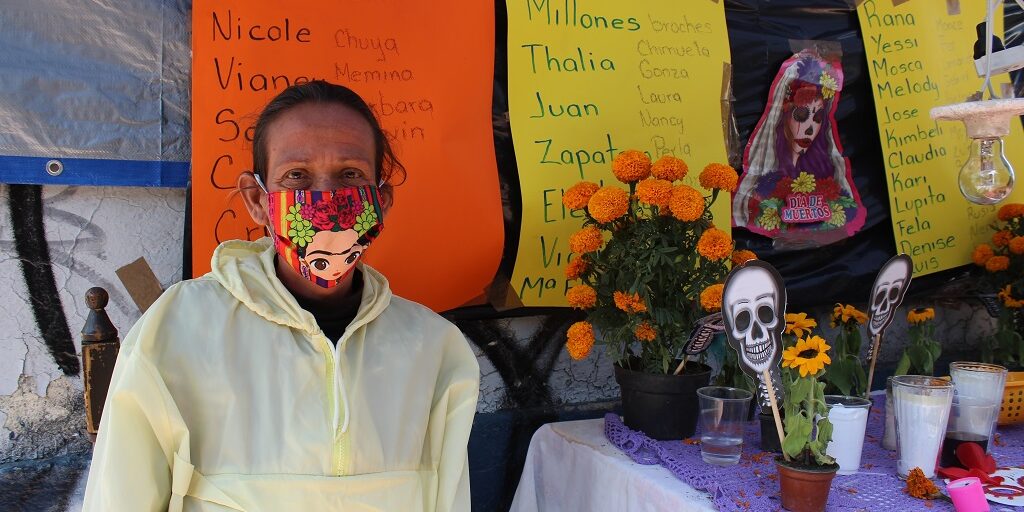
Since 1999, independent sex workers in the Puente de Alvarado area, next to the Revolución metro station, have made an offering to remember their colleagues who lost their lives due to violence or disease.
“Today I recognize them and today I am their voice. Today I demand of the government and society that they are important,” said Esther, an independent sex worker, after telling the story of this offering.

This year they also paid tribute to Jaime Montejo, a member of Brigada Callejera, an organization that since 1995 has supported and promoted the rights of cisgender and trans sex workers in the Merced and Revolución area.
Esther, who is also a founder of this offering, says that Jaime Montejo “gave his life for many of us so that we would have food to eat during this pandemic.” Jaime died from COVID-19 on May 5.

Another ally of sex workers who also lost his life to COVID-19 was remembered in this offering. He was Jorge García, a priest who accompanied and celebrated Masses for sex workers who were murdered or died from illness.

This offering is sustained by contributions from sex workers in the area. Students from the National Autonomous University of Mexico (UNAM) and activists from the Center for Support of Trans Identities also participate.
Shortly before nightfall, Esther, in the company of other sex workers and with the help of two Catholic women, prayed the Rosary and pronounced the names of the women who are no longer with us and those who supported them.
“The living eat what the dead have eaten.”
Another sex work hotspot in Mexico City is Calzada de Tlalpan. For the past ten years, Ana Luisa Arias has placed an offering in memory of the sex workers in this area, “who are usually forgotten,” she says.

The offering is located a few meters from the Hotel Caleta, the place where Alessa Flores was murdered in 2016. Her murder was part of a wave of violence that claimed 80 femicides that year in Mexico.

“Since Friday when we put it up, it was really beautiful, you should have seen it. But here, the living ones came out even more alive and are eating what was meant for the dead,” she describes, explaining how homeless sex workers have taken the fruit, bread, and water from the offering.
Unlike the historic offering at Puente de Alvarado, the one in Tlalpan looks sad and unstable. The wind easily knocks over the candles and colorful decorations. And the only one who tells the story of this memorial is Ana Luisa. This time, no one else is with her.
“Our revenge will be to be happy”
The Tiresias Dollhouse, along with four other organizations and with the support of the Mexico City government, set up an offering in memory of murdered LGBT people and sex workers.
A tensioned canvas structure was placed at the exact spot where Paola Buenrostro got into the car of the ex-military man who murdered her four years ago, a time that served to further strengthen her activism, which her friend, Kenya Cuevas, had been doing .

“The first offering was me sitting on that bench (she points) with a bouquet of flowers and two candles. After the pain, I have transcended it, not only to help other sex workers, but also other vulnerable populations,” Kenya Cueva says into the microphone.
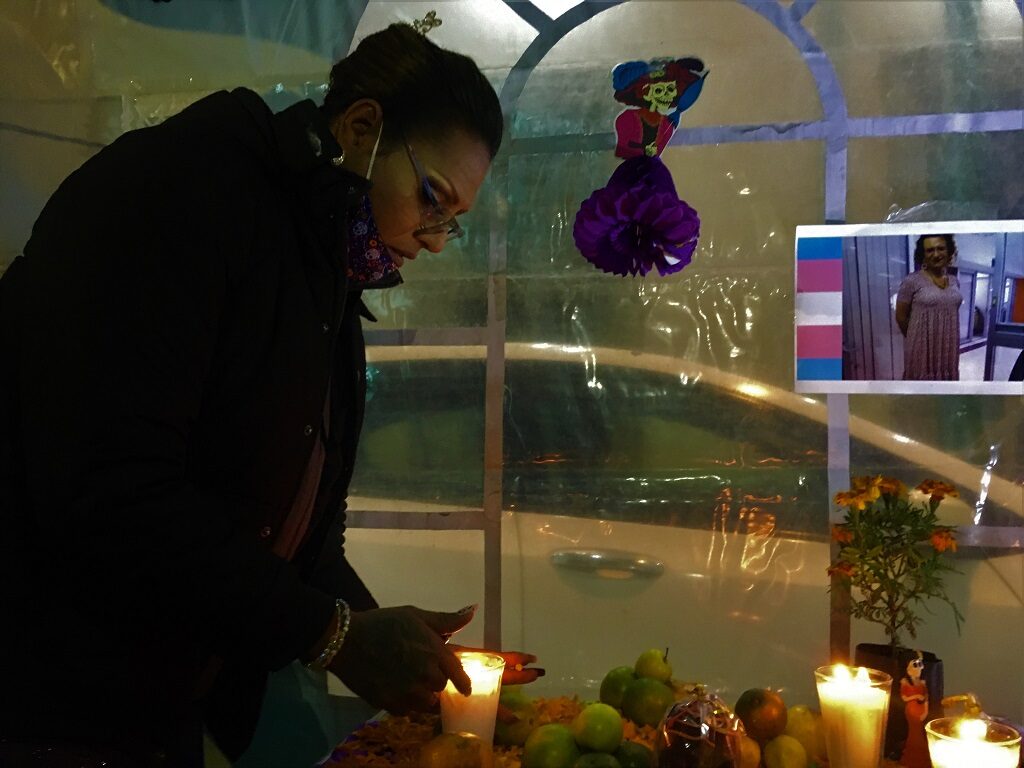
This year Kenya is not alone. She is surrounded by artists, activists, LGBT people, allies, journalists, and her team from Casa de las Muñecas Tiresias. The offering is adorned with marigolds; chocolate skulls; fruit; ceramic figures; colorful papel picado (cut paper decorations); and candles of all sizes.
For the first time, trans and non-binary teenagers from different parts of Mexico participated in the offering. Graphic pieces were displayed reflecting these teenagers' and young adults' perspectives on transfemicides.

“The fact that a channel of communication can be established between these two generations is very important to us, and they are very excited because they know that thanks to trans sex workers and activists, rights have been won and that the fight for the rights of trans children and adolescents is now underway,” says Nathan Ambriz, illustrator, independent cultural manager and coordinator of this exhibition.
In addition to denouncing crimes against LGBT people and sex workers, attendees celebrated their lives and their newfound happiness with impersonation shows, burlesque, and cumbia music.
We are present
We are committed to journalism that delves into the territories and conducts thorough investigations, combined with new technologies and narrative formats. We want the protagonists, their stories, and their struggles to be present.
SUPPORT US

FOLLOW US
Related notes

We are present
This and other stories are not usually on the media agenda. Together we can bring them to light.