

Paola was killed 4 years ago: her friend Kenya Cuevas became an activist to seek justice
The transfeminicide of Paola Buenrostro achieved unprecedented media attention in Mexico thanks to the activism of her friend Kenya Cuevas.

Share

Text and photos: Georgina González, from Mexico City
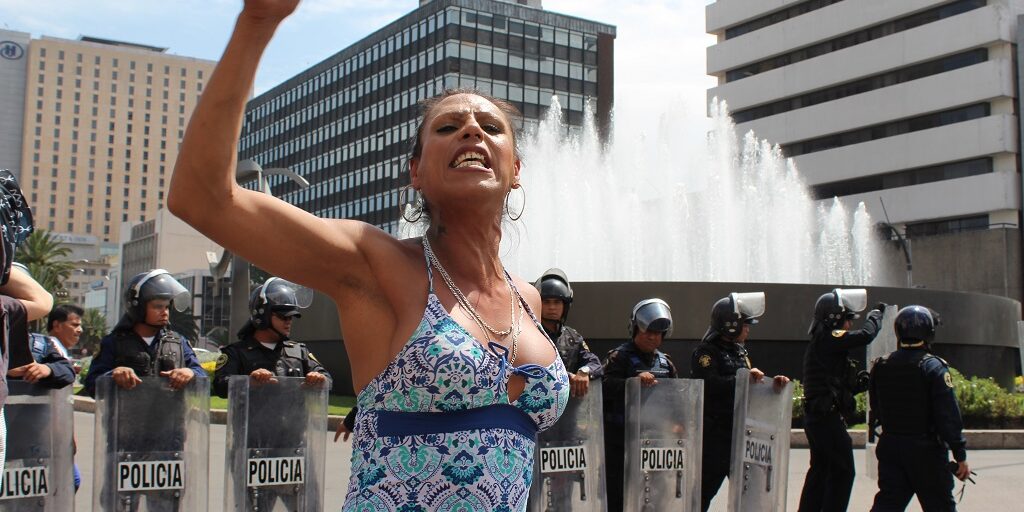
September 30th marked four years since the murder of Paola Buenrostro, a 25-year-old trans woman who worked as a sex worker. Paola was killed in a car at the intersection of Puente de Alvarado and Aldama streets in Mexico City. Her murder garnered unprecedented media attention in Mexico thanks to the activism of her friend Kenya Cuevas . Today, Kenya is not alone in her fight for justice. Together with her lawyer, activists, and trans sex workers, she held a memorial service at the site of her murder.
Kenya remembers that early morning as "freezing and strange," and also that her friend Paola was sad. Along with two other coworkers, they drank anise liqueur to ward off the cold. "That night, four of us played a game of roulette with Paola," she told Presentes.
Minutes later, Paola's voice rang out in a cry for help. "Kenya, Kenya! " Kenya ran, heard gunshots, and saw Paola dying. She was in the passenger seat of a gray car, next to a former soldier.
Kenya became the main witness that night in the murder of Paola Buenrostro.
“She gave her life to change the course of history for murdered trans women in Mexico and to bring about a paradigm shift. From that moment on, I never stopped fighting against the authorities who denied us our right to identity and access to justice when they arrested and released (two days later) Paola’s murderer for lack of evidence.”.

“She was an explosive woman, but also very noble.”
Paola was born in Chiapas and was rejected by her family from a young age. “She grew up resentful of her mother. That made her an explosive woman. She had a strong character, but deep down she was also very kind. She could see you and if you didn't have anything to eat, and she had 20 pesos in her pocket, she would give it to you,” Kenya said.
Paola, like many trans women, did not choose to live in circumstances of family exclusion. The rejection she experienced prevented her from accessing education and, consequently, the job market. Paola migrated to Mexico City at age 17 and, to earn a living, worked as a sex worker every day from nine at night until six in the morning.
“On weekends after work, sometimes we would go to Garibaldi, to number 33. Paola and I called it the 'thirty-run' because almost always when we entered the bar a customer would come out. We would have a drink, we would dance to Mónica Naranjo, Jenni Rivera, all those songs,” Kenya recalled.
In 2016, the year Paola was murdered, there were 80 trans femicides. This represents the most violent year for trans women in Mexico, according to records kept by the Center for Support of Trans Identities, which have been in place since 2007. That same year, the National Front for the Family , a conservative, anti-rights group supported by the Catholic Church, held two national marches and secured media coverage to disseminate its message.

Justice and reparation for Paola and Kenya
The man who shot Paola was released two days later, on October 2nd, due to lack of evidence. As a form of protest, Kenya, along with sex workers from Puente de Alvarado, staged a protest, blocking Avenida Insurgentes, one of Mexico City's main thoroughfares, with Paola's body in a coffin.

“From that moment on, I didn’t leave the Prosecutor’s Office alone. They never thought that two years later a trans woman, a sex worker, would corner them and make them relive and acknowledge that they did everything wrong, that they failed to follow due process, and that they violated Paola’s rights and mine.”.
In 2019, the Mexico City Human Rights Commission (CDHDF) issued , for the first time in history, a recommendation for the Attorney General's Office to address the transfemicide of Paola Buenrostro with a gender perspective, provide reparations to Kenya Cuevas, and establish a future model for investigating hate crimes against the LGBT+ population.
Throughout her struggle, Kenya has received death threats. For this reason, she requested protective measures from the authorities. Initially, the Prosecutor's Office granted them; however, Equis Justicia, the organization providing legal support in the case, has filed two injunctions against attempts to withdraw Kenya's protection.
“The Investigative Police, which reports to the Prosecutor's Office, have denied her protection twice, arguing that Kenya is no longer at risk,” explains Viridiana Valgañón, a lawyer with Equis Justicia, in an interview with Presentes.
"The Prosecutor's Office does not recognize the right to identity"
“We hope the Prosecutor’s Office will comply with the recommendation, because on the one hand, it recognizes the structural violence against trans women, and on the other hand, it recognizes that when they are victims of a crime, the Prosecutor’s Office criminalizes them for engaging in sex work and does not recognize their right to identity. We want them to be recognized as witnesses or as victims within the investigation files. And we want them to take effective action, not just things that pad the case file; we want them to apprehend, try, and prosecute the perpetrator,” Valgañón maintains.
Four years after Paola's murder, the Mexico City Prosecutor's Office has issued two orders to search for the former soldier, both in 2017, but there is no line of investigation.
“ For Kenya and trans women, it is important that the State publicly apologize and recognize, in Puente de Alvarado, that trans women are subjects of rights . That prosecutors throughout the country issue the protocol and implement it. Likewise, that they train ministerial and police personnel with the aim of ceasing to see cases of discrimination against our colleagues and ensuring there is no more impunity,” warns Viridiana Valgañon.
Transforming pain into life
After her friend's murder, Kenya began offering refuge to her fellow trans women. For a long time, her own home became a haven for many trans women struggling with addiction, lacking access to HIV treatment, and experiencing homelessness.
The dream Kenya had been nurturing for years materialized in 2018 with the founding of Casa de las Muñecas Tiresias , an organization that supports sex workers, drug users, and people living with HIV. Furthermore, in December 2019, Mexico's first shelter for transgender women , Casa Hogar Paola Buenrostro, opened in the Gustavo A. Madero borough.
Lives changed
Tonight, four years after the murder of Paola Buenrostro, Rebeca Martínez feels content. She worked in the Puente de Alvarado area as a sex worker, starting at age 18, and used drugs for 10 years. That situation led her to "a serious point of vulnerability," she explains to Presentes.
During the pandemic and the hotel closures, Rebeca had no options and began living on the streets. Kenya met her there and invited her to the shelter. Rebeca was afraid; she thought it was a rehabilitation center "where you're often mistreated, even abused ." Kenya insisted.
Rebeca has been at the group home for four months. “I’m going to finish high school and I’m taking beauty classes. We have therapy and an Alcoholics Anonymous group, that’s what’s helping me. I’m overcoming my fears, I feel confident in myself,” she says excitedly .
“ And tonight I don’t feel alone, I know we’re not alone. We have rights and we can defend ourselves. Soon they’ll offer a course to help us understand why they can’t take me to jail just for wearing women’s clothing , why they can’t deny me service in certain places. Now I know we can defend ourselves and that the laws are on our side. I feel so happy about all of this,” she adds.
Four years after the murder of Paola Buenrostro, Kenya has transformed pain into tangible dreams and livable lives.
Tonight she decides to pay tribute to her friend. She is accompanied by her lawyer, friends she made along the way, and transgender sex workers who were with her on the night of September 30, 2016.
Today, so as not to forget, they are preparing a performance. They recreated that night, from when they drank anise liqueur, when Paola got into the gray car and yelled to Kenya for help.

“This whole journey has been titanic, but I think there was a reason Paola yelled at me that night. And tonight, four years later, I remember her with her smile, with her zest for life,” Kenya Cuevas told Presentes.
We are present
We are committed to journalism that delves into the territories and conducts thorough investigations, combined with new technologies and narrative formats. We want the protagonists, their stories, and their struggles to be present.
SUPPORT US

FOLLOW US
Related notes

We are present
This and other stories are not usually on the media agenda. Together we can bring them to light.