

Salta: Police repressed Guarani women and shot a baby
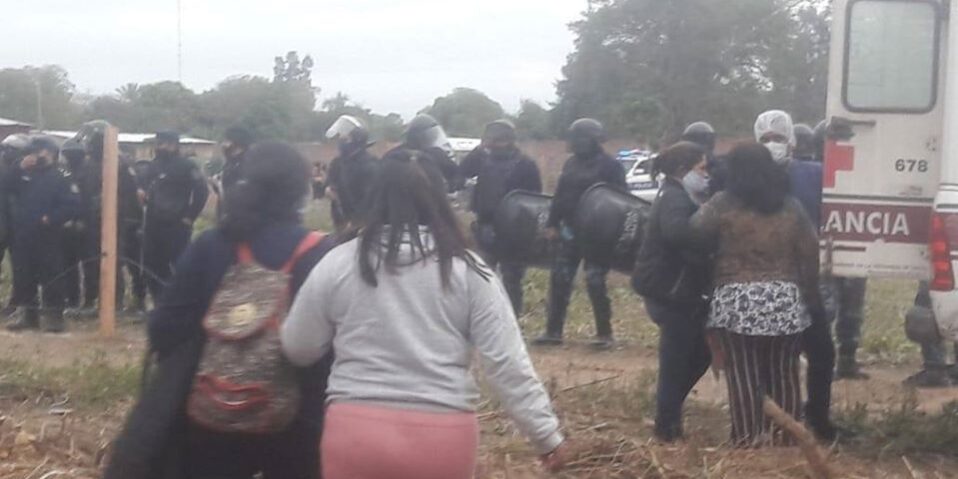
A Guarani woman was arrested and 18 people were injured by rubber bullets, including six children (one of them a baby), as a result of a police operation carried out on Thursday the 23rd in the Guarani Community Cheru Tumpa, in Salta.

Share

Photo: Indigenous Women's Movement for Good Living
A Guarani woman was arrested and 18 people were wounded by rubber bullets, including six children (one of them a baby), as a result of a police operation carried out on Thursday, the 23rd, in the Guarani community of Cheru Tumpa (Father God), in the town of Colonia Santa Rosa, in the Orán department of Salta province. The community remains on alert and demands the release of its leader, Yamila Veleizán, who was transferred to the city of San Ramón de la Nueva Orán, an hour from her home. The National Institute of Indigenous Affairs (INAI) described this as an “aggravation” of her detention.
The operation took place on a vacant lot at the entrance to the town, known as the Manero property, which the family claims ownership of. The Salta Police informed Presentes that the operation, carried out after dark, was in response to a complaint filed that afternoon by a 74-year-old woman. Community members identified her as Blanca Manero. This woman had ordered the fencing of a plot of land, prompting a reaction from the occupants.
The Public Prosecutor's Office (MPF) of Salta reported that the case is being handled by criminal prosecutor Sofía Fuentes, from Pichanal, a town 30 kilometers from Colonia Santa Rosa, on the road to San Ramón de la Nueva Orán, the capital city of the Orán department. The MPF also stated that the investigation began with a complaint filed by the Manero family. Veleizán was questioned and remains in custody, charged with the crimes of "resisting authority and threats, trespassing, fraud, and extortion."
The Indigenous Women's Movement for Good Living highlighted that Veleizán “was arrested without a court order, brutally beaten and dragged and taken to police station No. 9 in Orán,” “1 hour away from the community” and that “the police officers who acted were all men violating the law.”
Community spokesperson and leader Juliana Martínez Soria told Presentes that lawyers from Orán informed them that Veleizán would be detained for at least 15 days. “We don’t want her detained,” Martínez Soria insisted. She also noted that police officers visit the community “from time to time,” which they interpret as a clear intention to arrest the chief, Raúl Ceballos, “but we will not allow them to take him,” she asserted.
“There are children with rubber bullet wounds”
Yesterday afternoon, the community received supplies and support from the Evita Movement. Jocha Castro Videla, a leader of this organization, described the police operation as “a hunt reminiscent of Argentina’s worst times.” “ They came looking for the community leaders, they came shooting, they ransacked everything, they laughed, they insulted them, with the objective of basically kidnapping and arresting the leaders, the chiefs. They took one of the sisters who is one of the leaders, they threw down their flag, they trampled it, they threw them down, they trampled them. There are babies here with rubber bullet wounds to the forehead . There are children with rubber bullet wounds, elderly women, pregnant women. What happened here yesterday was a complete outrage,” she described. She insisted that there was a hunt, “the Brigade came through the only two access points to this land, to hunt them down, to run them over.”
Martínez Soria maintained that behind the Manero family's complaints and the police action lies a situation of discrimination against her people because of their Indigenous identity. She added that the police "do not respect women." They disparagingly call them "chahuancos" or "cuñas."
The police intervention, which included a large deployment of members of the Infantry Division, was initially reported by Indigenous journalists and prompted a reaction yesterday from the Indigenous Women's Movement for Good Living, which in a statement demanded "that the National Government intervene immediately to protect the rights of the Guarani Cherú Tumpa community in Colonia Santa Rosa. And we ask all Indigenous peoples and the Argentine people to raise their voices in indignation and condemnation of these events."
Yesterday, the president of the National Institute of Indigenous Affairs (INAI), Magdalena Odarda, requested information from Prosecutor Fuentes regarding these events. In a statement, the national official recalled that the "occupation by Indigenous families dates back to 2015," despite which "members of the police force arrived at the site without a court order and proceeded to evict the 80 people present, firing rubber bullets, resulting in several injuries, including a minor, and the arrest of community leader Yamila Veleizán." The Salta branch of the National Secretariat for Human Rights also became involved in the case yesterday.
Claim for access to land
The Public Prosecutor's Office clarified that the Manero family's complaint alleges that Veleizán and others "attempted to illegally occupy another plot of land yesterday (last Thursday) in the so-called Gauchito Gil Settlement, established in 2015." The agency stated that the new occupation was on an adjacent plot, that the Manero family owns several property registration numbers, and that they had reported previous occupations. According to the Prosecutor's Office, there was a police presence, and on Thursday the conflict arose because there was another attempt to settle by members of the community, who "prevented the owner from fencing off her land" and then "resisted" being identified by the police.
The INAI recalled that “ one of the conflicts of indigenous communities is the territorial claim, on which both the construction and conservation of identity as well as the possibility of a future projection in community terms are articulated - It is necessary to highlight the validity of the territorial emergency established by law 26.160 and its extensions,” which, among other provisions, orders in its article 2 “the suspension of the execution of sentences, procedural or administrative acts that tend to the eviction or dispossession of the lands occupied by indigenous communities.”
The national agency asked the prosecutor to apply this article and seek “alternative resolution methods outside of criminal prosecution in all those judicial cases that could affect the territorial rights of indigenous communities until the territorial survey ordered by Law 26,160 is carried out.”
According to the Indigenous Women's Movement for Good Living, "in Argentina a low-intensity war is being waged against indigenous peoples, with the aim of exterminating us and allowing the establishment of extractive companies."
The document “Socioeconomic and Cultural Effects of the Covid-19 Pandemic and Mandatory Preventive Social Isolation (ASPO) on Indigenous Peoples in Argentina ”—a transdisciplinary study involving thirty teams, including several from CONICET—highlights the inequality and structural violence suffered by many of the country's Indigenous communities, which the pandemic has exacerbated. “This situation worsens the socioeconomic inequality, the irregular land tenure they inhabit, the historical invisibility, stigmatization, and, at times, criminalization associated with their sociocultural condition,” the study emphasizes. The work addresses racism, discrimination, and verbal and physical violence against Indigenous peoples, often perpetrated by security forces or through other forms of institutional violence.
In May, the Inter-American Commission on Human Rights warned of the particular vulnerability of Indigenous peoples at the regional level within the context of the pandemic. They urged States "to suspend administrative procedures aimed at granting permits for extractive projects and other projects for the exploitation or development of natural resources in or around Indigenous territories, in order to guarantee respect for cultural practices and the effective participation of Indigenous peoples in all decisions that may directly affect them."
We are present
We are committed to journalism that delves into the territories and conducts thorough investigations, combined with new technologies and narrative formats. We want the protagonists, their stories, and their struggles to be present.
SUPPORT US

FOLLOW US
Related notes

We are present
This and other stories are not usually on the media agenda. Together we can bring them to light.