

The Peruvian judiciary left LGBTI+ people without explicit protection
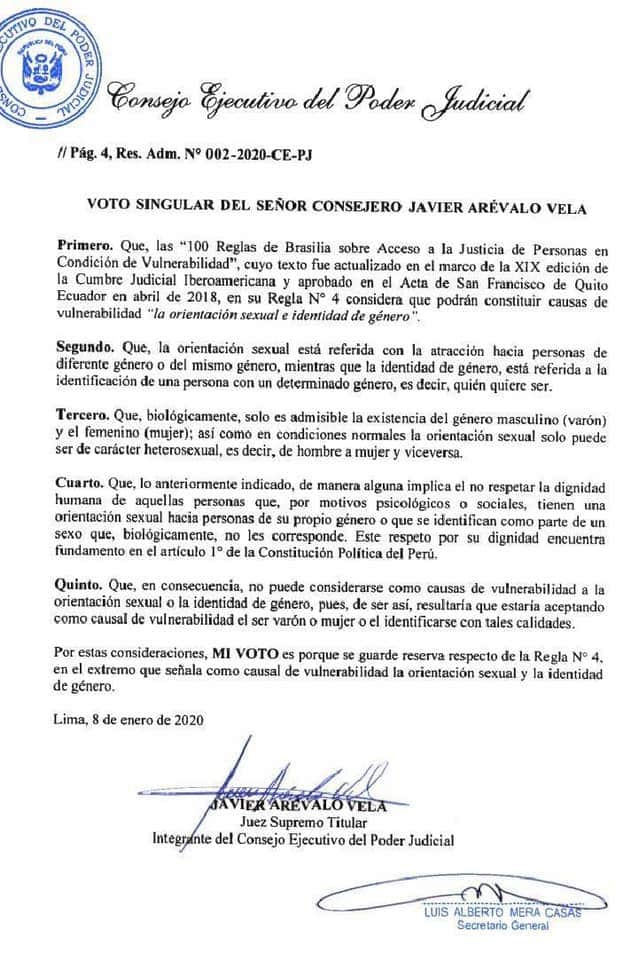
The Executive Council of the Judiciary published a resolution excluding LGBTI+ people from the "100 Brasilia Rules on Access to Justice for People in Vulnerable Situations."

Share

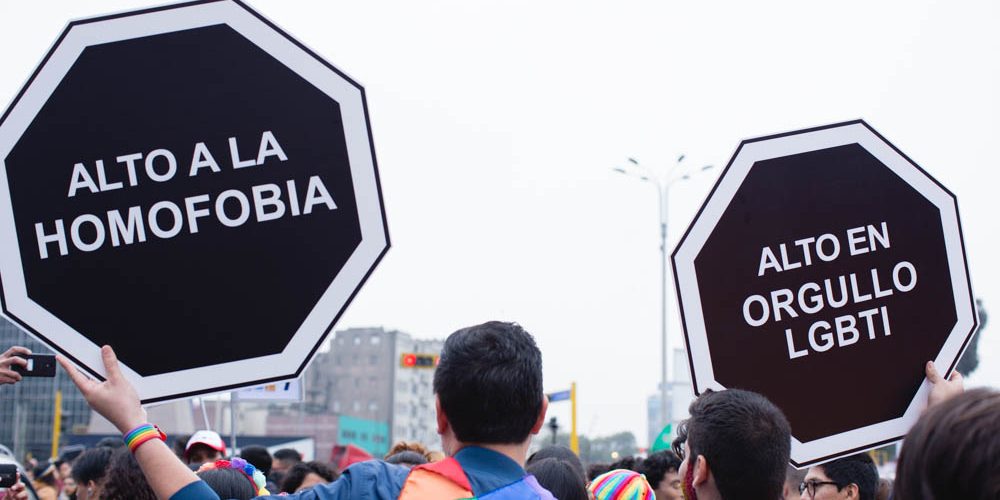
Photo: Esteban Marchand
The Executive Council of the Judiciary, one of the highest bodies in the Peruvian justice system, decided to adhere to the “100 Brasilia Rules on Access to Justice for People in Vulnerable Situations,” but explicitly and specifically excluded the LGBTQ+ population. This homophobic decision was made in January of this year, but only circulated in July when Resolution No. 002-2020-CE-PJ reached the offices of all judges in Peru.
Supreme Court Justice Javier Arévalo Vela justified this decision by stating in his written opinion that sexual orientation, under normal circumstances, is heterosexual, and that any other situation is due to psychological and social causes. In short, he called LGBTQ+ people abnormal, mentally ill, or suffering from some kind of social trauma, which is a crime since the Peruvian Penal Code, in effect since 2017, punishes discrimination based on sexual orientation and gender identity . Furthermore, it is unconstitutional, as the Political Constitution of Peru protects and guarantees the dignity of all its citizens.
The resolution was published today in the official gazette, El Peruano . This caused shock among LGBTQ+ activists and some judges who had been leading a series of initiatives related to the recognition of the LGBTQ+ population. For example, the first National Congress on Access to Justice for Victims of Discrimination and Violence Based on Sexual Orientation and Gender Identity, held in 2019. This event was approved by the same Council that is now deciding to deny the LGBTQ+ population access to justice. In this regard, provisional Supreme Court Justice Carlos Calderón, organizer of this event, told Presentes that "this resolution is a setback, a complete disregard for the rulings of the Inter-American Court of Human Rights, and a painful, frustrating, and sad event."
Judge Janet Tello, president of the Permanent Commission on Access to Justice for Vulnerable Persons, sent a request for reconsideration to the council members. In it, she points out that it is unacceptable for them to ignore the recent condemnation of Peru in the Azul Marín case (2008), in which the Inter-American Court of Human Rights, in April of this year, stated that justice officials failed to exercise due diligence and that their homophobic prejudices acted against the young trans woman who was tortured and raped in a police station, preventing her from obtaining justice until twelve years later.
Adherence to the Brasilia Rules allowed for the development of care protocols for each vulnerable population, documents that were already being drafted by the designated courts. In this case, the protocol for access to justice for LGBTQ+ people was being developed by the courts of Ucayali, Madre de Dios, Huancavelica, Áncash, and Lima, which, faced with this situation, have been left in limbo.

Presentes contacted Jonatan Basagoitia, a senior judge of the Superior Court of Justice of Ucayali, which is responsible for drafting the protocol for the LGBTQ+ population. He also lamented what happened: “It was an arbitrary and homophobic decision by the Executive Council. It's a setback because Ucayali is the one drafting the Access to Justice Protocol for the LGBTQ+ population, and it was the Council that had to approve this protocol. Fortunately, a motion for reconsideration has already been filed, which still allows time for them to resolve the matter in favor of the community. If the motion for reconsideration is rejected, the only remaining option is to file for an injunction.”
A legal challenge against the Peruvian justice system itself, which today decided to deny the dignity of LGBTQ+ people.
]]>We are present
We are committed to journalism that delves into the territories and conducts thorough investigations, combined with new technologies and narrative formats. We want the protagonists, their stories, and their struggles to be present.
SUPPORT US

FOLLOW US
Related notes


We are present
This and other stories are not usually on the media agenda. Together we can bring them to light.