

Trans women displaced by gangs in El Salvador fear for their lives
Displacements in El Salvador due to gender identity and sexual orientation increased by 50% in the last year.

Share

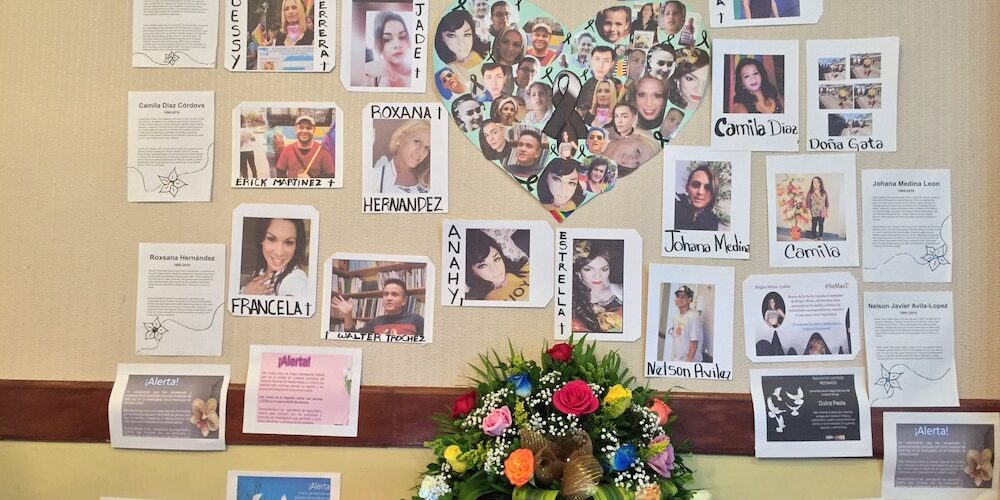
Virginia Flores, a Salvadoran trans woman, is used to fleeing and hiding to protect her life. She has had to move at least three times in the last six years, during which time her two best friends were murdered: one by the violent gangs operating in the Northern Triangle of Central America, and the other beaten to death by three police officers. The latter, Camila Díaz, became an emblematic case of institutional violence: for the first time in El Salvador, three police officers were tried for the murder of a trans person.
Displacement and forced migration have been her salvation; twice she had to leave El Salvador, abandoning her entire life, family, and home. She tells Presentes that this dynamic became a habit she had to adopt after receiving repeated death threats.
According to the study on internal forced displacement of the LGBTI population in El Salvador “Fleeing and Surviving” carried out by the Association Communicating and Training Trans Women with HIV in El Salvador – COMCAVIS TRANS, an increase of 50% was reported in 2019, compared to 2018.
The beatings, the discrimination, the lack of access to employment, healthcare, and decent housing became the daily reality for Virginia, 34. She has lived a life of precariousness and the fear of losing what little she has.
“I have stayed here where I am currently, but that doesn’t mean I don’t perceive the discrimination, that I don’t perceive that anxiety and that fear of insecurity, not because of the general insecurity that exists in the country, but also because of the insecurity of being a trans woman and belonging to the LGBTI population, which puts us at a disadvantage, predisposes us and exposes us to being more vulnerable,” Virginia told Presentes.
No defense for LGBTI people
In 2018, the Constitutional Chamber of the Supreme Court of Justice issued a ruling ordering the Salvadoran State to recognize forced displacement and take effective protection measures for the victims, and in January 2020, Congress issued the "Special Law for the comprehensive care and protection of persons in a condition of internal forced displacement," but to date there is no mechanism to protect LGBTI people.
“I am afraid of being caught in the clutches of violence, afraid of being murdered, because I have experienced it firsthand on two occasions very, very close to me with the murder of my two friends, Monica and Camila; however, I have perceived it, I have touched it and I have felt it on many more occasions,” Virginia said.
the COMCAVIS TRANS organization recorded a total of 84 reports of forced displacement, compared to 56 cases in the same period of 2018 at the national level.
In addition to the reports of forced displacement, eight cases of need for protection for LGBTI people deported from Mexico and the United States have been documented.
“Many people cannot find a safe place within the country and have no other option than to cross a border in search of the protection and security they cannot find at home,” said Elisa Carlacini, UNHCR’s country chief, during the presentation of the report.
Trans women are the ones who suffer the most forced displacement; COMCAVIS registered 38 complaints.
“The report represents updated statistics of a population that is severely affected by internal forced displacement and that is not reflected in official statistics,” stressed Elisa Carlacini.
Violated population that does not report the crimes for fear of reprisals
The LGBTI population in El Salvador is not immune to the violent gangs that operate throughout the country and control territories for drug trafficking and extortion. The report indicates that gangs are the main perpetrators in 62% of cases, the National Civil Police in 21%, and romantic partners in 7%.
“When my friend Monica was killed by gangs, I had to lock myself in my house. I spent about seven or eight months locked in my room. I didn't go out. I was falling into a deep depression. I had headaches, I heard noises, and I felt like they (the gangs) were coming for me,” Virginia said.
The types of violence that COMCAVIS TRANS records in the victims' interviews are: direct threats in 36%; personal injuries and extortion in 18% each; and sexual assault in 8%. (Data is missing here; 80% is given)
El Salvador saw a 62.5% reduction in homicides in the first six months of the year, compared to the same period last year, due to a greater presence of police and military on the streets, the government reported.
According to official data, between January and June of this year, authorities recorded 585 homicides, compared to 1,561 during the same period last year.
The data on violence contrasts with the number of complaints filed; victims of internal forced displacement do not report for fear of reprisals from their attackers. The study recorded that only 51 percent dared to report, while 49 percent did not because they distrusted state institutions.
“At this point in my life, I don’t expect anything anymore, at least not for myself, but I don’t have to be selfish and I also think about the new generations, many trans girls who are beginning their transition stage and they deserve dignified treatment, they deserve a dignified life, they deserve to have dignified health care, they deserve to have a formal job, with all the legal benefits that any human being can have, to have all the same rights, I believe that we all have the same rights,” Virginia expressed.
]]>Share
We are present
We are committed to journalism that delves into the territories and conducts thorough investigations, combined with new technologies and narrative formats. We want the protagonists, their stories, and their struggles to be present.
SUPPORT US

FOLLOW US
Related notes
We are present
This and other stories are not usually on the media agenda. Together we can bring them to light.