

What does Pride mean today?
"Pride is standing up to contempt and reclaiming our identity in the face of insult." On LGBT struggles, freedoms, and politics.

Share

By Ricardo Vallarino, member of 100% Diversity and Rights (Argentina)
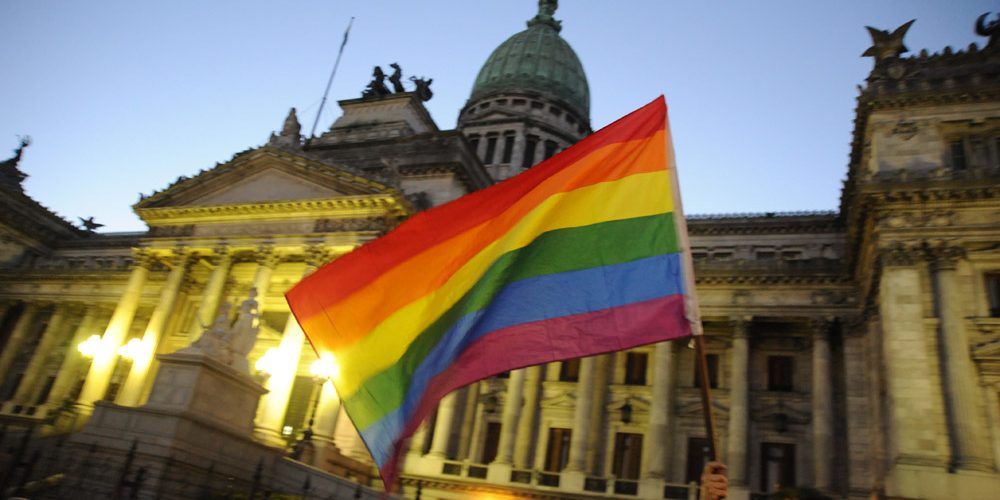
Photo: Ariel Gutraich/Presentes Archive
Do you know when the queer revolution began? When someone was called crazy and that person turned around and said, “So what?” We don’t know when it was, we won’t be able to pinpoint it. But this happened in Peru, in Guatemala, in China, all over the world.
Luis Negrón
The first lesson we learn is the most fundamental and liberating: pride is standing up to contempt and reclaiming our identity in the face of insult . Today we also know that pride is the fight for a non-patriarchal order put into practice through caring for others.
From liberation to politics
We stand tall on the shoulders of giants. But pride wasn't always pride, nor was it always LGBTQ+. The parable that began at Stonewall moves from liberation to politics. It started with a demand for liberation that contrasted with attempts at assimilation. And it continues with the understanding that this goal will not be achieved without transforming state policies.
READ MORE: #LGBTIPride: Why it's celebrated around the world
When a group of transvestites, lesbians, and gay men confronted the police in 1969, what they wanted was to be left alone to love and have fun in peace. Stonewall wasn't the first police raid or the first act of resistance, but from then on, scattered groups would opt for visible and organized protest.
Resisting a police raid is not the same as organizing a march, a less urgent but far more laborious and patient task. It was after much preparation that the following year's march, known as "Christopher Street Liberation Day," took place. At that time, the marches encompassed only a generic "gay" subject, perhaps equivalent to what we now call queer . The demands emphasized liberation and the freedom to love without interference from the police and the mental health system.
It wasn't until the 1980s that political vocabulary began to encompass disparate identities united in a single expression, which would gradually expand to the current "+" sign— an openness that now punctuates the disorder of our acronyms . "Pride" emerged in response to the new challenge of differentiating itself from earlier, more modest attempts, where visibility came at the cost of adapting to heterosexist norms.
It was necessary to be open and outrageous, without ambiguity or resentment. At the time of the first march in Argentina, the movement's tension lay between those who defended the notion of "dignity," rooted in the Universal Declaration of Human Rights, and those who championed "pride," warning of the danger of a supremacist irreverence. Even today, Jáuregui's statement effectively transcends this tension: " Pride is the political response of a society that educates us for shame ."
Throughout these years, we have faced social and state abandonment in the face of the AIDS pandemic, all kinds of exclusion, and judicial inaction regarding hate crimes. We speak of these issues in the past tense because we managed to bring them into the public discourse, not because they have disappeared.
The fight against police raids is also the founding milestone of the CHA (Argentine Homosexual Community) in 1984, which, in the midst of the pandemic, quickly began to articulate demands for the recognition of rights and public policies. It would find its antagonist in the bluntness of Quarracino: "If you want to live free and in peace, go to an island," said the then Bishop of Buenos Aires, Quarracino . With that provocation, Quarracino expressed a segregationist fantasy that sought to leave the country "immune" to all "deviations." The bishop warned that LGBT+ demands were beginning to cast a malevolent eye on constitutions and laws. For those who only know how to brandish a crucifix, any freedom is a cause or effect of disease. And all disease is the work of Satan.
What does the acronym LGBTIQ+ mean and how is it spelled?
Demanding equal marriage and gender identity laws was nothing more than wanting to live with dignity, according to our desires and identities. This demand for "sectoral" recognition had a universal impact. Given the demand that the law treat us as equals, what happened was not the normalization of the movement.
Anyone observing the passage of the ten years since those laws were passed cannot help but notice the transformation of the family institution and legally recognized relationships. We have so thoroughly embraced this openness to relationships that the loving and legal bond between two people is beginning to seem too rigid, the binary system too imposed, and the noun too violent and outdated. Patriarchy, which organizes social life primarily through the actions of the State, has been exposed, and at the same time, the convergence of the LGBTQ+ movement with feminism has accelerated .
But it is also true that the time elapsed since the achievement of these rights has disappointed our expectations regarding real transformations. In these months of the pandemic, we see and feel the deepening of fundamental exclusions . The health and autonomy of trans and gender-diverse people still face appalling conditions compared to the rest of the population, and prior to the demobilization imposed by the quarantine, conservative groups were rising to the pinnacle of executive power in countries like Brazil and the United States. With the creation of the Ministry of Women, Gender, and Diversity, we hope for an acceleration in the transformation of the heterosexist and patriarchal state. And with the prompt passage of the trans and gender-diverse employment quota law and the legalization of abortion.
[VIDEO] Flags of sexual diversity: what they are and what they mean
As these victories continue, the vastness of the violence and obstacles seems to both reveal itself and multiply. With the possibility of marriage, adoption, and access to reproductive technologies, we witnessed the resistance of institutions to implementing them.
With the recognition of gender identity, we observe delays in access to justice and healthcare by state agents. And at every turn, we encounter new waves of violence fueled by religious panic surrounding our progress. We often deceive ourselves with a linear representation of history: a multitude of paths are offered, always forking and swirling in multiple directions. We are not mistaken in asserting that pride is the dream of a future embrace, of building a world where care and freedom are combined. Pride is the lightning bolt in the night of Stonewall and also the thunder of history marching noisily toward us.
All our content is freely accessible. To continue producing independent, inclusive, and rigorous journalism, we need your help. You can contribute here .
We are present
We are committed to journalism that delves into the territories and conducts thorough investigations, combined with new technologies and narrative formats. We want the protagonists, their stories, and their struggles to be present.
SUPPORT US

FOLLOW US
Related notes


We are present
This and other stories are not usually on the media agenda. Together we can bring them to light.