

The transvestite-trans side of the pandemic in Santa Fe
Solidarity, poverty, prostitution, exceptions and opportunities: the stories behind the coronavirus in Santa Fe.

Share

By Soledad Mizerniuk and Victoria Rodríguez
The Covid-19 pandemic exposed the stark realities of Santa Fe. Quarantine is not the same for everyone. Without work, without a home, with limited access to healthcare, and often without family support, a large part of the LGBTQ+ community has been plunged deeper into their pre-existing hardships. Far from the kitchen photos on Instagram, their daily lives are a race for survival.
Prostitution, solidarity, poverty, exceptions, and opportunities. Jackeline, Tamara, Dino, and Noly share their experiences of isolation and the consequences they believe it will have on the trans and travesti community.
Fighting the streets
Tamara Micaela Morcillo is a trans woman, 20 years old, and this year she began working as a prostitute "to have food for my family." In Barranquitas, one of the neighborhoods in the west of the provincial capital, she is spending the lockdown with her mother and brother, who make a living by collecting recyclables. Before the pandemic, because money wasn't enough and she didn't want to collect garbage, Tamara started working as a prostitute.
Today, what she earns on the street is the only income her household has, though that too is affected by the changes the pandemic brought to the city. “With this mess, I can no longer work on the street. Before, I worked every day, in the afternoon, at night, and in the early morning; I worked all day long. Now I can’t,” she tells Presentes. She had to limit her hours and rented an apartment with a cisgender woman to receive those who contact her by phone.
Her goal, once the coronavirus emergency is over, is to save enough money to live on her own. She has a good relationship with her family since they accepted her identity several years ago. Tamara is not on hormone therapy. “I used to buy the pill, the one women take, at the pharmacy, and it didn't do anything for me. I didn't feel it had any effect. Other girls told me that pill was good, but it didn't do anything for me,” she says, recalling that she once made an appointment at the hospital but missed it because she overslept. “I'm going to call again this week,” she says, as if she were at fault.
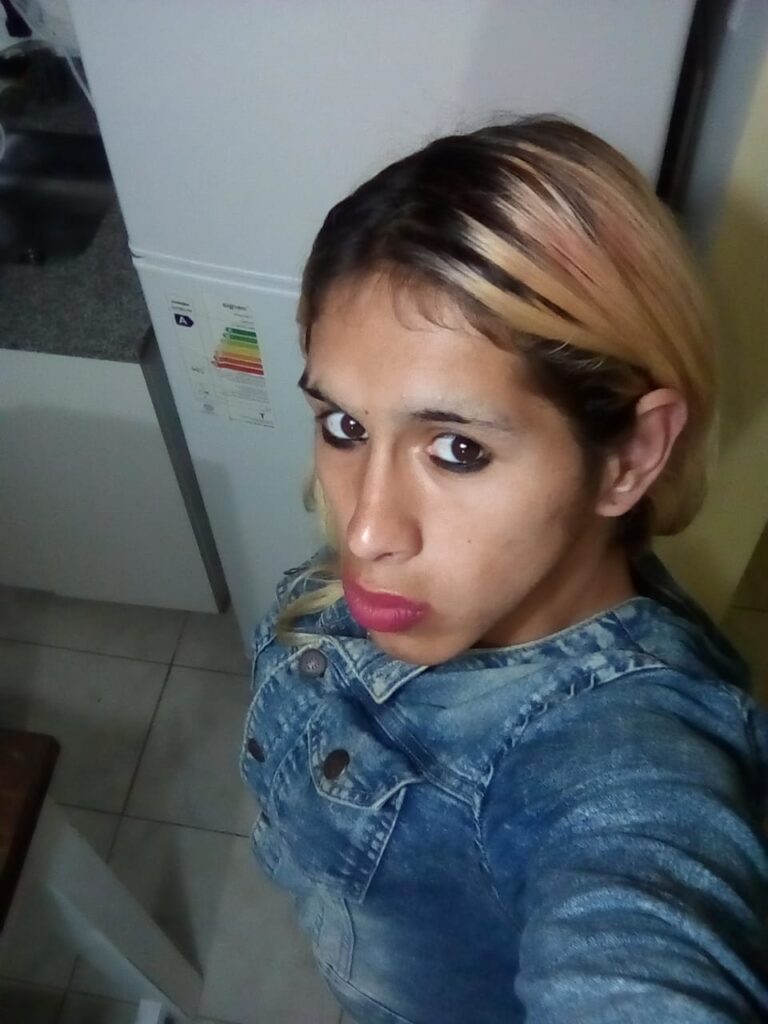
For Tamara, the hardest part when the “new normal” arrives will be the routines, the relationships with the people she hasn't seen during this time, and people getting together again and starting to go out, in every sense of the word. “When all this crap is over, I don't know what's going to happen to us. Today we go out to work and then we're back to being locked up all day. That's going to be difficult,” she remarks, adding that she'd like to find another source of income: “The street is tough, and sometimes bad things happen.”
Jackie and solidarity
Jackeline Ailín Quinteros, known as "Jackie," is a beautiful, dark-haired trans woman from the Barranquitas neighborhood in the city of Santa Fe. Her reality differs from many of her peers because she lives in a house with her parents and her partner—"My husband of nine years," she clarifies—and, while she needs a job, her basic needs are met. She was able to finish high school (graduating as valedictorian from Cristo Obrero) and today sells products from at least four "cosmetic booklets."
“I have a list of 17 girls, one of them a lesbian and the others are trans, whom I take care of bringing food to. There was some food distributed by the government, but it's not enough. Some are homeless and others go out to work on the street. They're without work, without a penny,” Jackie tells Presentes.
While many support networks were activated as a result of the pandemic, she explains that for years they have been assisting a percentage of the community with clothing and food. “Now, because of the coronavirus, everything is much worse for the girls in many ways. For example, the medications for hormone treatments aren't arriving. And the surgeries we had scheduled have been suspended,” she lists.
Regarding the list of girls she helps, she says she put it together a while ago so they could be more connected with each other: “I would ask them for their phone numbers and tell them to write mine down, in case they had a problem or emergency and they had someone to call. Many are from my neighborhood or very close by. I've even taken them home when they had nowhere else to go.”
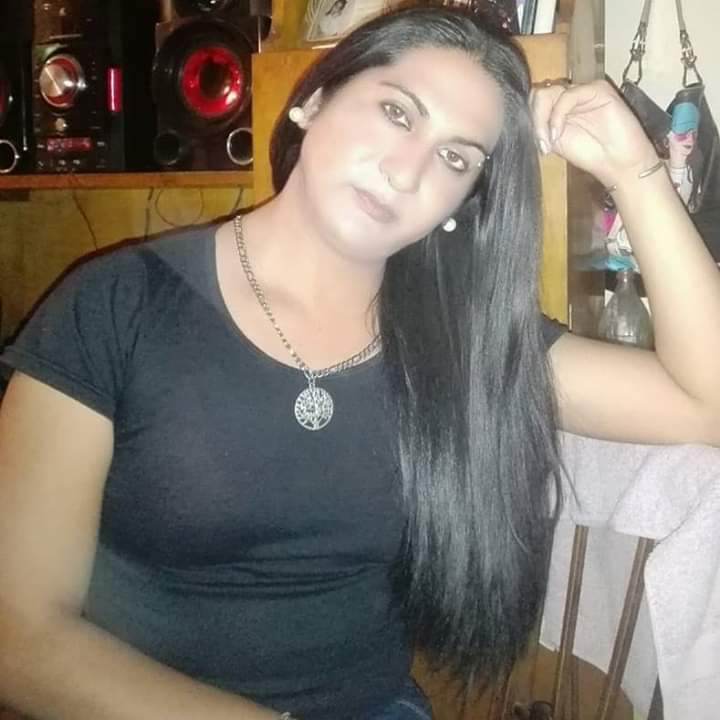
Jackie doesn't want to be associated with any political party or organization. She also doesn't like having her picture taken while delivering the food. "I do it from the heart, I don't want anything for myself," she says, adding an anecdote: "I ask for help for the girls everywhere, and once someone offered to take us to Buenos Aires for the Pride March and other events. We got there, and most of them didn't know the city, so I just took them out to see as much as possible. We went to the March afterward, of course, but I did that first because they might not have had another opportunity."
Aware that her story was perhaps a needle in a haystack in relation to the experiences of most of the group, Jackie joins the demand for opportunities for all, both in the workplace, as well as in education and health.
The future lawyer
From the bleak scenario facing many, flowers also bloomed. They are the helping hands of a group accustomed to building networks that, in the midst of social distancing, are providing meals and food baskets to more than 70 people in that community in the capital of Santa Fe province.
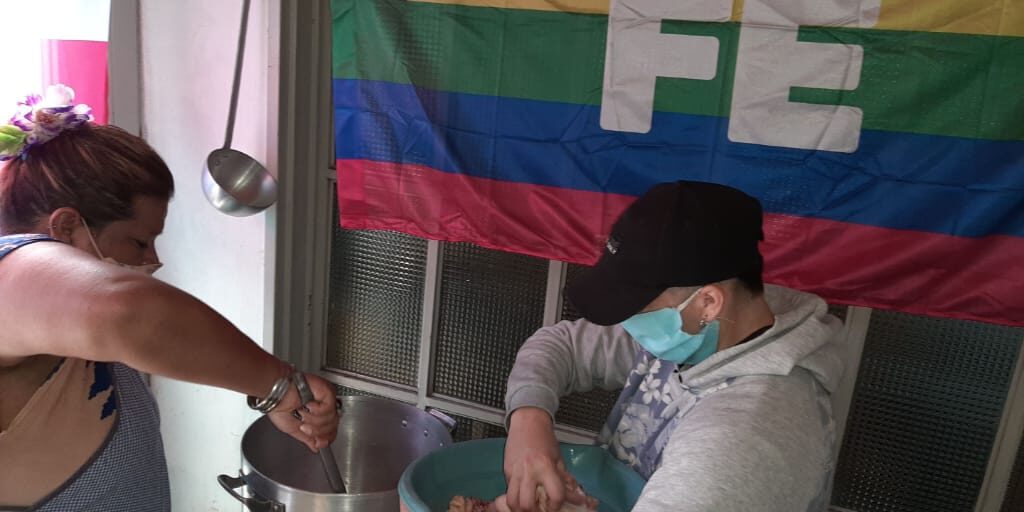
Dino Germani arrived in the city of Santa Fe from San Justo three years ago, when he was 24. He is a trans man, studies law at the National University of the Littoral, lives with some friends, and, until the start of the pandemic, worked in a pizzeria. During these days of confinement, he joined the kitchen of a community kitchen to distribute meals to around 70 people from the LGBTI community in the cities of Santa Fe and Santo Tomé, every other day.
In the context of the pandemic, she not only lost her job. “ I had a date for my mastectomy at the end of April, but both my surgery and the others have been suspended and will be rescheduled after the emergency. From what trans women tell me, there is also a shortage of hormone treatments, not only in Santa Fe,” she tells Presentes.
His volunteer work these days has led him to witness firsthand the situation many members of the community are facing during the health emergency. “There are many women without work or a stable income, in a very difficult situation. We fought for years for the approval of the trans quota in the province, and last year we achieved its approval. Today we are waiting for the regulations, so that the law doesn't get shelved and truly becomes a tool for inclusion,” he emphasizes.
Dino also points out that “the reality of trans women has nothing to do with that of trans men.” “Women are inherently more exposed to discrimination, especially in the workplace. For example, it’s rare for a trans man to have to resort to prostitution to survive. While there are cases, they are not the majority. And it also happens that most trans women are kicked out of their homes by their families,” she adds.
While chopping vegetables and stirring in the pot, Dino continues along his own path. “I came to study law with the intention of being able to defend the violated rights of sexual diversity. It’s one of the main reasons that motivated me,” he says. With a deep desire to write his own destiny, he made the decision more than three years ago: “I came to Santa Fe in July of last year. I didn’t even know that university was free; I found out when I came to inquire. I had just enough money for that trip. I saved for those months, took the entrance exam in November, and settled in February. I haven’t left since, literally.”
Her experiences at school, with her family, and at work had been negative up until then. Bullying at school, rejection from her family—her mother didn't speak to her for five years after she confessed her feelings about her gender identity—and a municipal job where the promised social inclusion didn't materialize; these were all part of a past she wanted to leave behind. “Here I didn't know anyone, but today I have many friends, thankfully. In San Justo, everyone knew you and judged you,” she emphasizes.
Immersed in online classes, notes, and practical assignments, Dino continues to fight, clinging to his goal. Today, he needs a stable job to support his studies and his stay in the city of Santa Fe. “I did an internship for a few months at a prosecutor's office and learned a lot; but the truth is, I need a job now, even if it's not related to law. I want to graduate,” he concludes.
Memories of other confinements
Noly Trujillo is a survivor. She has lived through and fought through them all. At 56, she is one of the few who has surpassed the life expectancy for trans and travesti people and who has a stable income thanks to the State's historical reparations program . She knows this pandemic has found her in a better place than most of her peers. A few days ago, she wrote on Facebook: “These past few days I've stopped to think about how fortunate I've been, to have a roof over my head, a comfortable, warm bed for these chilly days, food on the table, the possibility of a pension, and no longer having to worry about making ends meet. But I never stop thinking about those who aren't so lucky or those who passed away without ever having had that opportunity.”
She says that social isolation brought back old memories, but she can't stop thinking about what the end will be like. She describes the confinement with one word: anxiety. Since the pandemic began, and because she belongs to a high-risk group, she decided to strictly adhere to all safety measures.
“A few days ago, Marina Quintero (a long-time trans activist from Santa Fe) passed away, and that, combined with the loneliness, makes me wonder: will I be next?” she tells Presentes, continuing: “My mind races, and it generates anguish and anxiety. At first, I didn’t feel the confinement much because what people experienced in those first weeks is what we experienced when we were imprisoned. There was a recollection of that situation; it’s horrible because you feel imprisoned again. Trans people of my generation went through so many arrests that it brought back a lot of memories.”
As the days passed and the economic crisis deepened, she organized with other activists to join forces . “Many of our colleagues have nothing. Many are sex workers and are not working,” she points out.
She also analyzed how the generational gap leaves younger women in a worse situation. “We need to take advantage of the help we are providing to have updated data and see what help they need, beyond the emergency,” says Noly, who acknowledges that, unlike older women, young women are very isolated and many don't dare to seek help and advice to change their documents, access healthcare, or exercise other rights.
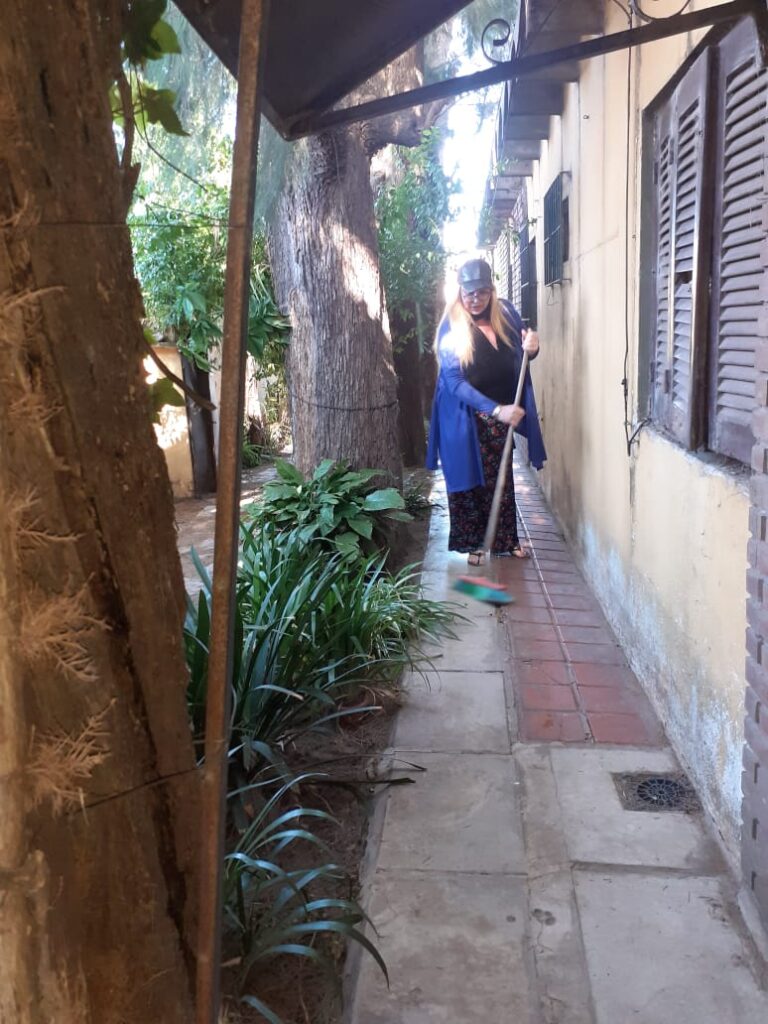
Noly is confident that this stage will allow them to better understand individual cases in order to build volunteer networks that can support and improve the quality of life for these trans and travesti women. “The new activists can do this work and expand their reach. We, the older ones, can support and contribute from our own perspective. We need to reach out and help the younger girls, guide them, tell them they can achieve what they want, and provide them with support,” she says.
All our content is freely accessible. To continue producing independent, inclusive, and rigorous journalism, we need your help. You can contribute here .
We are present
We are committed to journalism that delves into the territories and conducts thorough investigations, combined with new technologies and narrative formats. We want the protagonists, their stories, and their struggles to be present.
SUPPORT US

FOLLOW US
Related notes
We are present
This and other stories are not usually on the media agenda. Together we can bring them to light.