

Voices of lesbian, black, and queer artists from Mexico
As we always say, the revolution will be trans, queer, lesbian, intersex, feminist, anti-racist, intersectional, sexual, visual, musical and loving or it will not be.

Share

As we always say, the revolution will be trans, queer, lesbian, intersex, feminist, anti-racist, intersectional, sexual, visual, musical and loving or it will not be.
Nobody goes around reaffirming heterosexuality because it's a bit obvious, and when you say lesbian, bisexual, or queer in most circles, it resonates with discomfort, a silence that lesbians like, because it shakes up what's established by a heteronormative system.
That's why we at Presentes decided to talk to female musicians, DJs, composers, curators, producers, rappers, lesbians, bisexuals, queer people, and brown people who are making another kind of music and cultural scene possible in Mexico City. “I've been producing my own events for a while now, and thanks to that, I've discovered and supported a lot of women, so that purist scene means nothing to me,” says Sonora Mulata.
Art and activism to intervene in the scene
In addition to artists who work on their music and propose new sounds, music and lyrics, they also carry another commitment, which is to rethink and recreate alternative scenes to the mainstream, to break everything heteronormal in the local scene and this ranges from weaving feminist networks and work practices to sustaining and caring for spaces where you will always find a place, where you will always be welcomed.
Labels, parties, places where sound matters because behind the curation there's a lesbian hand, a queer ear, a bisexual body, but above all a network of love, because in the end that's what it is: “Talking about love and talking about affection is political for me, the most beautiful thing about being an LGBTQ+ artist in Mexico is being able to keep making music and resisting, so that flame doesn't go out,” says MarieV, singer, rapper, and workshop facilitator.
“Always be yourself; it’s less complicated and more fun to live as you really are .” – Gibrana Cervantes
In Mexico, according to a report by LetraS , during Enrique Peña Nieto's six-year term, at least 473 LGBT people were murdered due to their sexual orientation or perceived gender identity and expression . The report also states that, "According to a survey by Conapred and the CNDH, 6 out of 10 LGBT+ people surveyed suffered discrimination during the past year (2018)."
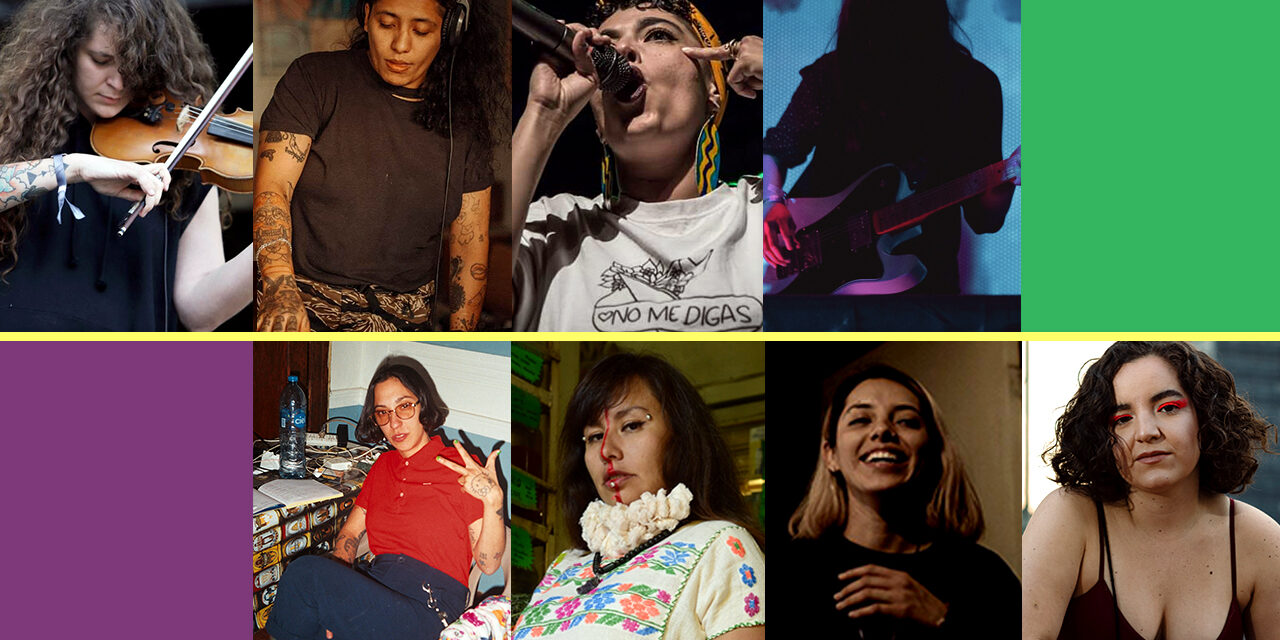
This applies to all contexts and all areas of work, even within music and its various workspaces. They tell and describe it here, accompanied by their photo, who they are, links to their music, and a reflection on a question we asked them:
What is the most rewarding and the most difficult thing about being openly lesbian/bi/queer in the music scene in Mexico?

GIBRANA CERVANTES (Chilpancingo, Guerrero)
https://soundcloud.com/gibrana-cervantes / www.vyctoria.bandcamp.com http://www.umor-rex.org/ur126-s1/ / https://www.facebook.com/316centro/
«I've never felt like I was in a difficult position for being openly lesbian; maybe the awkward part is when guys don't know and try to push it, haha. Observing the music scene in Mexico, I'm aware of a lot of microaggressions because they continue to be reproduced through power dynamics, between the egos of musicians and patriarchal violence. In both the classical and experimental worlds, there are more men than women; there are few lesbians, and the mistake is that sometimes they think you're one of them.
The best thing, definitely, is being able to be visible and live peacefully being myself in all aspects of my life. I believe you should always be yourself; it's less complicated and more fun to be who you truly are . Another wonderful thing about Mexico is seeing and hearing more women making music. It's important to show ourselves and love ourselves; let's break down prejudices and barriers simply because we have the right.
A professional violinist, experimental artist, and curator for over a decade, Gibrana is a fundamental figure in Mexico City's musical life. She has been playing the violin since she was nine. She is a member of orchestras such as the OSUAEH (Symphony Orchestra of the Autonomous University of the State of Hidalgo), where she currently plays, as well as iconic bands in the city's underground scene like Vyctoria and Amor Muere, contributing a unique nuance with her violin, which she also explores as a soloist. Gibrana is also the co-founder of 316centro , an independent venue that has become essential for live music in Mexico City; there, she curates programming from a diverse and multidisciplinary perspective that combines concerts, visuals, and experiences.

MARÍA VERAS ÁLVAREZ AKA MarieV (Pachuca, Hidalgo)
Official video of Masta Quba and MarieV song «Renacer»
“ Talking about love and affection is political for me. The most beautiful thing about being an LGBTQ+ artist in Mexico is being able to keep making music and resisting, to keep that flame alive. And the hardest thing is sometimes embodying self-love while still living in a country where you're oppressed and where ideas from a system that fosters false, sometimes toxic, love are imposed. That's why I believe it's important to make all women from all walks of life visible so that we can truly embody free love and that can be our real revolution.”
A graduate of the Rock to Word music school, she is a singer, rapper, and workshop facilitator. A feminine soul, she sings an ode to the journey through various genres, combining poetic language (rap, blues, soul, cumbia).

ARIESHANDMODEL,
self-taught DJ and cook, brown & cuir
https://soundcloud.com/arieshandmodel
"From my personal experience within the music scene in Mexico (at least the one I am part of) I have been quite lucky since it is quite open and even within it I have managed to create and be part of a creative lesbian community and that along with seeing representation is one of the things I find most rewarding/valuable.

PANCHITA PELIGRO
Set from March 8th at the tortilla party at "La Cañita"
https://soundcloud.com/panchitapeligro/panchita-peligro-en-vivo-desde-la-canita-8m
DJ and co-founder of the collectives Mi Hermosa Vagina, Berraca Bici Bass, Mal de Ojo, and Chingona Sound—feminist LGBTQ+ music and art platforms—Panchita Pelitro currently hosts a radio show called Curados Finos on Radio Cósmica, performs at parties and festivals in Mexico, and continues working with the Chingona Sound community.
What is the most difficult and beautiful thing about being an open lesbian?
" The hardest part was coming out until my family fully accepted it. For six years I barely spoke to them because of it. Then one day my mom told me she didn't want to lose me and that she accepted me as I was. From then on, we could talk more openly, I introduced her to the girls I was dating, and things got better."
The best thing is being able to be openly part of lesbian and queer communities and networks. Knowing that we're all a team, that we look out for each other, that we support each other, that we work together, that we create economies among ourselves. And this is within the music scene. Chingona Sound is a community like that; we're many very different women, many of us are lesbians, others are queer, others are bisexual. Some play techno, others psytrance, others cumbia, others footwork, some sing, others are sound engineers, others are musicians. Some have daughters, others have steady jobs, others are freelancers, others are anarchists. But we are a community, and we work together and we all look out for each other.

https://www.mixcloud.com/NoodsRadio/pellizcadas-w-sonora-mulata-11th-july-19/
"The hardest thing individually is getting recognition for the career you've built through hard work. What I appreciate most is meeting women who are on the same path of transformation within the current scene. It's the feminist movement of creative women in music that's becoming increasingly powerful. Finally, sexism and inequality in everything—pay, treatment, venues—are being called out. Personally, I've developed on the fringes of what you mentioned. I never felt part of it because I saw, and still see, the classist ways of including people on lineups. If you're a woman and you meet their musical and beauty standards, you get invited, or if you're close friends with the organizers, you'll get the gig. I'm too lazy to do either of those things, so for a while now I've been producing my own events, and thanks to that, I've discovered and supported many women. So, that purist scene means nothing to me." I'm very interested in the concept of race in the underground scene, but it's a micro reflection of the macro Mexican culture. Here, everything revolves around your social position, although also your skin color. It's not just that dark-skinned people are oppressed; they are also oppressors and classists.
Being a lesbian is condemned worldwide; it's a negative concept, but in Mexico, where everything is violent, it's even worse. In fact, male homosexuality is more accepted; that's the level of misogyny in Mexico. So, making lesbian dissent visible is a huge and incredibly difficult task because people don't want to accept that women can be free, starting with our bodies and who we have sex with, not to mention the differences that threaten their comfortable homogeneity.
Being a lesbian is going against the grain, and those of us who go against the grain live on the margins.
I like women, although I've also had relationships with guys—definitely unsuccessful ones, but I've had them. Then comes the label of bisexuality, eternally criticized and invalidated because, for lesbians, I'm not enough, even though my political trajectory defines me more as such than some 'lesbians' who only think they are because they have homonormative relationships with women. And for cisgender people, I'm eternally curious, even though my positions are quite clear and open. Which leads me to totally disagree with the labels applied to sexual preferences. That's personal, and everyone lives their sexuality as they please; it's not something others should label or judge. To each their own.
Zay is Sonora Mulata. She currently manages and produces feminist electronic music events. Sonora Mulata is "an exploration of tribal and Afro-descendant rhythms, with fast-paced beats inspired by sound system culture."

ADRIANA ROMA
https://soundcloud.com/adrianaromamexico
" The hardest thing, I think, is overcoming the taboos surrounding the words lesbian or bisexual . I know that, unlike in other eras, we're living in a less complicated time, but I've received comments like 'go ahead and kiss each other,' to which I reply, 'You kiss him,' and they're taken aback, haha. Or the fact that they think that because you're lesbian or bisexual, you hate men, which is completely untrue. I think most of my best friends are men. The best thing is having the courage and strength to say, 'I don't care,' I'll keep doing what I want. There will always be other people who judge, who disagree, who don't understand. A graduate of the Design School of the National Institute of Fine Arts, I'm a comprehensive designer and co-founder of WOMXN, a collective and agency that aims to increase the visibility of women in the national electronic music scene."

PIAKA ROELA
https://soundcloud.com/piaka-roela
"From my experience as a musician and a lesbian, in different scenes like rock and experimental music, the difficult part has been encountering people who aren't open or informed about issues of sexual diversity, and I've witnessed sexist or homophobic comments. I try to start a dialogue about these things and bring other perspectives to the table. The best part is that, because of this, I've been able to contribute to building our diverse spaces and relating to each other safely."
Piaka Roela is a musical producer and performer who uses the guitar as her main instrument. She develops sound experiments with acoustic, analog, and electronic media, leaning towards soundscapes and ambient music. She is currently a member of Sexores (EC-MX) as bassist, Lxs Chavez as guitarist, *Todas las Anteriores with Libertad Figueroa, and her solo project, Piaka Roela . Since 2017, she has been a co-founder of the collective Híbridas y Quimeras , which seeks to promote and showcase women in sound, electroacoustic, and electronic experimentation.

Vic Tolchinsky aka ZOMVIC
https://soundcloud.com/zomvic-ba /// https://zomvic.bandcamp.com/releases
https://www.youtube.com/watch?v=T7IBG-aaI6M / https://www.youtube.com/watch?v=x9ky43CGcds
"The nightlife scene, where I usually work, is a space where dissent is generally starting to find its footing. It's a path through which we begin to conquer spaces and achieve equality. Discrimination can only go so far, but many battles have been won since the 1960s with disco. I recommend reading 'The Secret History of Disco: Sexuality and Racial Integration on the Dance Floor' by Peter Shapiro. The nightlife scene is, above all, sexist, so my advantage of being a lesbian is that I can skip the part where some jerk tries to hit on you while you're pitching an idea or a business. But anyway, more than one guy doesn't care that I'm a lesbian, and, driven by macho ego, tries to hit on me even more. Sometimes when you ignore them, the deal falls through, and they're not even listening to your proposal."
Vic Tolchinsky, aka ZOMVIC, is an Argentinian DJ and producer currently based in Mexico City. Her sets feature a selection of Electro, Techno, Dark Wave, New Beat, Breakbeat, and Acid House, which has led her to perform in important clubs throughout Argentina and Latin America.
All our content is freely accessible. To continue producing inclusive and rigorous journalism, we need your help. You can contribute here .
We are present
We are committed to journalism that delves into the territories and conducts thorough investigations, combined with new technologies and narrative formats. We want the protagonists, their stories, and their struggles to be present.
SUPPORT US

FOLLOW US
Related notes

We are present
This and other stories are not usually on the media agenda. Together we can bring them to light.