

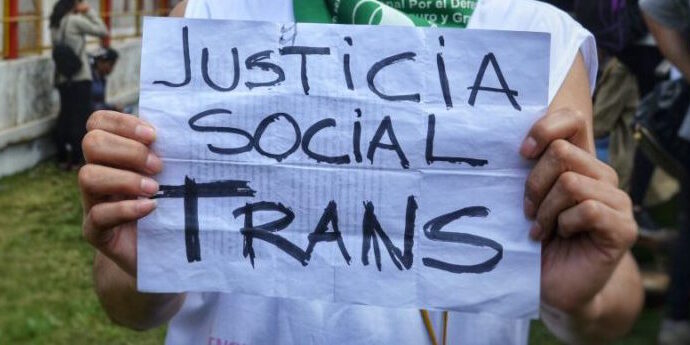
Are there privileged trans people?
I do not agree with the term “privilege” to refer to access to basic rights mentioned above.

Share

By Violeta Alegre
Photo: Luciana Leiras/Present Archive
I have a habit of always looking at the etymology of words. In this case, I'm drawn to a term that some trans women and transvestites have been using when we access healthcare, education, work, or housing. We call these fulfilled basic needs "privileges." However, we don't delve into, for example, whether the public or private healthcare system puts you on equal footing with the rest of the population. Or whether education considers your specific needs, whether its institutions aren't exclusionary and largely try to force you to disassociate yourself from your identity and life story in order to belong. Whether "decent" work is truly dignified, recognizing your life experiences and the conditions of your employment; whether it has any intention of repairing those years of vulnerability, abuse, and violence. Whether we face more obstacles than others in obtaining and maintaining housing, and so on. I could give many more examples, but I suggest we return to my habit of looking at the etymology of words.
The origin of the word “privilege” comes from the Latin privilegium , composed of privus from the verb privare (private, particular, one's own), legio from legalis (related to the law), and the suffix –ium ( -io, indicating a relationship). Thus, the meaning would be: a private law for a person or group of people. In legal language, a privilegium is a law that affects a particular sector of citizens or a specific individual, thus constituting a difference in legal treatment compared to the rest. Today, the term privilege is also used beyond its legal meaning. We say that it is a privilege when a person or institution grants a particular benefit or concession to another person or group without them having made objective merits for it. [1]
Regardless of the etymology of the word and the meaning with which we use it, I do not agree with the term "privilege" to refer to access to basic rights mentioned above.
Transvestite and trans identity in Argentina is the result of the organizing of our comrades outside the status quo, outside the recognition of nation-states, all their institutions, and their churches . Our identity is resistance to that hegemony that sought to exterminate us. It is resistance to a “morality and good customs” that a large part of society continues to defend to this day.
Privileges in quarantine?
In this particular situation of quarantine, I also think about what "privileges" really mean. When we have to go out to do some shopping or to help a friend, it makes me think back to many situations where we "camouflaged" our identities. Wearing a mask is a relief for many of us because we're not being watched as much since a large part of our face is covered; I felt the same way in my teens during winter with scarves, even though I hated the cold.
Nevertheless, the fear is there, because if a police officer stops you and asks, "What are you doing? Where are you going?" they might realize you're a trans woman and be determined to make your life miserable. Why? Because you're trans, it's as simple as that. In this way, we relive the violence and survival strategies in our emotional and physical memories. For those of us who have a justified distrust of the police, we think twice before going out, because it seems we amplify suspicion a hundredfold, even if it's just to go to the corner store.
"Transvestite and trans identities would have been successfully exterminated if we didn't keep being born," Marlene Wayar would say. I call her, my friend, the activist, to tell her that a comrade was stabbed, that she has nothing to live on. I tell her we need to weave something that translates into urgent action from this place of absolute powerlessness, and the crazy woman's voice starts to break, because it hurts, because we will never feel privileged as long as they keep killing us for being transvestite, trans, gay, or dyke.
From an individual perspective, I could say: I, Violeta Alegre, have enough to eat and pay my rent today, and from that standpoint, I consider myself "privileged" compared to others who don't. But what the hell does Violeta Alegre matter when she's just another link in a collective network? Because I also run the same risk we all run, and that risk is due to our identity.
In any case, we will celebrate privileges when we are on equal footing with our identities intact, recognized in the difference from that hegemony that we do not want to include us because it disidentifies us and co-opts us.
What privileges are you talking about when every small or large victory reminds us of all the women who fought and are no longer with us because they were transvestites?
Let's not get confused, we are not privileged. We are still survivors.
[1] http://etimologiaspalomar.blogspot.com/2014/07/privilegio.html
All our content is freely accessible. To continue producing inclusive and rigorous journalism, we need your help. You can contribute here .
We are present
We are committed to journalism that delves into the territories and conducts thorough investigations, combined with new technologies and narrative formats. We want the protagonists, their stories, and their struggles to be present.
SUPPORT US

FOLLOW US
Related notes

We are present
This and other stories are not usually on the media agenda. Together we can bring them to light.