

How Covid-19 affects LGBT+ people in the region: data and assistance
A regional report on how LGBT+ people are being affected by the pandemic.


Share

Photo: Josean Rivera/Presentes Archive
Reports: Vero Ferrari (Peru), Airam Fernández (Chile), Lucas Gutiérrez, Ana Fornaro and María Eugenia Ludueña (Argentina), Milena Pafundi (Mexico) Juliana Quintana (Paraguay), Paula Rosales (El Salvador and Honduras), Pilar Salazar (Guatemala).
[AN UPDATED VERSION OF THIS REPORT CAN BE FOUND IN THIS MULTIMEDIA SPECIAL]
In recent weeks in Latin America, human rights organizations have reported an increase in human rights violations against LGBT+ people in the context of the Covid-19 pandemic. This is due to the increased vulnerability of these populations, as well as the fact that mandatory isolation measures and street controls subject them to domestic violence or discrimination by security forces. In the case of trans and gender-diverse people, this situation is exacerbated by the housing crisis.
For these reasons, the Inter-American Commission on Human Rights (IACHR) called on States to guarantee the rights to equality and non-discrimination for lesbian, gay, bisexual, transgender, and intersex (LGBTI) people in the care and support measures they adopt. It cites the example of Peru, where the government issued a decree restricting movement based on gender, and abuses by security forces against transgender people became commonplace.
As the coronavirus pandemic spreads regionally, ILGA LAC issued an urgent call to adopt “an anti-discrimination and rights-based perspective in the implementation of measures taken by the region’s states in response to the COVID-19 pandemic, taking into account the inequalities faced by LGBTI+ people in our countries.” In its statement , the organization warns that “most LGBTI+ people work in the informal sector and without health insurance, and therefore it is essential to adopt public and private measures to prevent the economic impacts on LGBTI+ people from becoming even more severe.”
The Latin American and Caribbean Network of Trans People (RedLactrans) estimated that "95 percent of trans women engage in sex work" and are excluded from the formal economy, and demanded that ministries and governments in the region create programs for support and socioeconomic assistance. "Trans people do not own their own homes; they must pay rent, buy food, and maintain preventative measures." The network also estimated that "due to poverty and exclusion, they are a high-risk population during the coronavirus pandemic."

ARGENTINA
As of March 26, Argentina has been under mandatory preventive isolation since March 19. The Ministry of Health reports 502 cases and 8 deaths to date, with the 20-59 age group being the most affected. Of these, 117 cases were reported yesterday, 25 of them. The Ministry publishes constantly updated reports on its website.
At the beginning of the lockdown, trans activist Violeta Alegre Ríos published a letter addressed to the president asking how trans and travesti women who live from self-managed productions and/or prostitution will be able to comply with the measures: “Many of us do not have family and social support to take the proposed measures.”
Among the measures taken by the government is a ban on evictions for the duration of the quarantine. The President of Argentina reaffirmed this on Public Television in response to a question from Diana Zurco, the station's first transgender broadcaster .
Trans people, the most affected population
“ The most affected and vulnerable population during the pandemic is that of trans women. Because the number of trans women who still work in prostitution is very high in the province of Buenos Aires,” Daniela Castro, director of Sexual Diversity for that province, which has 17 million inhabitants and a large part of the LGBTI+ population, told Presentes.
“Our colleagues who used to receive a daily income no longer have the resources to guarantee a meal. The province of Buenos Aires is in crisis due to the emergency and because a large part of the LGBTI+ population lives here. We are receiving an enormous number of calls for help. The most urgent need is food , and we are working hard on this,” she reported.
To address this, the Ministry of Women, Gender Policies, and Diversity, headed by Estela Díaz, is working on several fronts. On one hand, together with the provincial Ministry of Development, they are "ensuring food baskets for these women in prostitution. We requested additional funding specifically to reach them, and it's already starting to be implemented," Castro stated.
On the other hand, with the National Women, Gender and Diversity program, they are working to allocate funds from the Hacemos Futuro program specifically for transvestites and transgender people. “It’s one of the first programs implemented. It provides 8,500 pesos. We already have more than 5,000 applications from our colleagues,” Castro said.
“We are strengthening food assistance for trans and gender-diverse people by incorporating them into the social programs of the @MDSNacion . Given the health emergency, it is essential to preserve the health and protect the rights of the most vulnerable,” the national ministry reported on its Twitter account.
The National Institute Against Discrimination and Xenophobia (INADI) reported that they are also working with the Ministry of Social Development to provide food assistance to transgender and transvestite individuals. "Through the Secretariat of Social Economy, all transgender and transvestite people in our country who do not have formal employment or who are in a situation of social vulnerability are being enrolled in the 'Potenciar Trabajo' (Strengthen Work) program," they stated. The program helps them complete their education, receive vocational training, and also supports entrepreneurial ventures they may develop within the framework of the informal economy.
"We successfully arranged for two trans women, who returned from Spain and were at risk of becoming homeless in the City of Buenos Aires, to find a place to complete their quarantine under the conditions recommended by the Ministry of Health of the Nation," shared INADI, where Ornella Infante, a trans activist, is in charge of the Directorate of Policies and Practices Against Discrimination.
National program for transvestites and trans people
Among the new measures announced by INADI is a specific program for transvestites and transgender people. This is the National Program for Socio-Productive Inclusion and Local Development : Potenciar Trabajo (Strengthening Work). It consists of the allocation of a supplementary social wage "corresponding to 50% of the Minimum Living Wage in order to satisfy basic needs and/or strengthen productive initiatives implemented by the beneficiaries."
Here you can access the requirements and the form.
Useful information for asking for help
Ministry of Women, Gender Policies and Diversity of the Province of Buenos Aires: (0221) 421 4035 and (0221) 421 3450
Sexual Diversity, Province of Buenos Aires Direcciondiversidadsexual@ministeriodelasmujeres.gba.gob.ar
INADI: You can request help via WhatsApp from 9 a.m. to 3 p.m. at the numbers 1164921079 / 1161853968 or by writing to 0800@inadi.gob.ar .
Line 144: for advice and support for victims of gender-based violence. This is not an emergency line. In case of emergency, call 911.
PBA Mental Health Helpline: 08002225462
If you see homeless people in the province of Buenos Aires, please report it to: 0800 666 7232
Campaigns: We all take care of each other
Social organizations and LGBTQ+ activist groups are calling for donations of money or essential supplies to be distributed among members of the community. The LGBTQ+ Network: “We Take Care of Each Other” is an initiative of 100% Diversity and Rights, along with La Rosa Naranja and members of Orgullo en Lucha (Pride in Struggle). The network is already working to reach various cities in Argentina.
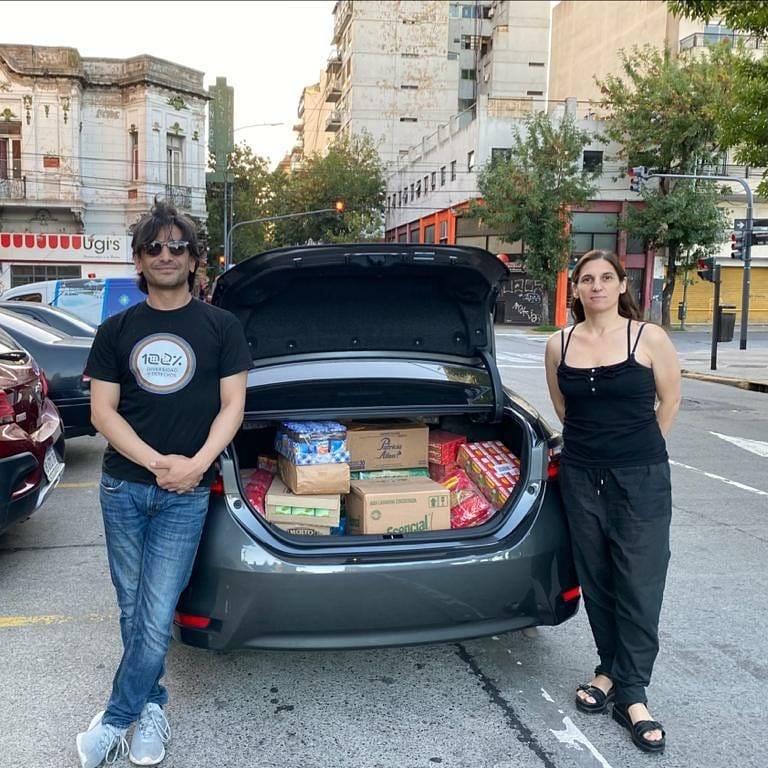
To donate to We take care of each other: http://bit.ly/
[READ ALSO: Coronavirus: "We take care of each other," the network to assist LGBTI+ people ]
trans people deprived of liberty
Otrans Argentina, based in La Plata, expressed concern “about the sanitary conditions, prevention and containment of the coronavirus in prison settings, as well as the lack of food.” The organization is requesting donations for “fellow inmates housed in Penitentiary Unit No. 2 in Sierra Chica,” who are not receiving visitors due to the preventative isolation measures.
They are asking for food, but also fabric and surgical interfacing. Transvestites and transgender people deprived of their liberty want to use the six sewing machines they have to make face masks for themselves and for others who need them.
To donate: contactootrans@gmail.com

Health and access to medication
Other significant situations involve complaints from people living with chronic illnesses who have difficulty accessing medication. “Starting today in the province of Buenos Aires, a mobile unit from the Ministry of Women, Gender Policies and Diversity is distributing medication and prescriptions to those who urgently need them and cannot leave their homes,” Daniela Castro told Presentes.
With some municipalities closing their borders and police forces in charge of controlling movement, a complex situation has arisen. “The security forces include sectors that have historically discriminated against LGBT+ people, and it is sometimes difficult to get them to allow movement, for example, for transvestites and trans people who need to go to a health center or pharmacy,” says Castro.
[READ ALSO: Why we need to stop comparing HIV and Coronavirus ]
The Ministry of Health, in line with international organizations, reported that HIV-positive individuals with a healthy CD4 count (above 350 cells/mm³) and an undetectable and controlled viral load are no more at risk from the coronavirus than a person who is HIV-negative. If they require leave, they can take it without compromising the confidentiality of their diagnosis. This is specified in Article 7 of Resolution 627/2020, , regarding isolation measures.
If you need medication, the Ministry's AIDS Department provides phone numbers where you can find out how to proceed . If you need to travel, it is recommended that you carry documentation proving you are going to pick up medication and print (or write by hand) the following document.
CHILI
On Sunday, March 22, the Chilean government decreed a curfew between 10 p.m. and 5 a.m., as a new measure to try to curb the spread of COVID-19 in the country. Prior to this, supermarkets reduced their hours, shopping malls closed, and some of the wealthier districts of the capital, where the first cases were registered, were already under mandatory quarantine.
As of Thursday morning, March 26, Chile had 1,306 confirmed cases of COVID-19 and four deaths. Health Minister Jaime Mañalich said the curfew was implemented to “protect the entire population,” but especially the elderly. On Wednesday afternoon, he announced a “total quarantine” for seven municipalities in the Metropolitan Region for the next seven days.
Sex workers
Sex workers also face enormous health risks and economic hardships. As in other countries, the rapid spread of the virus is preventing them from working. Alejandra Soto, president of the Amanda Jofré Cerda Independent Union of Sex Workers, told Presentes that since last week, most transgender sex workers in Santiago have had to stop working as a preventative measure when the government declared a health emergency.
“The curfew directly affects us because we work at night and on the streets,” she said. Faced with this situation, they activated their support networks and requested assistance from some municipalities, city halls, and universities . “We are trying to obtain supplies and any kind of financial aid because we can’t work during this emergency, and since we live off our daily earnings, it will be very difficult for us to cover basic needs like paying the monthly rent or buying food.”
Alejandra indicated that they are working with the Ministry of Health to organize a flu vaccination drive for all union members. They are generally requesting support programs and socioeconomic assistance from the government to help them face the pandemic in dignified conditions.
Access to health
Health consultations for transgender people and hormone therapy for those receiving care in the public system are also at risk . Presentes received a complaint from a user of the transgender clinic at Sótero del Río Hospital, located in one of Santiago's most populous neighborhoods, warning of the suspension of services. A notice posted on a bulletin board in the so-called "Rainbow Office" reads: "Due to the current situation, services are suspended and appointments will be rescheduled."
Presentes contacted Cinthia Aránguiz, coordinator of the Gender Identity Program at this hospital, but received no response by the time of publication.
For Franco Fuica, head of legislation and public policy at Organizing Trans Diversities (OTD), the spread of COVID-19 could replicate this situation in other hospitals across the country. “They are already prioritizing clinical cases, as is to be expected. But this will affect trans people in terms of surgeries, hormone therapy, medical tests, and psychological care. We don't know exactly how this will play out, but we believe it will be suspended until further notice,” he told Presentes.
On Tuesday, the health minister announced a ban on all elective surgeries "that do not pose a risk" to patients' health, in both the public and private sectors.
People living with HIV

In Chile, there are approximately 71,000 people living with HIV, according to the latest report from the Joint United Nations Programme on HIV/AIDS (UNAIDS). This figure has increased by 82% since 2010, making Chile the country with the largest increase in new HIV infections in Latin America between 2010 and 2018.
Until yesterday, the supply of medication for this population group was proceeding normally, but organizations fear that complications will soon arise, at least in hospitals, because they are not providing treatment for several months . If the government yields to pressure and decides to decree a total quarantine, as other countries have already done, the situation could worsen, since there would be no possibility of accessing health centers unless the authorities have a plan in place for this eventuality.
The Ministry of Health's National HIV/AIDS and STI Program has not yet issued a statement. Meanwhile, the Chilean Nurses Association is sharing advice on its social media channels to help people living with HIV reduce their risk of contracting the novel coronavirus.
The Chilean Society of Infectious Diseases has prepared a guide with information and recommendations for the prevention of COVID-19 in people living with HIV.
And amid the crisis, the Lesbian Group Breaking the Silence also activated its channels to receive reports of cases affecting the LGBTI community.
PERU
The first coronavirus patient in Peru was detected on March 6. By March 25, there were 580 infected and 9 dead. The State of Emergency was extended until April 12. Only one person per household is allowed to leave to make nearby purchases, and others must carry a transit pass (essential workers, journalists, etc.). A curfew is in effect from 8 pm to 5 am. The Armed Forces are deployed in the streets.
The delivery of a bonus of 380 soles was established for people in situations of poverty or extreme poverty, which should cover three million Peruvians.
Domestic violence
In these circumstances, a large number of communities have been affected. On March 22, the first femicide during quarantine was recorded. Line 100, responsible for receiving reports of gender-based violence, has received 2,500 calls so far; 207 cases have already been reported, and in 38 cases, the victim has been taken to a shelter. 600 of these calls are from children and adolescents reporting that they or their siblings are being beaten .
Migrants and trans people in Peru
Another at-risk population is the nearly one million Venezuelans (862,000 in 2019) who arrived in Peru due to the crisis in their country. The Peruvian government decided not to grant them any government assistance, even though most worked in the service sector or in the informal economy, leaving them in a precarious situation: starve or break the law.
The trans community has been organizing to confront the crisis through donations, monitoring of trans social organizations, and municipal policies. director of Féminas , indicates that they have provided support to 181 trans women in Callao, East Lima, North Lima, and South Lima, thanks to donations collected in the first days after the quarantine was announced. They have also managed to support 120 women in downtown Lima thanks to the Lima Municipality's Women's Office.
Huerta points out that strong bonds of solidarity have been generated among trans women in these times of crisis; some even cook for their own homes and for the homes of other women, so that they do not go hungry while they cannot go out.
Taki Robles, from the trans association Amigas por Siempre (Friends Forever ) in Callao, explains that they are facing the crisis with two measures: distributing donated food supplies and providing meals through a community kitchen. “This pandemic affects us because we live day to day, and this measure caught the vast majority of us with empty pockets, which makes us extremely vulnerable and marginalized. Confining the women to their homes only means watching them languish without social assistance, especially since many haven't qualified for the 380 soles bonus,” she emphasized.
People living with HIV
project coordinator for the organization Jóvenes cambiando VIHdas ), pointed out that people with HIV were indeed receiving the corresponding medication and, due to the health emergency, the Ministry of Health had arranged for them to receive it for a minimum of three months, so that they would not be exposed by leaving home every month.
So far, only in the city of Huancayo, has one person with HIV complained of not receiving their medication for a week due to shortages, and that when they went to request it, the healthcare staff mistreated them. After the complaint became public, they received all their medication yesterday.
No complaints but on alert
So far, no complaints of discrimination or violence against LGBTQ+ people by the police or the Armed Forces have been registered. But we know that this is common even in calmer times; the exercise of LGBTQ+ citizenship in Peru is diminished, and the community suffers constant violence.
In this sense, if LGBTQ+ children and adolescents were already at risk without a pandemic, they may be suffering even more now that they are confined to their homes. LGBTQ+ and feminist organizations are attentive to these situations and have demanded that the Peruvian government take them into account in any measures to mitigate the health crisis.
PARAGUAY
The Ministry of Public Health reported this Wednesday that there are 41 confirmed cases and 3 deaths due to Covid-19. The quarantine has been extended until April 12, and preventive isolation has been mandated until Saturday, March 28. With this new measure, everyone must remain in their homes, restricting movement as much as possible. Healthcare workers, public officials, and journalists are exempt.
According to the 2019 World Development Report (WDR): The Changing Nature of Work , in Paraguay, 7 out of 10 workers are in the informal sector . The study places it among the countries with the highest level of informal employment among upper-middle-income economies.
Garbage collectors, street vendors, sex workers, maintenance workers, public transportation workers, security guards, delivery drivers, gas station attendants, cashiers, and others continue working. There is no quarantine for them, and they are the most exposed to infection.
Discrimination against LGBT people
The coronavirus pandemic exposed a moral and class-based discrimination against LGBT people that already existed in Paraguayan society. Political neglect and the absence of a financial and emotional support system from the state further precariousize their lives, forcing them to work in the informal sector, even during the pandemic.
According to trans human rights activist Yren Rotela, 93% of the trans population is involved in prostitution and most are "unaccounted for" or homeless.
The context of the health emergency reduced the demand for sex services, and at the same time, cases of institutional violence by the police were reported . The Lince Group, a police unit known for arbitrary arrests and human rights violations, is harassing them even more than before and threatening to arrest them. Unable to go out in public, organizations like Casa Diversa, Escalando, and Panambi are appealing for donations to cover the needs of trans people during the emergency, and collecting non-perishable food items for community kitchens.
For donations: Current Account Banco Familiar: 22 2660341 and Tigo Money Transfers: 0984609823).
People living with HIV
The Vencer Foundation, which advocates for the rights of people with STIs, in conjunction with the WHO and the British HIV Association, stated that there is currently no evidence that people with HIV are at greater risk of contracting the coronavirus. The recommendations for the care and prevention of COVID-19 are the same as those for the general population, although they emphasize the fundamental importance of antiretroviral treatment to strengthen the immune system.
In Paraguay, it is estimated that 21,000 people live with HIV, of whom 18,000 have a positive diagnosis, but only 10,000 are linked to the health service (regularly attend consultations and pick up medications).
Currently, there is no shortage of medications; they are available and free. However, many people cannot access them due to other factors: discrimination by healthcare personnel and limitations in mobility (distance, transportation, cost).
HONDURAS
According to official figures, the number of confirmed Coronavirus cases rose to 52 active cases as of March 26, and there was one death. On March 23, the government of Juan Orlando Hernández decreed a total curfew throughout Honduras in order to contain the spread of the virus that has gripped all countries in the region .
Since the curfew and the closure of markets and businesses went into effect, protests have been taking place in Tegucigalpa due to food shortages. Hernández ordered the military into the streets to suppress the demonstrations. It is estimated that three people were injured during the dispersal.
Presentes consulted Indyra Mendoza of the Cattrachas Network about possible impacts on the LGBTI population in the context of the Coronavirus crisis, but they have not yet received any complaints in this regard.
EL SALVADOR
On Saturday, March 14, Congress approved a state of emergency at the request of the Executive Branch to contain the spread of the Coronavirus pandemic in the Central American country. To date, the Ministry of Health has confirmed 13 cases of infection and no deaths.
The state of emergency is valid for 15 days and can be extended. The measure temporarily affects certain constitutional rights, such as freedom of assembly, freedom of movement, and the right not to be forced to change one's residence.
The countries of Belize, Guatemala, El Salvador, Honduras, Nicaragua, Costa Rica, Panama and the Dominican Republic that make up the Central American Integration System (SICA), report to date a total of 1,081 confirmed cases; 21 deaths and 1,056 active cases.
Transgender sex workers, the most affected
LGBTI activists and human rights defenders have created a group on the social network Facebook to coordinate care for affected people, receive reports of rights violations, and organize help for those who need it.
The group has received requests for help from trans women who perform sex work on the streets of San Salvador, but whose income has ceased due to the inactivity caused by the state of emergency.

For the Solidarity Association to Promote Human Development (ASPIDH Arcoiris Trans), the main impact on the trans population is the lack of economic income for sex workers, entrepreneurs, informal vendors and older adults who have not been taken into account by the emergency subsidy programs announced by the government.
“I believe that the Salvadoran State is not prepared for this type of national emergency or any other disaster, at the level of the general population and much less for populations in context of vulnerability such as the LGBTI,” Mónica Linares of ASPIDH told Presentes.

Among the palliative measures that organizations have implemented is the distribution of a basic food basket. However, they believe this is insufficient to cover the 30 days of the decreed quarantine.
The government has stipulated that those who entered the country before March 17, the date on which they decreed the closure of borders and the prohibition of the arrival of flights, must remain confined for 30 days in 62 shelters or containment centers where they will remain in quarantine.
According to Bryan Rodríguez, deputy director of Trans Men El Salvador (HT), a trans man, a gay man, and two lesbians have been detained at a shelter located in the department of Chalatenango (88 kilometers north of the capital). They also reported the arrest of two trans women who were found on the street outside of permitted hours.
“Shelter staff have threatened people to prevent them from revealing information about the limited conditions in the centers. Healthcare staff are not complying with the guidelines for treating LGBTI people, as they call them by the name on their official documents, which does not correspond to their gender identity,” Bryan Rodríguez, deputy director of HT El Salvador, told Presentes.
HT is trying to confirm the confinement in detention centers of 2 trans men and 6 trans women.
People in government-run shelters have reported appalling conditions and inadequate medical care, hindering efforts to prevent the spread of disease.
“The facilities were infested with insects and lacked the necessary sanitary conditions to prevent the spread of the coronavirus. They weren't even being provided with personal hygiene products,” Rodríguez stated.
Salvadoran president turns his back on LGBTI population
The president of El Salvador, Nayib Bukele, who took office on June 1, eliminated five State Secretariats just hours after beginning his term, including the Secretariat of Social Inclusion, which served vulnerable and LGBTI populations.
Within the Secretariat of Social Inclusion, the first Directorate of Sexual Diversity was established to promote the eradication of discrimination based on sexual orientation and gender identity within the public administration. Bukele's decision was to transfer this directorate to the Ministry of Culture. Currently, the LGBTI population lacks a forum to report violations in the context of the health crisis caused by the Coronavirus.
“Uniformed forces were already attacking the LGBTI population, and now it’s happening even more, because they’re controlling people’s movement and preventing them from leaving their homes. So far, we have no information that anyone has been assaulted by the police, but we are monitoring the situation closely,” Rodríguez emphasized.
Bukele, who will govern for the next five years, was elected in the last elections with the right-wing Grand Alliance for National Unity (GANA) party. During the election campaign, he stated his opposition to same-sex marriage and abortion.
El Salvador does not have a gender identity law that would allow, among other things, the collection of official statistics on crimes committed against the LGBTI population.
GUATEMALA
The first case of Covid-19 was confirmed on March 13, and to date there are 24 cases and one death. No LGBT individuals have been reported as confirmed or in quarantine.
Government Decree 6-2020 establishes new government measures to address the pandemic: a curfew from March 23 to March 31: from 4 p.m. to 4 a.m.
Civil society organizations such as Redmmutrans Guatemala, Trans Reinas de la Noches, and the trans men's collective Trans-Formación have issued statements requesting solidarity support from society and calling on the central government and the Human Rights Ombudsman's Office to take action. They are requesting consideration for the protection of the human rights of trans people who may be quarantined in field hospitals coordinated by the central government, ensuring that their gender identity is not violated.
On March 20, Ilse Janeth, from the "El Trébol" collective of transgender sex workers in Guatemala City, issued a call for solidarity on social media regarding the worsening situation of sex work they face due to the Covid-19 pandemic. The response was swift, and several civil society organizations, including Otrans Reinas de la Noche and the Trans-Formación collective of transgender men, began collecting food supplies for this sector of the LGBTIQ+ community.
“We need social and humanitarian services for the transgender sex worker population in various parts of Guatemala. Remember that everyone talks about everyone else and expresses their needs, but we, as human beings who live from sex work , live day to day and have to eat, pay rent, electricity, water, and other bills. And what work is there for us transgender women if not for social, political, and religious rejection? The pandemic is spreading, and it's necessary to stay home, but who will do it for us? There are elderly transgender women who have no family, others live on the streets. That's why, sisters, we must pray to God; He is the only one who can help us. He gives us the wound and the cure. Let's be vigilant. We love you all very much. Many blessings to everyone,” Ilse Janeth of the “El Trébol” collective posted on her social media.
Yesterday, March 25th, the organization Otrans Reinas de la Noche delivered food and other donations to transgender sex workers from the "El Trébol" collective. Ilse Janeth, president of the collective, told this publication that some transgender women go out to work earlier in the day, while those who work at night, like herself, have not been able to go out.
Domestic violence during curfew
As of yesterday, Presentes had received reports of two LGBT+ individuals assaulted during the Covid-19 crisis. These include a trans woman and a 16-year-old gay boy who were victims of violence perpetrated by their families.
Amnes is a 26-year-old trans woman who, until two days ago, lived with her father and sister. She left her home on Saturday, seeking help despite the curfew, due to an emergency involving violence. She is a constant victim of mistreatment and denial of basic needs because of her family's transphobia. Amnes makes a living through informal work and is now staying at a friend's house, where she feels safer than with her family, as she told Presentes.
Marvin* is a 16-year-old boy from San Antonio Sija, part of the municipality of San Francisco el Alto, in the department of Totonicapán, located 173 kilometers from the capital city. He told his family a few months ago that he is gay, and since then he has been subjected to constant violence. The situation escalated on Tuesday when he was physically assaulted by family members.
Visibles, an LGBTIQ+ civil society organization, received a complaint from a friend of Marvin* who contacted the Office of the Ombudsman for Sexual Diversity of the Human Rights Ombudsman, which, together with the Attorney General's Office (the PGN is responsible for representing children, adolescents, the elderly, and people with disabilities before any court of law when they lack legal representation), proceeded to visit his home and verify the situation.
[READ ALSO: How Covid-19 affects LGBT+ people in the region: data and assistance ]
“We held a dialogue with his family and informed them that if this situation were to repeat itself, Marvin* would be placed under the protection of the State of Guatemala. We suggested they enroll in the “Parents' School” program to avoid the minor's institutionalization,” Henry España of the Ombudsman's Office told Presentes.
Marvin* can currently only communicate through a close friend.
#YouAreNotAlone
Since Covid-19 entered the country, the diversity organization Visibles has been developing a campaign called “#NoEstasSolx” (You Are Not Alone) , which states that home is not always a safe place for LGBTQ+ people. It also addresses leisure and free time, as well as the economic and employment impact of the crisis.
Daniel Villatoro, Executive Director of the organization, told Presentes that this campaign aims to remind people that LGBTQ+ individuals continue to be victims of violence and that response efforts must also include this vulnerable group. In a time when the times we live in and the conditions in which we work are no longer the same, it is necessary to strengthen reporting mechanisms during periods of isolation and confinement.
According to unofficial data, since the Covid-19 crisis there have been 5 complaints of violence at the Office of the Ombudsman for Sexual Diversity.
Aid coordination
Galilea Monroy de León, from the organization Redmmutrans Guatemala, told Presentes that they are coordinating the distribution of 350 prevention kits to transgender women in 11 departments of the country, each containing two face masks, a 240 ml bottle of hand sanitizer, and a package of disposable towels. This work is being done in conjunction with the organization Otrans, which has also distributed food baskets to 45 transgender women in the "El Trébol" area, Zone 7, Bethania neighborhood, and Zone 1 of Guatemala City. Food baskets were also delivered to five transgender women incarcerated at the Preventive Detention Center in Zone 18 of Guatemala City.
MEXICO
Mexico's Ministry of Health reported that as of today, March 26, there are 475 confirmed cases and six deaths from COVID-19 in Durango, Mexico City, and Jalisco. The Mexican government launched the "StayHome" and "National Healthy Distancing Campaign" on Monday, March 23, featuring a superheroine you can follow on social media: "Susana Distancia" (Susana Distance) .
So far, the support and incentives announced by President Andrés Manuel López Obrador's government will be provided to senior citizens through bank transfers—with operations organized in towns and regions where there are no banks—and to micro-enterprises. But this will not be enough for a population where almost 60% work in the informal sector and lack social security. "It's hard to stay home when you don't have enough to eat," a street worker told Presentes.
This fragile balance between pandemic measures and the looming economic recession leaves Mexico at a crossroads where the most vulnerable populations will be the hardest hit, including the LGBT+ community, which already occupies a precarious position within Mexico's unequal social structure. Vida Alegre, a space for LGBT+ seniors in Mexico City, was one of the first to close its doors. As one of the communities most at risk of exposure to the coronavirus pandemic, this measure is necessary but insufficient without a government alternative for the care and support this population requires, given the double vulnerability of being LGBT+ and senior citizens.
Presentes is in constant dialogue with activists, collectives, and individuals within the LGBT+ community, and several concerns have been raised. The most prominent issues are those faced by transgender sex workers and the elderly. The Center for Support of Trans Identities, AC, has launched a fundraising campaign to help protect those most at risk of infection. Casa de Muñecas Tiresias AC and Casa Hogar Paola Buenrostro have also launched campaigns in response to the health emergency, which has led many transgender women, people living with HIV, and those with degenerative diseases to remain in responsible social isolation. They have also closed and canceled all their meetings, services, and events.
Jessica Marjane, a trans activist with the Trans Youth Network, says: “ We need to recognize that private spaces are the primary sites of violence against women and LGBTQ+ people, and in public spaces, those most affected are people experiencing homelessness, or those living in spaces where people are deprived of their liberty, such as prisons.” Regarding family spaces, there are already several known cases of LGBTQ+ people who have recently come out and been expelled from their homes, leaving them in a situation of extreme vulnerability in the current context. Here you can read the Twitter thread about one of these cases , which adds to the nearly 15 reported in the last week by the organization It Gets Better in Mexico.
LGBT migrants
This is also a grim scenario for migrants, as LGBT+ migrant shelters on the US border have already announced that they cannot guarantee sanitary supplies or basic medical care in the event of a quarantine or a surge in COVID-19 cases. Furthermore, the US border will remain partially closed for 30 days, further delaying the asylum application process.
People living with HIV
People living with HIV are concerned about the potential reduction in healthcare professionals and the closure of medical facilities and services caused by the virus, which could exacerbate the uncertainty surrounding the medication shortages they have been experiencing for months. The Condesa Clinic , a leading healthcare center for people living with HIV, announced that it will temporarily suspend all appointments at the National Institute of Respiratory Diseases (INER) for viral load and CD4 count tests. The dispensing of medications through pharmacies will not be affected.
All the LGBT+ groups and activists mentioned are calling for people to pay attention to their posts and are asking for solidarity in this adverse context.
We are present
We are committed to journalism that delves into the territories and conducts thorough investigations, combined with new technologies and narrative formats. We want the protagonists, their stories, and their struggles to be present.
SUPPORT US

FOLLOW US
Related notes


We are present
This and other stories are not usually on the media agenda. Together we can bring them to light.