

Why we need to stop comparing HIV and Coronavirus
HIV and Coronavirus are not the same. Spreading misinformation creates prejudice and stigma towards people who are HIV-positive.

Share

By Lucas Gutiérrez
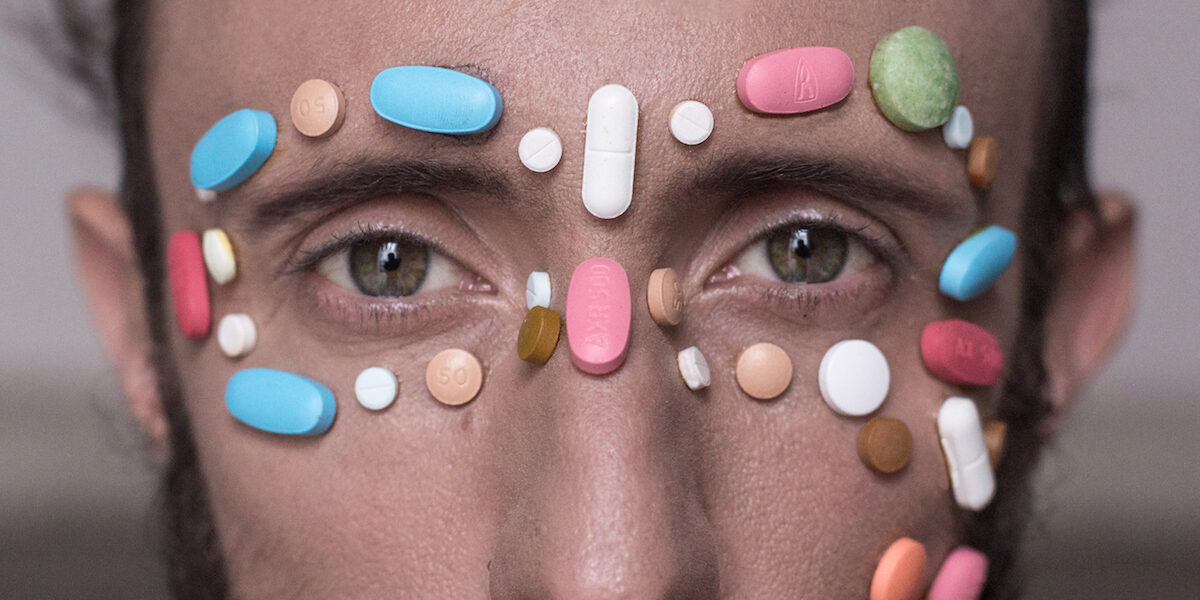
Photo: Courtesy of Pablo Gómez Samela/Makeup: Max Escalante
[Here you can download the form from the Argentine Ministry of Health to allow people with HIV to go to pharmacies and health centers. As stated in this document, if you don't have a printer, you can copy the text by hand and sign it.]
Since the beginning of the Coronavirus pandemic, many people have tried to compare this situation to the emergence of HIV in the early 1980s. Thinking about the restriction of physical contact between people as a preventative measure, and the fact that we are facing a virus we still don't know how to combat, led some people to believe that these situations might be similar. But no, HIV and Coronavirus are not the same, neither at the beginning of HIV nor now . Reinforcing this message that they are similar only creates prejudice and stigma towards people living with HIV.
Contagion and transmission are not the same thing
The Argentine Ministry of Health's guidelines for communicating about HIV and AIDS explain that HIV loses its ability to replicate very quickly outside the body. Transmission requires a very specific medium, such as blood or genital fluids. In contrast, COVID-19 is contagious. Therefore, mandatory measures such as coughing into the crook of the elbow, wearing a mask if someone has symptoms, and other recommendations apply to a contagious virus.
Yesterday, March 24th, during the morning on Argentine television, on Channel 13—one of the country's most-watched free-to-air channels— infectious disease specialist Eduardo López stated that the HIV virus is transmitted through saliva. Do we understand how serious it is that a healthcare professional, through a media outlet, would make such a statement, which is not only erroneous but also creates prejudice?

As an HIV activist, I still hear from people who won't share mate with HIV-positive individuals for fear of "contagion." And now we see a supposedly respectable professional reinforcing misinformation and spreading the stigma.
They were talking about HIV because it's a recurring topic during the Coronavirus pandemic. But the approach isn't right. And they're talking about HIV now, when a few months ago it would have been more effective to talk about the shortages of medication and reagents. But at that time, nobody mentioned it.
Disinformation, the worst virus
“Nobody cared about people dying of AIDS at the beginning of the pandemic. The markets didn’t crash, the president didn’t hold press conferences, and trillions of dollars weren’t spent,” says activist Mark S. King on his blog. King, who was diagnosed HIV+ in 1985, continues: “In the early 1980s, the virus was killing the right people: gay men, drug addicts, Black men and women,” thus drawing a contrast with the response to the coronavirus.
Before, there was no reaction because nobody cared about us. While this pandemic, which became known in 2020, can be asymptomatic, just like HIV, King explains that in the 1980s it was easier to practice social distancing because your friends' bodies were covered in purple marks on their skin.
People who were HIV-positive and died from AIDS-related causes died in the streets because they had nowhere to go, nowhere to isolate themselves. The healthcare system wouldn't take them in. They might die during a march demanding a responsive healthcare system. And many of them asked for the same thing: "If I die, scatter my ashes in front of the White House."
Undoubtedly, the activism of people living with HIV has repercussions on global health systems today. But as King says, that's a difference between how things were before and how they are now, not a similarity. Again, they are not the same.
PRESENTES TV: Let's Talk About HIV: Chapter 1 What is HIV?
Messages like the one from infectious disease specialist López equate a person living with HIV to a person with Coronavirus. I don't transmit HIV to you through a mate. Furthermore, if I am HIV-positive, take my antiretroviral medication, and achieve and maintain an undetectable viral load, I don't transmit it through sexual intercourse. I must follow the same mandatory preventive isolation ordered by the government.
READ MORE: Information and recommendations on HIV and Coronavirus
Comparing HIV to Coronavirus in this way, without accurate information and fueled by prejudice, is tantamount to invoking control and punishment of people living with HIV. In 2012, the Oslo Declaration on the Criminalization of HIV explained how harmful these erroneous messages are to society as a whole—both people living with and without HIV. And this is especially true when such punishment stems from misinformation and falsehoods. Moreover, this misinformation often originates from professionals and the media.
HIV and punitivism
It might sound like talking about HIV and punitivism is an exaggeration. Well, it's not. In 2018, thanks to the power of activism, a code of misdemeanors that penalized the transmission of STIs . The measure was about to be approved within a framework of unconstitutionality and persecution of all people (positive and negative). Activist organizations condemned this measure. Ultimately, it was not approved.
READ MORE: Gay couple adopted baby girl suspected of having HIV: she had been rejected by ten families
Living with HIV in times of Covid-19
The Ministry of Health of Argentina shared that if a positive person has high defenses (above 350 Cd4) and their viral load is controlled and undetectable, they are not at greater risk than a negative person.
The Argentine Ministry of Health has made available a sworn statement form for people who need to travel to pick up medication. "People living with HIV, or their designated representative if they are unable to travel, must carry the completed Annex 1 form to present to the appropriate personnel during their journey to and from health services or pharmacies."
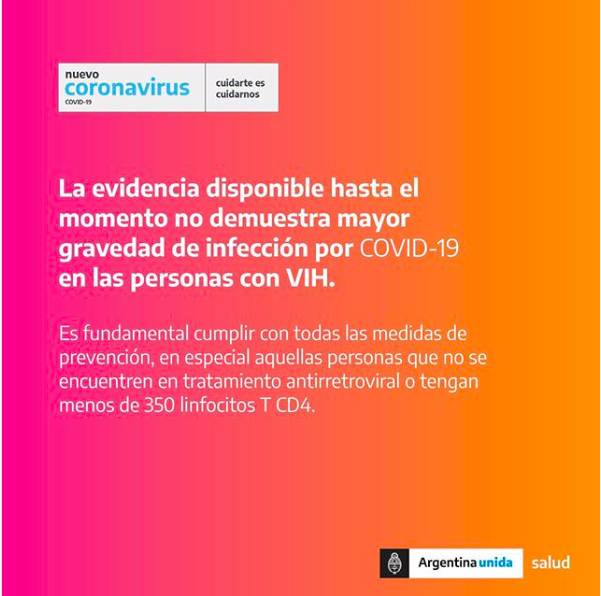
For those who are below this defense count, with a high viral load, or who also belong to one of the risk groups, it is important to follow the prevention measures proposed by the Government and health professionals in these cases.
Even if for some reason a license needs to be requested, the Ministry itself shares the letter template to use that does not reveal our serology.
Although Argentina is under mandatory preventive isolation, health services continue to operate. If you have any questions, the Ministry's AIDS Directorate has provided contact numbers depending on your location.
Meanwhile, the World Health Organization reports that antiretroviral medications such as Ritonavir and Lopinavir are being tested as a potential solution to the Coronavirus . This does not mean that people already taking these medications will experience any difference. Nor does it mean that anyone should start taking this medication without medical advice. These treatments are still in the trial phase, and no results have been published yet.
If you see information in the media that stigmatizes or discriminates, you can file a complaint with the Ombudsman for Audiovisual Communication Services.
We are present
We are committed to journalism that delves into the territories and conducts thorough investigations, combined with new technologies and narrative formats. We want the protagonists, their stories, and their struggles to be present.
SUPPORT US

FOLLOW US
Related notes


We are present
This and other stories are not usually on the media agenda. Together we can bring them to light.