

Argentina: Hate crimes against LGBT+ people increased in 2019
“Of all the hate crimes recorded, 44% of the cases (78) correspond to violations of the right to life, that is, murders and deaths due to absence and/or abandonment by the state.”

Share

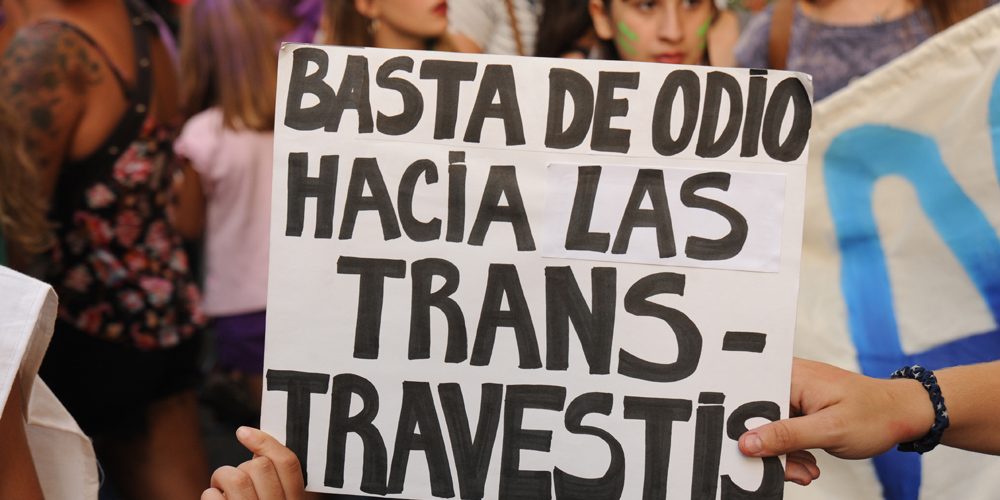
From January 1, 2019, to December 31, 2019, at least 177 hate crimes were perpetrated in Argentina where the victims' sexual orientation, gender identity, and/or gender expression were used as a discriminatory pretext to violate their rights and commit acts of violence. This information was released today, on the International Day for the Promotion of the Rights of Transgender People, by the National Observatory of LGBT Hate Crimes in Argentina. It is part of the findings of the report "Hate Crimes Against LGBT+ People in Argentina ," prepared by the National Observatory of LGBT Hate Crimes (ONCO LGBT). The Observatory was created in May 2016 by the LGBT Ombudsman's Office (part of the Institute Against Discrimination) of the Ombudsman's Office of the City of Buenos Aires, in conjunction with the Argentine LGBT Federation and the National Ombudsman's Office.
The report outlines the definitions of hate crimes and describes various forms of bias-motivated violence. While there is no universally accepted definition of hate crime, the Observatory compiles documented attacks committed against individuals associated with the LGBT+ community.
“Of all the hate crimes recorded, 44% of the cases (78) correspond to violations of the right to life, that is, murders and deaths due to absence and/or state abandonment; and the remaining 56% of the cases (99) correspond to violations of the right to physical integrity, that is, physical violence that did not end in death ,” the report says.
How is this data collected?
The data used to prepare this report was obtained from media outlets and information collected by the LGBT Ombudsman's Office—part of the Institute Against Discrimination (ICD) of the Buenos Aires City Ombudsman's Office—through complaints received, social media, and telephone contacts, in coordination with the Argentine LGBT Federation and its territorial development in the country's 24 provinces. Data was also provided by the Center for Documentation and Trans Situation in Latin America and the Caribbean (CeDoSTALC), which belongs to the REDLACTRANS network.
Therefore, the report clarifies that the data is not exact, but “it offers a glimpse into a reality that is undoubtedly much worse than the numbers suggest.” There is another problem: “not all trans people who are murdered are registered as trans and have their gender identity respected, and not all hate crimes against lesbians, gays, and bisexuals are recognized as such; on the contrary, in many cases, the sexual orientation of the victims is concealed.”
Hate crimes increased compared to 2018 and 2017
What do these numbers tell us when compared to the same report from previous years? “They reveal a worrying reality: the number of hate crimes that occurred in 2019 represents a significant increase in relation to the cases reported in 2018 -one hundred and forty-seven (147)-, and in 2017 -one hundred and three (103)-,” the report states alongside the data.
READ MORE: Argentina: 147 hate crimes against LGBT people in 2018
Murders and deaths due to state neglect
Of all violations of the right to life, 21% of cases are murders and 79% are deaths due to abandonment and/or state neglect . “The number of deaths due to abandonment and/or state neglect is imprecise and undoubtedly significantly lower than the actual number, since these cases are not reported in the media and can only be accessed through direct reports from family members, mostly other trans women.”
According to the report, in 2019 in Argentina there were at least “ 16 murders perpetrated against sexual diversity -12 were directed at trans women and 4 at cis gay men-; and 62 deaths due to abandonment and/or absence of the state -all of them were of trans women- ”.
Trans women, the most affected
Of the total number of LGBT people who were victims of hate crimes registered in 2019, 64% of the cases correspond to trans women (transvestites, transsexuals and transgender people), followed by cis gay men at 24%, lesbians at 8%, and finally trans men at 4%.
95% of violations of the right to life are against trans women. The remaining 5% are against cisgender gay men.
“These alarming numbers show how violence against the LGBT community is particularly targeted: it is trans women who are shown with special hatred, cruelty and in the most brutal way, discrimination in its most extreme form,” she explains.
The report recalls and describes how the chain of exclusion operates against trans people, for whom violence begins at a young age. “Throughout their lives, trans women are subjected, because of their gender identity and expression, to discrimination, stigmatization, harassment, persecution, physical violence, rape, torture, and other abuses that in many cases end in death. In general, the violence begins at a very young age with expulsion from the home caused by the prejudices of their own families, placing trans women in a diminished position to pursue any life project due to a lack of material resources and, consequently, the weakening of their primary network of material and emotional support.” It adds: “Discrimination in the labor market stems from a double matrix of exclusion. In many cases, trans people are excluded due to their lack of formal education. But even when they have had studies—including university degrees—they are often discriminated against in access to employment because of their gender identity and expression—that is, because they are trans.”
The report emphasizes that eight years after the Gender Identity Law was passed, “many social and state debts remain with trans people. The State has the obligation to take the necessary precautions to prevent these deaths, and the duty to implement positive action measures aimed at providing the opportunities that have historically been denied to them.”
The 20-29 age group is the most affected
According to the report, regarding the ages of the victims in hate crimes where this data is recorded:
-The most affected age group is that of people between 20 and 29 years old with 35.29% of cases.
-Secondly, with 30.39% of cases, the victims belong to the 30 to 39 age group.
-Thirdly, with 14.71% of cases, are people aged 40 to 49.
-Next, with 8.82%, is the 50-59 age group. This is followed by the 10-19 age group and the 60-69 age group, each with 4.9% of cases respectively.
Institutional violence
Another observation regarding the findings of this report: “Argentine security forces and prison services demonstrate particular cruelty and hatred towards LGBT people, and particularly towards the trans women community . This is manifested in the disregard for their self-perceived identities—mockery, insults, and denigration—in arbitrary arrests with fabricated legal cases, in the criminalization of sex work, in the demand for bribes or free sexual services, in persecution, harassment, degrading and inhuman treatment, rape, and torture, both in public and in police stations and prisons.”
This situation is also fostered because, as the report recalls, “in some provinces of the country there are codes of misdemeanors and contraventions that still today contain open figures that typify offenses against “morality and good customs”, “decency” or “decorum”, and are used by the police forces as a tool to justify their violent and discriminatory actions towards the trans community.”
It is noted that there is also a large underreporting of these cases, "since the victims most of the time do not dare to report for fear of reprisals, for the need to continue working in the area and even in some cases due to the normalization of discriminatory situations.
trans people deprived of liberty
Regarding the situation of trans women deprived of their liberty, the report describes that “they are exposed to detention conditions contrary to what is established by national laws - the Gender Identity Law in particular - and international human rights treaties. Social organizations in Argentina denounce the systematic mistreatment and violence against trans women in prison settings.”
In May 2019, the Provincial Commission for Memory (CPM) filed a precautionary measure with the Inter-American Commission on Human Rights (IACHR) regarding the lack of healthcare suffered by the entire trans community in the prisons of Buenos Aires Province. The CPM argued that the trans and travesti population housed within the Buenos Aires Penitentiary System is "at constant risk of suffering irreversible damage or death." Mónica Mego's story is just one of many. Mónica became paraplegic after being denied access to healthcare for six months. The report also cites five other cases of trans women who died or suffered irreversible health damage while in state custody.
Salta and the most violent territories
The report documents the geographical distribution of hate crimes and yields these results:
-The highest percentage -27%- occurred in the province of Buenos Aires; followed in second place with 24% by the Autonomous City of Buenos Aires; then with 12% the province of Salta; subsequently with 5% each Santa Fe and Río Negro.
-In sixth place are Entre Ríos, Mendoza, Chubut, Jujuy and Santiago del Estero and Tucumán with 3% each; followed by La Rioja, Santiago del Estero, San Juan and Rio Negro with 2.72% each; then La Rioja with 2%.
The remaining 4% is distributed—in very low percentages—among Chaco, Corrientes, Formosa, and Santa Cruz. In 1% of cases, there is no record of the geographical location where the events occurred.
“It is no coincidence that large urban centers concentrate the highest number of hate crime cases in the country, given the significant migration of LGBT people to these areas due to the considerable stigma and exclusion associated with belonging to the LGBTQ+ community in smaller cities. However, the relationship between population and hate crimes in the province of Salta is striking. This jurisdiction has a considerably lower population density than Buenos Aires Province and the City of Buenos Aires (CABA), yet it ranks third in the number of cases, with almost half the number of hate crimes as the province of Buenos Aires and exactly half the number as CABA.” The article also clarifies that “in the Argentine provinces with the lowest or nonexistent percentages, there are not necessarily fewer hate crimes, but rather underreporting.”
On public roads
Regarding the physical location where the hate crimes were perpetrated, the data collected shows that:
-The highest percentage occurred on public roads, with 47% of the cases.
-26% of the cases occurred in homes. Of that percentage, 20% correspond to the victim's own home - and is directly related to gender violence and the practice of sex work in private homes without any type of security due to the lack of regulation -; 3% of the cases occurred in the aggressor's home, and the remaining 3% in another home.
We are present
We are committed to journalism that delves into the territories and conducts thorough investigations, combined with new technologies and narrative formats. We want the protagonists, their stories, and their struggles to be present.
SUPPORT US

FOLLOW US
Related notes


We are present
This and other stories are not usually on the media agenda. Together we can bring them to light.