

This is how #8M vibrated in Latin America
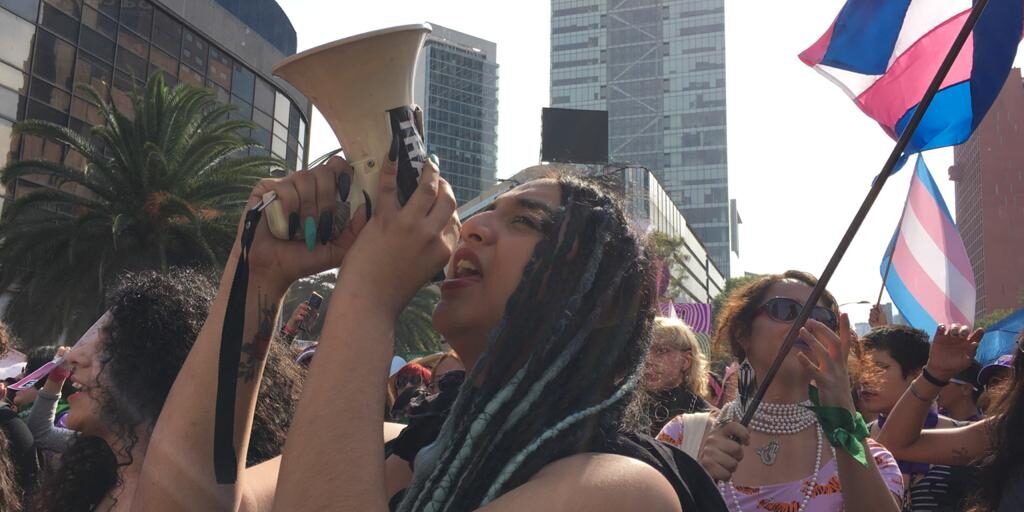
Hundreds of thousands of women took to the streets en masse in Latin America this weekend to commemorate #8M through resistance and struggle.

Share

By Airam Fernández (Santiago), Paula Rosales (San Salvador), Pilar Salazar (Guatemala City), Georginx González (Mexico City), Juliana Quintana and Jessie Insfran Pérez (text and photos, Asunción), Vero Ferrari (Lima)
Hundreds of thousands of women took to the streets en masse across Latin America this weekend to commemorate International Women's Day (#8M) through resistance and struggle. During these mobilizations, the demands are interwoven with the main points of convergence among the demands of women, lesbians, transvestites, trans people, and non-binary identities. The end of sexist violence against women and non-hegemonic identities, the cessation of femicides and transfemicides, and the right to legal and safe abortion were the demands that resonated most strongly throughout the region.
Massive march in Santiago, Chile

In Santiago this Sunday, March 8th, the march to commemorate International Women's Day was organized by the 8M Feminist Coordinating Committee. According to this organization, participation was estimated at over 2 million people. According to the Carabineros (Chilean police), the turnout did not exceed 120,000 attendees.

Several days before the march, sexual dissidents organized to march in a single column, the Counter-Hegemonic Bloc. Lorenza, a trans woman, was one of the participants: "This bloc is made up of around 17 organizations, and within them are Afro-descendant groups, lesbians, trans women and men, non-binary people, women with disabilities, and a large number of people who are generally considered marginalized in this society," she said.

"A Rapist in Your Path," the emblematic song by Lastesis, was key to the march that began shortly after noon in the former Plaza Italia, renamed Plaza Dignidad (Dignity Square) on October 18. It continued until 5 p.m., when the Carabineros (police) stormed near the La Moneda Palace and repressed the demonstration.
The day also saw a strong presence of slogans in support of the "Approve" option for the plebiscite to be held in the country on April 26, where citizens will be asked whether they approve or reject the drafting of a new Constitution. This was one of the agreements reached between political forces following the protests that erupted in Chile in October of last year.

Among the feminist slogans, the most chanted were: "Now that we are together, now that they see us, down with the patriarchy that will fall, that will fall. Up with feminism that will win, that will win"; "no means no, what part didn't you understand, the N or the O"; "may Piñera die and not my comrade"; "you'll see, you'll see, when the transvestites take power."


Another march is scheduled for today, also from Plaza Dignidad to La Moneda, as part of the Feminist General Strike.
Peru: LGBT protest for formal employment
In Peru this year, the aim was to return to the origins of International Women's Day, recognizing the plight of working women, those in precarious employment, and those exploited as a consequence of the neoliberal economic model imposed on the country more than 20 years ago under the regime of Alberto Fujimori. This model not only impacted the economy but also the entire social fabric, dismantling organized movements and dehumanizing social relations, profoundly affecting labor rights.

In this sense, the LGBTI community also highlighted the ongoing risk faced by trans, lesbian, and bisexual women when trying to access formal, well-paid work that provides dignified living conditions, unattainable until now due to the state's neglect in the way each Peruvian government has "responded" to this problem.

Trans women, lesbians, mothers, and all identities took to the streets to march in defense of their right to live without violence.
Thus, trans activist Sandy Sussel, dressed in traditional dress to demand justice for women sterilized during the Fujimori dictatorship, stated that she is marching "because I am fed up with all the violence directed against women and trans people."

Lesbian activist Esthefany Bendezú stressed that she was marching "because the State makes lesbians invisible due to heteronormativity and stigmatizes us as violent, when in reality it is the same State that denigrates us and relegates us from both political and social spaces."
Activist Nancy Tarazona, who attended the march with her daughter, stated that she wanted her daughter to be able to live a free and dignified life without her sexual orientation being a reason for discrimination.

The march, in which approximately ten thousand women participated, concluded with a political-cultural event in which the State was urged to put a stop once and for all to the continuous and diverse violence that women experience in Peru.
#8MPy: Paraguayan women marched against the anti-rights state
"Pehendu, pehendu, ropu'ãma kuña pehendu!" (Listen, listen, we bring our voices, listen) was the chant chosen for the March 8th mobilization in Paraguay. With a special focus on the exclusion and femicides of Indigenous girls and women, more than 6,000 people from the LGBTQ+ community marched from Plaza de la Democracia to the Costanera.

From 4 PM onwards there was music, theater, poetry, a festival, and talks. It was a large popular and feminist celebration in downtown Asunción and one of the largest demonstrations in the last four years.

So far in 2020, 14 femicides have been reported, including, for the first time, the murders of Indigenous girls and women. For this reason, with the support of the Qom and Mby'a Guarani communities, the Paraguayan branch of the International Women's Strike organized a dance with anklets, emulating the rituals used by Indigenous cultures to ward off evil spirits.

Sofía Franco Portillo is a trans woman and Indigenous, and yesterday she marched on behalf of her fellow trans women to demand a labor quota law and a law against all forms of discrimination. Beatriz Conde, a feminist and lesbian, told Presentes that it is important to take to the streets and for people to understand that lesbians exist.

“Just for being women, we have to suffer certain stereotypes, and being lesbians is a double reason for us to be discriminated against and mistreated. Even in progressive work environments, I had to perform tasks that nobody else wanted to do,” Bea said.
“In this society, I don’t feel safe enough to live my sexuality publicly. Although my gender expression isn’t considered feminine from a hegemonic point of view, I’m always perceived as heterosexual, so I don’t suffer discrimination, but the fear is too great,” reinforces Ana Díaz, a bisexual researcher and activist.
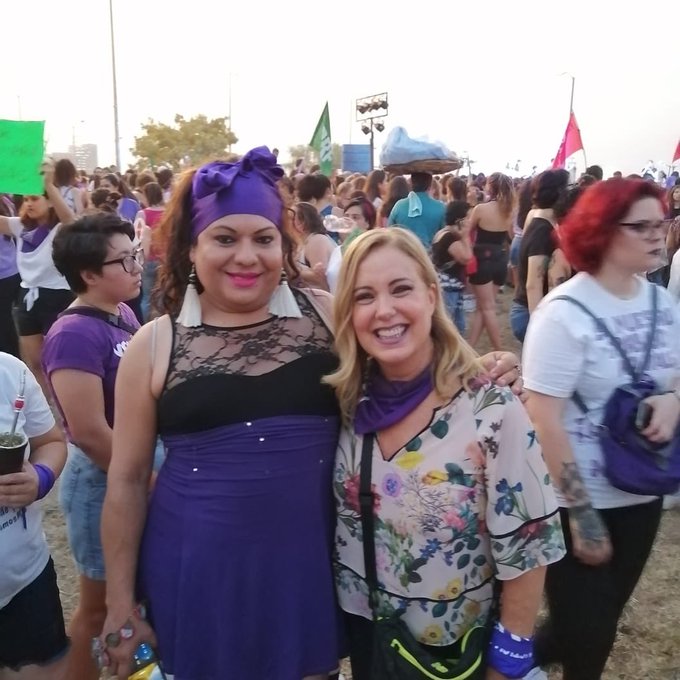
Under the slogan "We insist! Our work matters," women marched in other parts of the country besides the capital: Encarnación, Pilar, Concepción, Ciudad del Este, and the Misiones department for the eradication of violence and abuse against all identities.
Mexico in the midst of an explosion of protests against femicides
In Mexico City and its surrounding areas, various marches were organized. This March 8th, families of victims and feminist collectives from Ciudad Nezahualcóyotl (a municipality in the State of Mexico) mobilized to raise awareness about the plight of girls and women in the city's outskirts who face femicide and disappearances, despite the activation of two gender violence alerts in the municipality. The march began at the Coyote Rojo monument in Neza and concluded with a rally at the Antimonumenta in Neza.

In Mexico City, one of the planned marches took place at 2 p.m. It began at the Monument to the Revolution, paused at the Antimonument to Victims of Femicide, and concluded at the Zócalo. Amidst widespread demands on the president regarding the femicide crisis that claims the lives of 11 women every day in the country, the Mexico City march was historic and massive. As every year, mothers and family members led the diverse demonstration.
The trans contingent was made up of women, trans children, mothers of trans girls and women, and non-binary people. Along the route, there were artistic expressions such as performances, singing, dancing, and music; there was also direct action against businesses, and clashes broke out in which the police used fire extinguisher powder against the protesters.

For a Guatemala free of sexual violence
"I march for girls, teenagers, and women free from sexual violence": this was one of the main slogans of the mobilization that took place in the streets of Guatemala City on #8M2020. Women, lesbians, trans people, and gender dissidents also strongly demanded an end to trans genocide, as they shouted in one of the columns that left the university auditorium.
[NOW] 🇬🇹 “The revolution will be trans or it won’t be,” says activist Stacy Velasquez in front of the Congress of the Republic of #Guatemala on this day of struggle #BloqueOtrans #8M2020 💜✊🏽⚧️ pic.twitter.com/JVnWZroywf
— Presentes Agency (@PresentesLGBT) March 8, 20
“If not with us and for us, then with whom and for whom?” asked Alejandra, an activist with the #BloqueOtrans movement. “We will not take a single step back. The revolution will be trans or it will not be,” said activist Stacy Velásquez when the demonstration stopped in front of the Congress of the Republic of Guatemala.

Together we fought and resisted in El Salvador
In San Salvador, women and gender dissidents took to the streets en masse to demand an end to femicides and transfemicides. “Together we fight. Together we resist. Together we move forward.”
Hundreds of feminists sang "A Rapist in Your Path" by #LasTesis. "The patriarchy is a judge that condemns us for being born, and our punishment. It is the violence you don't see."

Abortion was one of the issues that resonated most strongly. “We want the decriminalization of abortion in the four circumstances necessary to guarantee the life and health of women. The poorest women are the ones dying or ending up in jail,” Edith Elizondo, from the Feminist Youth Network in Rebellion Against Patriarchy, told Presentes.

In the streets of San Salvador, they sang and danced loudly, with pure feminist power: "And now that we are together, now that they see us, down with the patriarchy, it will fall, it will fall."
We are present
We are committed to journalism that delves into the territories and conducts thorough investigations, combined with new technologies and narrative formats. We want the protagonists, their stories, and their struggles to be present.
SUPPORT US

FOLLOW US
Related notes



We are present
This and other stories are not usually on the media agenda. Together we can bring them to light.