

"La Coty", the first trans cooperative in Santa Fe, was born
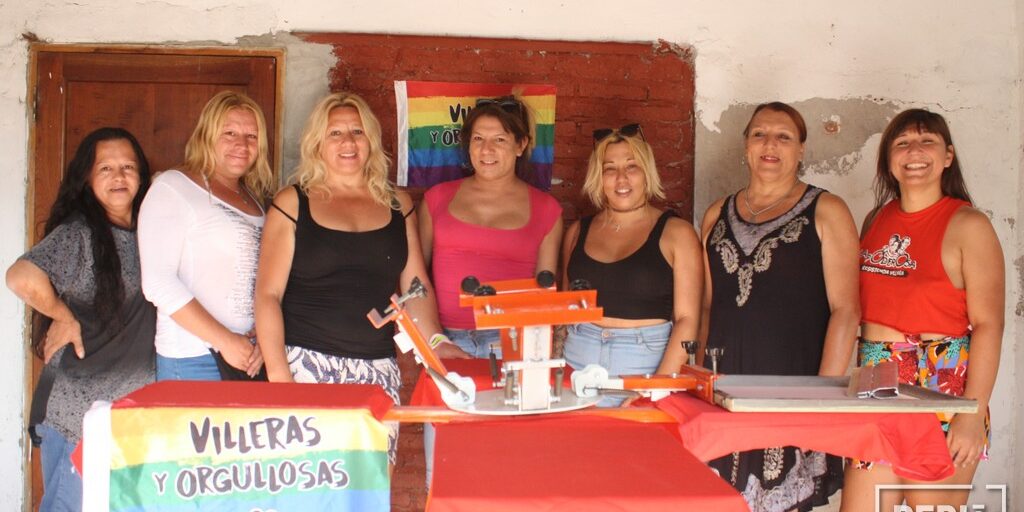
Textiles "La Coty" is made up of six people and they work with screen printing on fabric.

Share

By Victoria Stefano for Periódicas
Photos: Priscila Pereyra
Textiles «La Coty» is made up of six people and they work with screen printing on fabric. Its name honors a trans woman from the Alfonso neighborhood who faced police brutality, social inequality, and flooding.
The first trans cooperative in Santa Fe is Textiles La Coty, made up of María Muñoz, Morena Vallejos, Verónica Velocci, Sol Narbonne, Mateo Banegas, and Victoria Stéfano. They do screen printing on fabric and are currently in a training phase with the goal of diversifying their products. The initiative arose from meetings of the Santa Fe Trans Roundtable last year, where they began to acquire the equipment they needed to work. The soaring dollar caused delays and anxiety, but the equipment finally arrived, and everything is ready to start.
Regarding the team's formation, Victoria Stéfano, a member of La Coty and Periódicas, stated: "The idea is to first train ourselves and then expand our production base so we can bring in more colleagues." She elaborated on their work: "Initially, production will focus on screen printing on fabric. The idea is to start with that and then explore ways to finance ourselves, not only to expand our production base but also to diversify it. We want to produce more in the textile sector, but also go beyond that and consider other production areas. I believe that from this starting point, the possibilities are endless. Although we understand that job creation is the State's responsibility, as it possesses the resources and tools."
[READ ALSO: Transvestites and trans people will be able to access Progresar scholarships without age limits ]
“Right now we’re in a training phase. We’re learning the technique. But we hope to start production soon. Beyond any orders we might receive, the idea is to simultaneously develop a product line with our own unique style and our own branding, and we’re also working on that creative process. We don’t have social media accounts yet, but for now, to learn more about the project or for business inquiries, you can contact us at (342) 154768989,” Victoria added.
Regarding the significance of this undertaking in Santa Fe, she explained: “For us, being the first trans cooperative in the city doesn't mean much more than demonstrating the possibilities to which our access is restricted. Cooperative work and the popular economy emerge as alternatives to the failure of a system. A system that expels, denies, and marginalizes. In our case, for being trans people, but also for being impoverished trans people from working-class neighborhoods. We understand that this structural situation is reversible, but only with the tools the State has. And yes, it will take a very long time, and it certainly won't encompass everyone. But here is grassroots organizing, once again, showing the State in what direction it must move forward to begin repairing the horrors that, through omission or direct action, it has perpetrated and continues to perpetrate against our population.”
[READ ALSO: Map of the transvestite-transgender employment quota in Argentina ]
Coty, against police violence
When asked why they chose that name for the cooperative, Victoria explained: “The name is for Fernanda ‘Coty’ Olmos, a trans woman from the Alfonso neighborhood who was murdered in September 2015. Coty embodies all our values: a neighborhood resident, trans, with a strong sense of community, and a victim of flooding. Among trans women, she was known for standing up to the police during the period when the previous regulations were in effect, and among her neighbors, she was beloved for the support networks she had built during the flood. In short, a trans woman with a heart of gold. And that’s why we chose her name. Because we understand that honoring the memory of our sisters, victims of transphobic murders, like Coty, means continuing to demand justice from the State, for her and for all women.”

[READ ALSO: Together and United: the trans cooperative that cares for the elderly ]
When asked about the path they took to form the cooperative, Victoria recalled: “As Poderosa—named for her activism in the grassroots organization of the same name—we had already set ourselves the goal of incorporating trans people into our existing cooperative spaces. In fact, it was incorporated into our cooperatives' bylaws that priority be given to the entry of trans people into production spaces; it was an organic consensus without discussion. We understood that, faced with state neglect, making these resources available is a way to alleviate the emergency situation in which the population finds itself, while at the same time demanding that provincial, municipal, and national governments fulfill their obligations regarding the historical debt they owe to the trans community. This particular space emerged as an idea during a meeting of the Santa Fe Trans Roundtable, amidst discussions about the provincial employment quota bill, which had not yet been approved at that time. I mentioned this line of work that we had been pursuing at the national level, and some comrades really got on board.” And that's how La Coty was born."

“We maintain that the provincial law, as well as the municipal ordinance, without appropriate regulations designed with and for us, is nothing more than a dead letter. While in other provinces and localities, representatives, senators, and council members have incorporated trans people into their advisory teams, Santa Fe continues to maintain its record of cisgender designed for trans people. And therein lies the fundamental problem. In the Rosario City Council, there are trans people advising council members. And here? Who will be the first to take the step? How long are we going to continue settling for correcting the disasters they create, as they did with the municipal trans quota?” Stéfano asked.
[READ ALSO: A feminist cooperative helps trans women obtain decent housing ]
And she lamented: “Currently, and fortunately, the regulations for that ordinance are under review. While the Cambiemos administration was busy publicizing the approval of the trans quota in the city, they handed us an ordinance with a quota of five internships, without health insurance, without pension contributions, without vacations, without a single labor right. An ordinance that created precarious working conditions for a historically marginalized group. And they still dared to advertise it and take photos with trans women, all smiles. Today the situation is different; the way in which the ordinance was applied, which was anything but transparent, is under review to determine how to work with it going forward. And we expect nothing less than contracts, in accordance with collective bargaining agreements, which is precisely what the letter of that municipal legislation states. Flexibility and precariousness are not options.”
“Meanwhile, in the province, there’s still not much information about what they plan to do with the law passed on October 31st. They remain very focused on passing their package of public necessity laws. Meanwhile, we’re still here, grappling with public needs—housing, access to education, access to healthcare, access to work—organizing ourselves to do what they aren’t doing. Will we have to go out again and set deadlines for the municipal and provincial governments, as we did with the legislature for two consecutive years? I have no doubt that without urgent and appropriate responses, they’ll find us in the streets, taking whatever measures are necessary, as many times as necessary,” she concluded.
We are present
We are committed to journalism that delves into the territories and conducts thorough investigations, combined with new technologies and narrative formats. We want the protagonists, their stories, and their struggles to be present.
SUPPORT US

FOLLOW US
Related notes


We are present
This and other stories are not usually on the media agenda. Together we can bring them to light.