

The province of Santa Fe approved the transvestite-transgender employment quota
Santa Fe became the fifth province in the country to approve the trans/travesti job quota this Thursday.

Share

By Soledad Mizerniuk and Victoria Rodríguez
Santa Fe became the fifth province in the country to approve a trans/travesti employment quota this Thursday. The Legislature determined by law that the Provincial Government must employ transvestite, transsexual, and transgender people who meet the suitability requirements for the position in its permanent, temporary, and/or contracted staff, in a proportion no less than 5% of the total number of people who have legally changed their sex, name, and image on their official documents within the province.
[READ ALSO: Map of the transvestite-transgender employment quota in Argentina ]
According to a 2014 study published by the Huésped Foundation in collaboration with the Association of Transvestites, Transsexuals, and Transgender People of Argentina (ATTTA), “the proportion of those working in the formal sector is low, and as a result, only one in ten trans men and women have pension contributions. Sex work continues to be the most common employment option for trans women.” Therefore, a trans employment quota is an increasingly urgent necessity.
"Having a salary means more to us than anyone can imagine."
“Do you know what it means for us to be able to go to the supermarket and pay with a card? Having a salary means so much more to us than anyone can imagine,” Jackeline Romero, a long-time trans activist from Rosario, told Agencia Presentes . She continued: “It’s a historic day in the province of Santa Fe because now our sisters throughout the province will be able to choose between dignified work and sex work.”
“We demand rights and responsibilities from which we have been historically excluded. I am about to turn 50 and only now am I going to have a formal, registered job, at the National University of Rosario,” says Jackie.

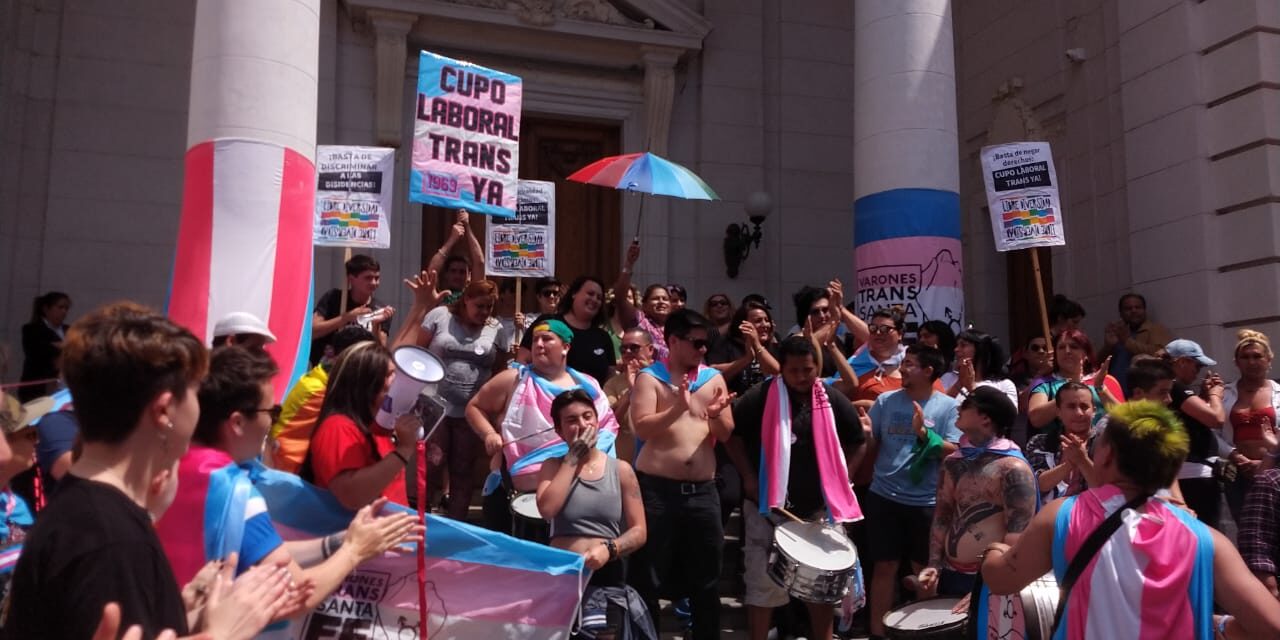
Rainbow flags wave and a multicolored umbrella twirls nearby. Drums, dancing, and joy transform the facade of the Santa Fe Legislature. Dozens of faces crowd together for the photo, smiles of triumph, the taste of a battle won.
The provincial Undersecretary for Sexual Diversity Policies, Esteban Paulón, stated: “This is a pure and exclusive achievement of the trans women and men collective who have tirelessly fought to achieve this law. They have led the debate in their communities and previously secured the approval of Trans Quota ordinances in 10 towns across the province of Santa Fe. Today, a very encouraging outlook opens up, and I have no doubt that in a very short time, trans equality will be a reality.”
Social transvesticide
With a megaphone in hand, at the top of the steps, Alejandra Ironici, a leading figure in the Santa Fe trans community, takes the stage. She lists the names of deceased comrades, victims of transphobic violence who didn't live to see this glorious day. And she leaves two words hanging in the air: social transphobic violence .
“It is the repeated murder of our trans sisters through the curtailment and segregation of the rights enshrined in the National Constitution. The inability to access work and education, health and housing, are fundamental rights for everyone, but we have always been questioned. Today there is a social structure in which many of our sisters under 30 are being exterminated,” Alejandra explains, in response to a question from Presentes .

Hopeful about the decision of the Santa Fe legislature, she reflects: “We feel that many of our colleagues throughout the country are waiting for this law and its implementation. Santa Fe is the hope of the dissident movement in many provinces .”
What follows
Emiliano Moyano, a trans man and activist from Rosario, was one of those who marched to the Santa Fe Legislature this Thursday. “Trans men have joined the fight of trans women, and today we are more organized as well,” he stated, adding, “We believe this is a historic act of redress from the State towards our community.”
Regarding the steps that will follow after the approval of the law, Emiliano says that "after the law is regulated, a single registry will be created where vacancies will be seen and from there trans people will be admitted."
Martín Arteriza, an activist from Santa Fe and also a member of the collective, notes that “it’s difficult for a trans man to get a job, especially if he’s over 45.” “We’re here for those who come after us,” he says, adding, “Supporting trans children is the most important thing.”
With a broad smile, Victoria Stéfano approaches and adds her own comment: “For our province and for the long-standing activists, this marks 15 years of demands. It is a fact that will set a precedent for comrades at the national level who continue to promote projects of this nature.”
Victoria emphatically clarifies the upcoming fight: “We will continue. We need to sit down and negotiate the terms of implementation with both the current and incoming administrations. The struggle doesn't end here; negotiations begin, taking into account the needs of trans and travesti people in Santa Fe.”

What the papers say
The law passed in Santa Fe aims to "promote the inclusion and job security of transgender, transsexual, and gender-diverse individuals, encouraging their hiring and employment in the public and private sectors to guarantee their right to work." The legislation, now awaiting its corresponding regulations, covers all three branches of government, their decentralized and autonomous agencies, and state-owned and majority state-owned enterprises.
The beneficiaries of the law “are those people, over 18 years of age, with a minimum residence of two years in the province of Santa Fe, who have proceeded to the registration rectification of sex, name and image in accordance with the provisions of article 3 of National Law No. 26,743 on Gender Identity.”
For the purposes of effective compliance with the five percent quota, vacancies that arise within the different hiring modalities must be filled based on objective and transparent processes of performance of functions that prioritize transvestite, transsexual and transgender people who demonstrate the conditions for the position or post to be filled, until the established quota is met.
The provincial government will ensure that personnel selection systems guarantee the conditions established in this article for the effective access of transgender, transsexual, and gender-diverse individuals to employment in public agencies. These selection processes must be advised by the Advisory Council of the Undersecretariat for Sexual Diversity Policies, which will also oversee the annual and progressive updating of the incorporation of transgender, transsexual, and gender-diverse individuals into the provincial government.
In the country
A national bill for a transgender and transvestite employment quota has been stalled in the Argentine Congress since July 2018, having been previously introduced in 2016 (but failing to pass). It proposes that 1% of jobs in the national public administration be filled by transgender, transsexual, and transmasculine individuals, but activists fear that the election year could jeopardize its progress.
Across the country, only five provinces (out of 23 plus the City of Buenos Aires) have passed legislation to include it, but none are currently in compliance. Besides Santa Fe, Buenos Aires, Chubut, Río Negro, and Chaco have the law.
We are present
We are committed to journalism that delves into the territories and conducts thorough investigations, combined with new technologies and narrative formats. We want the protagonists, their stories, and their struggles to be present.
SUPPORT US

FOLLOW US
Related notes

We are present
This and other stories are not usually on the media agenda. Together we can bring them to light.