

Young gay man who reported torture and sexual abuse by Carabineros testified in court
Josué Maureira testified for five hours. The National Institute for Human Rights (INDH) has filed 19 lawsuits alleging sexual violence by state agents.

Share

Josué Maureira testified for five hours. The National Institute for Human Rights (INDH) has received 19 lawsuits alleging sexual violence by state agents. The Catholic University will file a lawsuit.
By Airam Fernández, from Santiago, Chile. Photos: Josean Rivera
This Monday, October 28, was the first court hearing for the complaint against Carabineros officials for torture and sexual abuse of Josué Maureira, a 23-year-old gay medical student.

“Exhausting, emotional, and very intense.” With those words, María Elena Santibáñez, Josué Maureira’s lawyer and a law professor at the Catholic University (UC), described the hearing. Josué, a medical student at that university, went to the Southern Metropolitan Region Prosecutor’s Office to give a statement after reporting that three Carabineros officers tortured him and that at least two sexually abused him after arresting him near a looted supermarket in Santiago, Chile, in the context of the social protests that intensified across the country starting on October 18.
READ MORE: Sexual violence and torture of women and LGBT+ people by Carabineros denounced
His case went viral on social media after a Facebook post in which he recounted his experience at the 51st Police Station in Pedro Aguirre Cerda. A lawsuit filed by the National Institute for Human Rights (INDH) for the crime of torture with aggravated sexual abuse forced the Prosecutor's Office to open an investigation.
19 complaints of sexual violence

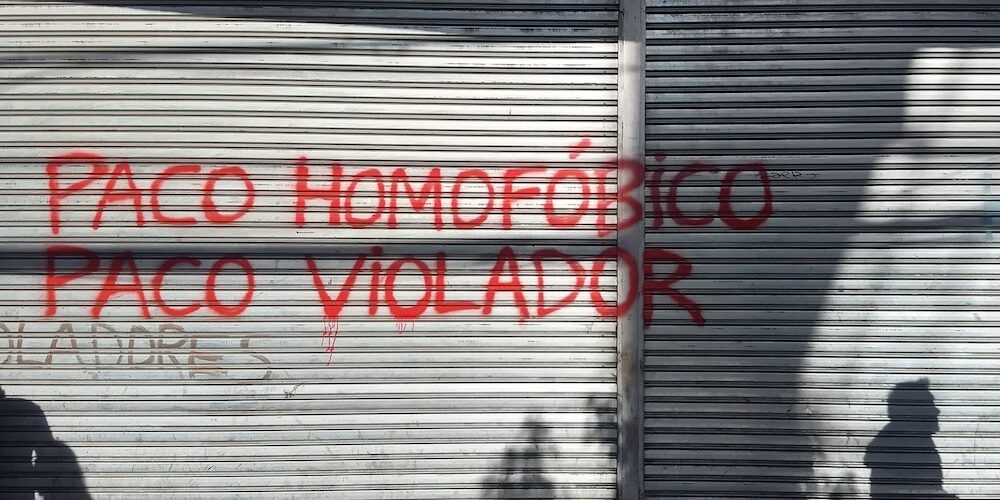
The document submitted by the National Institute for Human Rights (INDH) states that Josué was beaten with batons, fists, and kicks. It also notes that "he was kept handcuffed and beaten without any provocation. He was insulted for being gay, a fact his assailants deduced because he had his nails painted red. (...) Then they completely undressed him and also sexually abused him, within the context of the torture he was suffering at that moment, by inserting a baton into his anus," the organization adds. As of October 28, the INDH has received 19 complaints of sexual violence against civilians by state agents since the mass demonstrations began.

The investigation into Josué's case was assigned to Paulina Díaz, a prosecutor specializing in human rights. Therefore, he was summoned to testify this Monday, as a victim.
READ MORE: "Chile needs a new social and sexual pact"
“A long and painful statement”
The hearing was scheduled for 4 p.m., but there was a sudden change. The German Clinic notified the Prosecutor's Office that a series of additional tests Josué was to undergo in the morning would have to be performed in the afternoon. These tests could not coincide with his statement to the prosecutors. Therefore, the proceedings were moved up.
The room was ready at 12:30, after a 15-minute meeting that he, along with his parents, held with regional prosecutor Héctor Barros and some members of his team. Also present at the meeting were Ignacio Sánchez, rector of the Catholic University; Felipe Heusser, dean of the university's Faculty of Medicine; and Santibáñez, who acted as the young man's spokesperson.
READ MORE: The biggest march in Chilean history in photos
“That first meeting before taking his statement was a valuable gesture. The regional prosecutor and his team wanted to see Josué and, in some way, offer him their support,” the lawyer recounts. Josué spoke for almost five hours. He tried to provide as many details as possible about his assault. He remembered the names of the officers who assaulted and tortured him: Marcos Valenzuela, Luna Huelche, and M. Vásquez. He didn't see the faces or identification on the uniforms of those responsible for the sexual assault, however. But he knows there are two of them. “That is perhaps the most difficult aspect of this case. Although the sexual assault is more or less evident in the reports we already have, they only contribute from a scientific standpoint. And the most relevant thing in terms of the investigation is determining who was involved,” Santibáñez says.
"May human rights never be violated again in Chile"
Josué was heard by prosecutor Díaz, prosecutor Christian Toledo, a lawyer from the National Institute for Human Rights (INDH), an official from the Investigations Police, Santibáñez, and another lawyer who will be working with her on this case. At 2:45 p.m., they paused so he could cross the city and get to the clinic, a journey that would normally take 30 minutes by car. It took much longer because Santiago has been paralyzed for almost two weeks with protests of an intensity not seen since the dictatorship.

Upon arriving at the Clínica Alemana, she underwent a series of tests. Santibáñez explains that this was primarily to check for any "more internal" injuries beyond those already identified in the sexological examination conducted by the Prosecutor's Office following the complaint filed by the National Institute for Human Rights (INDH).
READ MORE: Emilia Schneider, trans student leader: “We lost our fear of repression and fought for our rights”
At 5 p.m., Josué was back at the prosecutor's office. Before resuming his testimony, he took ten minutes to go outside and greet a large group of students, friends, family, and other people who had come to support him. Minutes before he appeared, the demonstration was violently suppressed by police. Only a few managed to escape the tear gas.
“Thank you for being here, for supporting me. All of this is so that no one in Chile will ever again have their human rights violated, ” Josué told the crowd. “It’s a rather long and painful statement,” he added before going back inside, where he remained until 8 p.m.
READ MORE: [PHOTOS] Chilean resistance is also sexual: post-porn has taken to the streets of Santiago
How is the case progressing?
The results of the latest medical examinations are now in the investigation file. The lawyer expects to receive them sometime this Wednesday, October 30. Based on those results and a review of all the case files, a lawsuit will be filed next week on behalf of the Catholic University.
Santibáñez explains that an investigation of this nature can take between six and eight months. However, he hopes that the attention and media coverage the case has received will help shorten the process. Even so, he doesn't believe they will make any progress in less than three months.

Several investigative steps are already underway, including the analysis of Josué's statement, along with two other testimonies: those of his father and his cousin, who also testified as witnesses on Monday. Other "special" operations may take a little longer, along with a series of inquiries that include the search for other witnesses and the analysis of other evidence.
Torture linked to sexual orientation
Following his arrest on October 21, Josué was charged with burglary and assaulting police officers. Santibáñez believes these charges will be dropped as the investigation progresses and they can verify his account: that he went to the vicinity of a Santa Isabel supermarket—which had been looted earlier—after hearing cries for help in the distance.
If they can prove that sexual abuse occurred and those responsible are found guilty, they will face sentences ranging from five to 15 years. “But we are going to classify it as aggravated torture due to abuse , and under those circumstances, we could face life imprisonment ,” Santibáñez adds. They will also evaluate the application of the aggravating circumstance of the Zamudio Law: “There is a very important issue here, because the torture inflicted on Josué is linked to his sexual orientation . That would be the motive.”
READ MORE: [In Photos] This is how feminism and diversity resist in the streets of Chile
We are present
We are committed to journalism that delves into the territories and conducts thorough investigations, combined with new technologies and narrative formats. We want the protagonists, their stories, and their struggles to be present.
SUPPORT US

FOLLOW US
Related notes

We are present
This and other stories are not usually on the media agenda. Together we can bring them to light.