

Trans youth and their families fight for a law for minors under 18 in Mexico City
A bill was presented to the Chamber of Deputies to allow transgender people under 18 years of age to rectify their birth certificate through an administrative procedure.

Share

By Milena Pafundi, from Mexico City
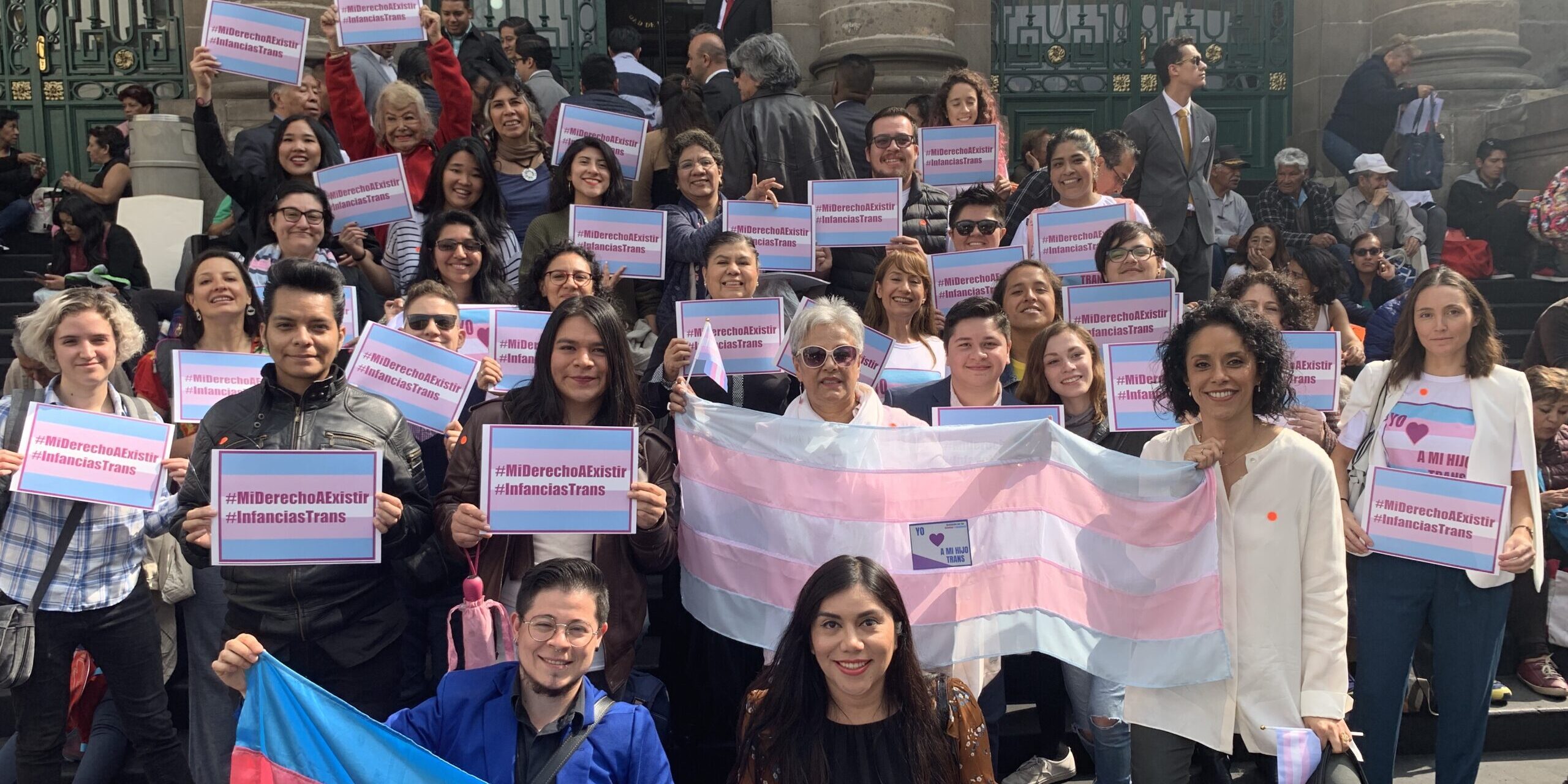
On October 10th, Representative Paula Soto, president of the Equality Commission, presented a bill to the Mexico City Chamber of Deputies to allow transgender individuals under 18 to rectify their birth certificates through an administrative procedure at the Civil Registry. The initiative was spearheaded by the Association for Transgender Children in the Women's Parliament. While Mexico City has had a gender identity law since 2015, it only applies to individuals over 18.
“There is already a process in Mexico City for people under 18 to have their gender identity recognized. But the current process is discriminatory. Furthermore, this initiative arose from a social need, driven as an exercise in citizen participation, which has been joined by families, feminists, young trans people, LGBT+ organizations, and allies,” Tania Morales, president of the Association for Transgender Children, told Presentes.
Presentes spoke with transgender teenagers, their families, and activists to learn about their experiences in recent years and how a law that includes them could change their lives.
Marcela, Sara's mother
“When Sara decided to tell me she identified as trans, she first sought support from the school psychologist. At the time, she was in the first year of secondary school at a private school. Initially, it was a tremendous shock. The psychologist told me that some students were already calling her Sara because she had told them as soon as she started school, and I was only just finding out—they started school in September, and I wasn't told until April of the following year. My reaction was to take her out of school because they hadn't told me before and because she needed to start receiving support therapy. Later, I enrolled her in a public secondary school and told the principal that she was going through a difficult time due to her adolescence. I never mentioned that she was a trans girl when I enrolled her, and I still didn't know much about the subject. She finished her first and second years there. The bullying was terrible. Sometimes I intervened, and other times I didn't because I still didn't fully understand or accept that my daughter was trans. However, I respected the fact that we called her by her name here at home. Little by little, I talked to family and friends until I got used to it.” It's normal to see him dressing in girls' clothes.

For third grade, we went back to the private school Sara loves so much because of its academic standards. I'm so proud of Sara because she's so intelligent. She asked me, "Mom, ask them if I can wear the girl's uniform and if they can call me Sara, please." The principal's response was, "You have to wear the uniform according to the gender you were assigned at birth, and we must use the name on your birth certificate." I felt my heart sink. And I thought, if I feel this way, what does Sara feel every day? That's where our fight to make our reality of being trans and a minor visible began.
What would this law facilitate and change? It would allow Sara to be the person she has always wanted to be, without limitations, more confident and happier with herself. Simply having her birth certificate with the name she has chosen would change her life and give her more faith in humanity.
Sara , 14 years old
“When I spoke to my school principal about my name or uniform, she said that society wasn't ready and that we had to wait until it was, and then they would call me by my real name. In my opinion, no one is ever ready for change, but that didn't stop minorities around the world from fighting for their rights. The fight for Black rights in the United States resulted in many deaths, as did feminism in Latin America, but that didn't stop anyone. We can't wait for things to change on their own. If I have to die so that a trans girl on the other side of the country can have her name, I will.”
[READ ALSO: "Pink Boys, Blue Girls": a documentary about trans children ]
Teicuh, 16 years old
“Until now, the struggle has been internal. The hardest part has been, first, processing my thoughts and feelings, and then putting them into words. As a child, I tried wearing dresses, braiding my hair, playing with ponies, and my favorite color was pink. By age five, I was fed up and knew it wasn't for me. I cut my own hair two or three times between the ages of two and five. After being told off for my safety, they hid the scissors, and I stopped. But I insisted on having my hair consistently short until I was fourteen, when they finally listened to me. I also didn't wear the school uniform skirt; I only wore the gym uniform. I had a brief period of experimentation in my teens as a gender fluid, but every time I was referred to using gender-neutral language, every cell in my body completely rejected it. My mind rejected the idea of being trans, but the first time my friend referred to me using male pronouns, I felt pure happiness… It felt right.
Alexandra, mother of Teicuh
“My son was always very restless and mischievous, running and jumping around all the time. When he got his hair cut, he'd cut it super short in the front, and when I caught him, I'd scold him because he could poke himself in the eye. He didn't like dolls; he played with animals and monsters. Sometimes he'd wear a princess dress for Halloween, but he always wore sweatpants. I work in special education, so I know about the different talents, strengths, difficulties, and challenges we can face because of the differences we're born with. There is discrimination, but also empathy, though it doesn't even come close to the transphobia in our society, which is what scared me the most. I sought specialized advice, started studying, and from there, his social transition happened very naturally; not so much for me, although I loved and supported him unconditionally. Changing his pronouns to masculine was very difficult, but fortunately, I gave him some unconventional names, so even though we haven't changed his gender on his birth certificate yet, it doesn't affect him that much.” as well as other trans children.
My son has participated in school competitions and received some awards, but he tells me that if he had a name that identified him as the opposite gender, he wouldn't go or wouldn't accept them, so they wouldn't call his name on the microphone. And that's what happens to many children and teenagers in that situation: they stop studying, stop participating in sports or cultural activities, and suffer more bullying, anguish, anxiety, and stress than most of their peers. As families, it has been a blessing to find each other and share our challenges, experiences, joys, sorrows, and many separations and divorces.
[READ ALSO: Mexico: A transgender teenager obtained a new birth certificate ]
That public institutions provide support
Congresswoman Erika Yamada Kubo, a member of the First Women's Parliament of the Mexico City Congress, told Presentes that in addition to this initiative, it is essential to promote non-discrimination policies that permeate all public institutions, especially regarding access to education. "Schools must adopt inclusive measures that address bullying prevention and intervention, respect for diversity (especially for the LGBT+ community), and provide training for teachers and other educational staff with a human rights and intersectional perspective. Ideally, the official curriculum of the Mexican education system would include comprehensive sexuality education. There is still a long way to go to guarantee a dignified life for all transgender children and adolescents, but this is a good start in this fight in Mexico City."
[READ ALSO: Mexico: Judge approves identity change for trans people without going to trial ]
For her part, Jessica Marjane, founder of the Trans Youth Network of Mexico, explained to Presentes the importance of the 2015 reform and the possibility of rectifying identity documents, which has effects on other institutions. “This opened a new vocabulary, a new conception, and above all, it built more visible political subjects in life and political participation. It also generated a new awareness and perception that we are subjects of rights and freedoms. The right to identity is a principle for exercising other rights, as it is a meta-right. At the Trans Youth Network of Mexico, we participate in both processes. We argue from an intersectional perspective and outside of any legal guardianship, so that our voice is not controlled by medical or legal discourse.”
We are present
We are committed to journalism that delves into the territories and conducts thorough investigations, combined with new technologies and narrative formats. We want the protagonists, their stories, and their struggles to be present.
SUPPORT US

FOLLOW US
Related notes
We are present
This and other stories are not usually on the media agenda. Together we can bring them to light.