

New homophobic attack in Buenos Aires: “They all need to be killed”
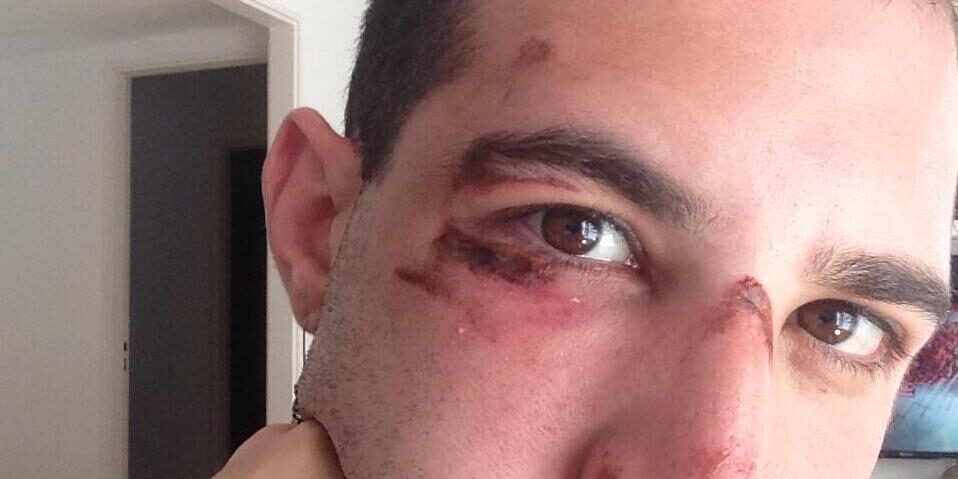
Journalist Imanol Subiela, 24, was the victim of a homophobic attack.

Share

By Lucas Gutiérrez
On Sunday, October 6, activist and journalist Imanol Subiela, 24, was the victim of a homophobic attack. “You fucking faggot, you won this time, all the faggots need to be killed,” his attacker told him as Subiela managed to escape. The incident occurred in the Villa Crespo neighborhood of Buenos Aires, where other similar attacks have recently taken place.
Shortly after 5 a.m., Subiela arrived at the bus stop located on Avenida Estado de Israel near Aguirre in the Villa Crespo neighborhood of Buenos Aires. There, an intoxicated man asked him for money for the ride. Subiela told him he didn't have any but that he would pay the bus fare with his SUBE card. "Suddenly, he cornered me against the wall and said: 'You like guys, and it shows. All I want is money, and money makes the world go round,'" Subiela told Presentes.
[JOURNALISTIC MAPPING OF HATE CRIMES IN ARGENTINA]
The young man said that when he tried to get away, the man stood in front of him. “What do you have there?” he asked, referring to the fanny pack. “I don’t have any more money, sorry,” Subiela replied, but the man still tried to snatch it away. That’s when he was hit: “He punched me. I was wearing my glasses, and they cut my eyelid. He hit me again, I fell to the ground, and he fell to the ground with me because neither of us would let go of the fanny pack.”
At that moment he managed to stand up and escape, but as he ran he heard the attacker's threat: "Fucking faggot, you won this time. All faggots need to be killed."
Social complicity
Subiela walked a few more blocks and called a friend who came to his aid. In his social media post, he also highlighted the lack of solidarity from people, including a police officer: “While I was walking, hurt and bleeding, no one wanted to help me, not even a police officer I signaled to come closer (he barely gave me a thumbs-up and kept walking). Two gay men who walked past me holding hands didn't help either, while I was wiping my face with my sweatshirt. We are selfish, that's a fact.”
“The kiosk owner saw everything and refused to help me at any point. I fell face-first to the ground. This happened next to the bus stop for lines 19 and 90; there were other people around and they didn't do anything either,” she told Presentes.
Dangerous area for LGBT+ people
In that same area, on Saturday, August 31, a gang of men attacked Reyvis Henríquez . It's the same neighborhood where Sofía del Valle , and a few blocks from the McDonald's on Avenida Córdoba where Jonathan Castellari was attacked in December 2017.
The next day, Subiela spoke with a friend who had organized the party he was returning from, and the friend told him that his attacker continued his assault. “He told me that the same man, after beating me to a pulp, started following some girls, and other friends had to go with them.”
"Even though it's cumbersome, we have to report it, we have to find the aggressors, and we have to talk about it. We all have to pull in the same direction and do everything in our power to live in a fairer and more inclusive place," Imanol wrote in the message he shared on Facebook, Twitter, and Instagram.
What to do in case of an attack
After receiving advice and guidance from the LGBT Ombudsman of the City of Buenos Aires, she filed the complaint with the City Prosecutor's Office (Balvanera Guidance and Complaint Unit).
Flavia Massenzio, coordinator of the LGBT Ombudsman's Office and legal affairs secretary of the Argentine LGBT Federation (FALGBT), explained to Presentes the importance of making these attacks visible and reporting them: “Sometimes when you post something, someone else who went through the same thing and didn't say anything might speak up. This is very helpful in investigations to identify recurring patterns. Sometimes even your own friends tell you that reporting is pointless, but reports must be made so that it becomes visible, so that people understand that this is happening and that the violence is increasing,” she explained, adding that they are seeing an increase in both institutional and interpersonal violence.
In the event of an attack or assault, Massenzio's first suggestion is to have the injuries documented, preferably at a public hospital, "since sometimes they won't file a report immediately, and it's necessary to have this documented." Regarding where to go, he said: "We suggest filing reports with the prosecutor's office. Many people go to the police station, and while that's a good thing, what has happened is that there's still a lot of institutional violence there."
Often, after complaints are filed, cases are not followed up on, sometimes because people lack the resources for a lawyer and other times because they think the case won't go anywhere. “It is the prosecutor's office that must investigate and pursue the case. What we at the LGBT Advocacy Office do with these cases is contact and make ourselves available to the prosecutor's office that is investigating, follow up, call, accompany, assist, and provide evidence related to hate crimes so that they have more tools and are aware of the appropriate approach to this situation,” said Massenzio.
We are present
We are committed to journalism that delves into the territories and conducts thorough investigations, combined with new technologies and narrative formats. We want the protagonists, their stories, and their struggles to be present.
SUPPORT US

FOLLOW US
Related notes

We are present
This and other stories are not usually on the media agenda. Together we can bring them to light.