

The judge who increased the sentence for a transgender woman because she was a migrant was suspended.
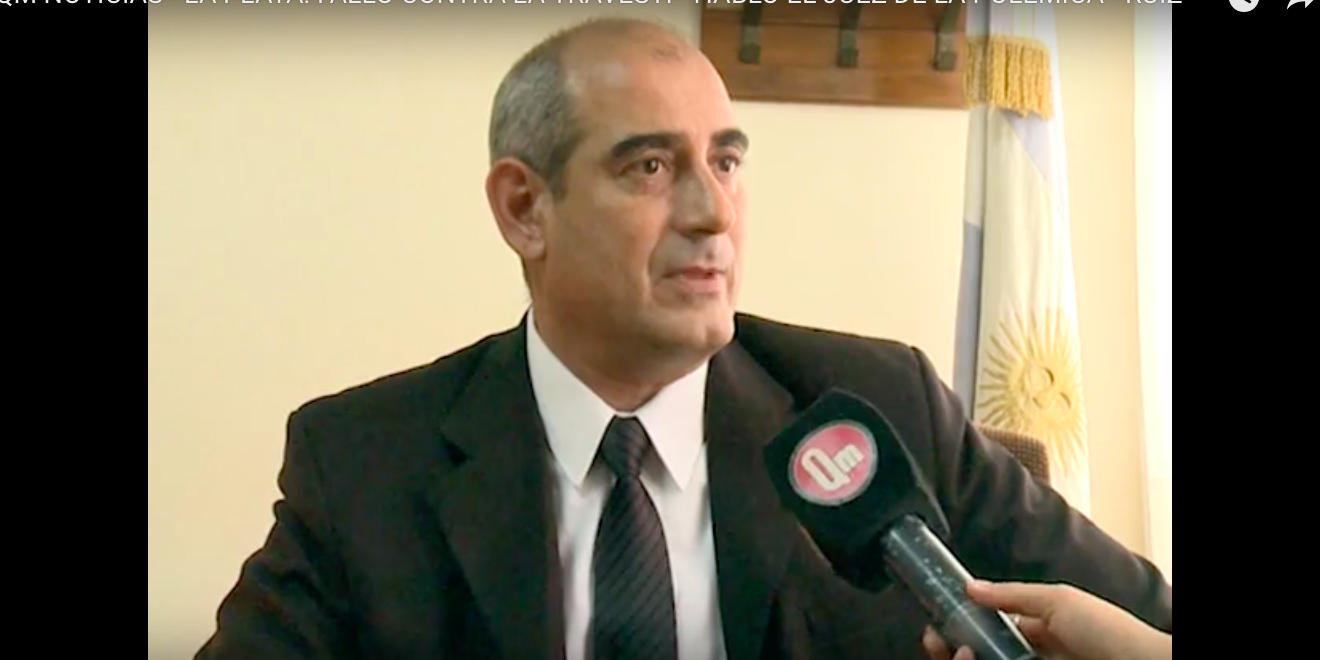
Judge Juan José Ruiz de La Plata was suspended for aggravating the sentence of a trans woman because she was a migrant.

Share

Judge Juan José Ruiz of La Plata was suspended for increasing the sentence of a transgender woman because she was a migrant, violating her right to equal treatment and the principle of non-discrimination. The measure was taken by the Jury for the Impeachment of Magistrates and Officials of the province, presided over by Eduardo de Lázzari, which also ordered the garnishment of 40 percent of his salary. Ruiz will now face a jury trial that could result in his removal from office.
It was following complaints against the judge filed by the Permanent Assembly for Human Rights (APDH), the Argentine Federation of Lesbians, Gays, Trans and Transvestites (FALGBT), the Association of Transvestites, Trans and Transgender People of Argentina (ATTTA), the Provincial Commission for Memory, and María Rachid. “We filed the complaint from FALGBT because the aggravating factor was that he was a migrant and trans, which constitutes a clearly discriminatory and unlawful decision that, coming from a judge, is very serious. That is why we are calling for his removal ,” Rachid told Presentes after the measure was announced.
“Xenophobic and transphobic”
The judge's ruling is not an isolated incident, in a context where organizations have been denouncing arbitrary arrests and fabricated cases, especially in the province of Buenos Aires. “The suspension of Judge Ruiz, who issued a xenophobic and transphobic ruling, is the visible face of the Judiciary's fabricated cases against trans and travesti women . It demonstrates the collusion between the police, judges, some prosecutors, and also the perverse network that is further complicated by the mistreatment of incarcerated women by the prison system,” stated Claudia Vásquez Haro, president of Otrans Argentina, one of the organizations that denounced the judge for his ruling.
The discriminatory ruling
The legal case began with a police operation in La Plata in April 2014 and the arrest of a transgender woman, Claudia Córdova Guerra. Claudia was in the so-called red-light district and was found in possession of one and a half grams of cocaine. Judge Ruiz, from the Single-Judge Court No. 1 of La Plata, handed down a sentence in May 2016: he condemned Claudia to five years and three months in prison plus a fine of 225 pesos for “possession of narcotics for the purpose of distribution,” a charge that was later overturned on appeal.
In his ruling, the judge increased Claudia's sentence because she was a foreigner, in her case, Peruvian. He stated: “The State can and must apply sanctions as an accessory penalty to imprisonment and increase the penalties for foreigners who commit common crimes in the country, without this implying a violation of the principles of equality before the law and non-discrimination, among others, given that we are dealing with an exceptional measure supported by our Constitution and the international treaties that form part of it. The only unconstitutional thing would be not to do so.”
But in addition to discriminating against her for being a migrant, the court file referred to Claudia in the male form and by her former name, which violates the gender identity law passed in 2012. It barely mentioned her name as an “alias” and made references to a “transvestite person”.
Claudia was searched by men and sent to a men's prison. The case file also referred to the female witnesses who testified in the case and identified as women, using male pronouns.
When the judge appeared to present his defense, he denied having increased Claudia's sentence because she was a foreigner. He said the accusations were a way of making a "covert appeal" to try to steer the course of the appeal.
In response to the appeal, in November 2016, the Fifth Chamber of the Criminal Cassation Court ordered the case file to be officially registered, including Claudia's gender identity, changed the charge to "simple possession of narcotics" (i.e., without "trafficking"), and rejected the aggravating circumstance of being a "foreigner" cited by Judge Ruiz. Finally, it reduced the sentence to two years of probation and the fine to 50 pesos.
The accusations against the judge
Following complaints from human rights and LGBTQ+ organizations, the Joint Committee and the Attorney General's Office accused the judge of misconduct "due to the unequal treatment of the defendant," non-compliance with Law 26743 on Gender Identity, and xenophobic discrimination in clear violation of Law 23592 (which penalizes discriminatory acts). They also stated that the judge's actions violated the Immigration Law and "compromised the Argentine State" in terms of its international commitments. This could lead to the judge's removal from office, according to the provincial Constitution.
Despite the judge's self-defense, the impeachment jury essentially determined that he had committed an act of discrimination. In its ruling, the jury emphasized "the right to equal treatment in the courts and all other bodies that administer justice." It also resolved to "suspend the judge effective immediately and order the garnishment of 40 percent of his salary."
Download the resolution that suspended the judge for discrimination
“I think it’s important to point out that this cautionary ruling, dating back to 2016, attempted to mark a new era within the justice system with the inauguration of María Eugenia Vidal in the province and Garro in La Plata. Today, almost three years later, we are seeing how we can begin to review all the cases we denounced. The justice system has been profoundly transphobic, xenophobic, and racist toward our community,” Vásquez Haro states. For her, this is not an isolated case but rather part of the numerous human rights violations that have been denounced, as well as the deaths of her trans and travesti comrades who died in 2017 while incarcerated: Pamela, Angie, Damaris, and Brandy .
READ MORE: Demands for justice after the death of a trans woman detained in Florencio Varela
“This is not an isolated case, and it is also related to what is happening today with our comrade Mónica (Mego), who walked into prison and today is in a wheelchair, paraplegic, because the conditions of detention aggravated her illness . This ruling exposes that perverse plot of fabricating cases and criminalizing trans and travesti people in Argentina, and also the double profiling based on place of origin.”
READ MORE: Calls for dismissal of charges against a trans woman accused of drug trafficking due to her vulnerability
We are present
We are committed to journalism that delves into the territories and conducts thorough investigations, combined with new technologies and narrative formats. We want the protagonists, their stories, and their struggles to be present.
SUPPORT US

FOLLOW US
Related notes



We are present
This and other stories are not usually on the media agenda. Together we can bring them to light.